What Makes an LCD Writing Tablet Suitable for Family Communication?
Before committing to any product as a permanent household fixture, it’s reasonable to ask a basic question: is this technology actually designed for this purpose, or are we forcing a square peg into a round hole?
When it comes to LCD writing tablets and family message boards, the fit turns out to be remarkably natural — though understanding why requires a quick look at how these devices actually work.
How LCD Writing Tablet Technology Works
LCD writing tablets use a layered display system that is fundamentally different from paper, whiteboards, or electronic ink. The core panel consists of a liquid crystal layer sandwiched between two substrates.
When you press the stylus (or any firm object) against the surface, localized pressure realigns the liquid crystal molecules in that specific area, changing how light passes through and creating the visible dark line you see as your writing.
The Persistent Display Advantage
Traditional whiteboards and paper notepads share one practical problem in family communication: they’re passive surfaces that offer no indication of how long a message has been there, they can be accidentally smudged or torn, and they require consumables — markers, chalk, paper — that run out at inconvenient moments.
Digital tablets, on the other hand, require active screen-on time to display content, meaning the screen either stays lit (burning battery and creating a glare issue) or turns off and hides the message entirely.
Understanding the Limitations Honestly
Intellectual honesty requires acknowledging what LCD writing tablets cannot do as message boards, so families can plan accordingly. First, the standard erase function is whole-board erasure . Most LCD writing tablets erase the entire screen in a single button press.
This means you cannot selectively delete one item from a list while keeping others — once you erase, everything goes.
Some higher-end models, including certain configurations available through manufacturers like GY-industries, incorporate partial-erase or lock functions that protect written content from accidental deletion, but this remains a premium feature rather than a standard one.
Real-World Use Cases: How Families Actually Use These Boards
Theory is useful, but the most convincing argument for any household product comes from practical, lived-in use cases. Families who have incorporated LCD writing tablets into their daily communication routines have found a surprisingly wide range of applications — many of which go well beyond the simple “leave a note” function.
Daily Scheduling and Household Logistics
The single most common use for a family message board of any kind is coordinating daily schedules in a household where multiple people have different commitments. LCD writing tablets handle this exceptionally well.
A parent can write the day’s key timings in the morning — pickup times, activity schedules, work-from-home meeting blocks when kids should stay quiet — and those reminders persist all day without any maintenance.
Shopping Lists and Household Task Management
The refrigerator-mounted shopping list is a household institution, and LCD writing tablets adapt beautifully to this role. Family members can add items as they notice them — “we’re out of milk,” “need more batteries” — and the list builds organically throughout the week without any paper waste or dying marker issues.
When the shopping trip is complete, one press of the erase button clears the board for the next cycle.
Communication Between Family Members Who Aren’t Home Simultaneously
One of the most underappreciated use cases for a family message board is asynchronous communication — messages left for people who aren’t home yet, or who have already left. A parent who leaves for work before children wake up can leave a morning note. A teenager who arrives home before parents can leave a message without needing to call or text.
Elderly family members who are less comfortable with smartphones can communicate clearly without navigating notification systems.
Choosing the Right LCD Writing Tablet for a Family Message Board
Not every LCD writing tablet on the market is equally suitable for the family message board role. Key specifications affect usability in ways that aren’t always obvious from a product listing, and understanding these specifications helps both consumers making a purchase and B2B buyers building a product range.
Size and Writing Surface Area
For a dedicated family message board, size matters more than it does for a children’s drawing tablet or a personal note-taking device. The minimum practical size for a multi-user household message board is generally 12 inches measured diagonally , and most families find 15-inch or larger formats more comfortable for the role.
The reason is straightforward: you need room for multiple lines of text at a readable font size, and ideally some visual separation between different categories of information.
Erase Lock and Partial Erase Features
As noted earlier, the default erase function on most LCD writing tablets clears the entire screen instantly. For a family message board, this creates a specific practical problem: a child who presses the erase button accidentally (or deliberately) eliminates all current messages in one motion. This can be a source of significant household frustration.
Several features address this issue at the product design level:
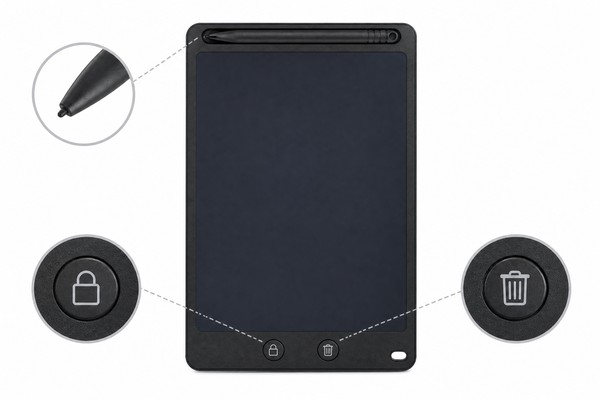
- Erase lock switches: A physical or electronic lock that disables the erase button unless deliberately unlocked. This prevents accidental or unauthorized erasure and is the single most valuable feature for a family message board in a household with young children.
- Partial erase: Some tablets allow the screen to be divided into sections that can be erased independently. This enables one family member to clear their portion of the board without erasing others’ messages.
- Protected message areas: A more sophisticated feature where a specific portion of the screen can be locked from erasure while the rest remains writable. This is useful for pinning permanent information (emergency contacts, WiFi password) alongside changeable daily messages.
Writing Characteristics and Stylus Quality
The writing experience on an LCD tablet is determined by two primary factors: the pressure sensitivity of the panel and the quality and design of the stylus. For a family message board that will be written on by multiple people of different ages and hand strengths, both factors deserve attention.
Safety, Durability, and What Certifications Actually Mean
A family message board is a product that children will interact with daily — writing on it, pressing its buttons, potentially dropping it, and generally subjecting it to the kind of treatment that only children reliably deliver. This makes safety and durability considerations genuinely important, not just regulatory box-ticking exercises.
Key Safety Certifications and Their Practical Meaning
LCD writing tablets sold in major markets carry various safety certifications. Understanding what each certification actually tests helps both consumers and B2B buyers make meaningful distinctions between products, rather than treating all certification marks as equivalent.
Physical Durability for Shared Family Use
Safety certifications tell you a product won’t harm a child under test conditions. Durability tells you the product will still function after six months of family use. These are related but distinct qualities, and both matter for a device that’s expected to function as a permanent household fixture.
Key durability factors for a family message board include:
- Frame and body material: ABS plastic frames are common and generally adequate. Look for uniform wall thickness and no visible mold seams that might crack under stress. Some tablets use aluminum or mixed-material frames that offer better drop resistance.
- Screen surface hardness: The writing surface is typically polycarbonate or a similar hard plastic. Harder surfaces resist scratching from non-stylus objects (rings, keys, toy parts) but may show scratches from severe impacts. The surface should not deform under the pressure used during normal writing.
- Button durability: The erase button is the most frequently pressed component and should be rated for a high cycle count. Quality manufacturers specify button cycle ratings; this is a useful spec to request when sourcing.
- Battery access: Most LCD writing tablets use button cell or AAA batteries to power the erase circuit. The battery compartment should be secure enough that children cannot access it unsupervised (ideally requiring a tool to open), but practical enough that an adult can replace the battery without difficulty when needed.
Chemical Safety: Understanding the LCD Layer
Parents sometimes express concern about the liquid crystal material inside the tablet, particularly if a tablet is damaged and the screen is broken. This is a reasonable question worth answering directly. The liquid crystal layer in LCD writing tablets is a very thin layer of liquid crystal material sealed between two substrates.
The total amount of liquid crystal compound in a typical writing tablet panel is extremely small — generally measured in fractions of a milliliter.
B2B Perspective: Sourcing and Positioning LCD Message Board Products
For importers, Amazon sellers, and toy brands evaluating LCD writing tablets as a product category, the family message board positioning represents a genuinely distinct market segment from the more common “children’s drawing tablet” category.
Understanding this distinction is commercially valuable, because it affects target customer, price point, packaging, size selection, and key feature priorities.
Market Positioning: Message Board vs. Drawing Tablet
The dominant positioning for LCD writing tablets in most e-commerce markets is as children’s creative toys — drawing pads and doodle boards aimed at keeping children occupied. This is a large, competitive market with significant price pressure and many entrants.
The family message board positioning targets a distinct and arguably less-crowded segment: adult household purchasers who are solving a specific organizational problem, rather than looking for a toy to entertain a child.
This distinction has several practical implications for B2B buyers:
- Target customer: The primary purchaser for a family message board is a parent or adult householder, typically 28-45 years old, who may also be drawn in by home organization, smart home, or family management content rather than toy content.
- Price point: The message board positioning generally supports a higher price point than an equivalent-size drawing tablet, because the perceived use case is practical household infrastructure rather than a toy. Consumers routinely pay premium prices for organizational products.
- Size selection: This segment skews toward larger formats (15-inch and above) where competing categories tend toward smaller, more portable formats.
- Feature priorities: Erase lock, mounting options (for wall hanging), and stylus security (tethered stylus) become important features to highlight — these differ from the feature priorities of a children’s drawing tablet listing.
Amazon FBA Considerations for LCD Message Board Products
Selling LCD writing tablets through Amazon FBA introduces specific operational and compliance considerations that B2B buyers should plan for before placing a sourcing order.
OEM/ODM Opportunities: Building a Family Communication Product Line
For brands with ambitions beyond a single product listing, the family message board use case opens interesting possibilities for a differentiated product line around a family communication theme. An LCD writing tablet is the core unit, but it can be positioned as part of a broader household organization ecosystem that also includes:
- A wall-mounting kit with installation hardware (sold separately or bund
GY-industries · Factory Direct · Shenzhen
Ready to Source LCD Writing Tablets?
Get factory pricing, free samples, CE/FCC/CPC certificates, and OEM/ODM consultation. Response within 24 hours.
✓ Free samples available
✓ MOQ from 500 units
✓ CE / FCC / CPC certified
✓ 15+ years experienceReferences
- [1] U.S. Consumer Product Safety Commission. Toy Safety guidelines for children’s products. https://www.cpsc.gov/Business–Manufacturing/Business-Education/Toy-Safety
- [2] American Academy of Pediatrics. AAP guidelines on media and children. https://www.aap.org/en/patient-care/media-and-children/
LCD Writing Tablet Buyer Review Table
| Area | Buyer check | Evidence |
|---|---|---|
| Buyer review area | What to clarify | Evidence to keep |
| Product scope | Confirm the final model and use case | Approved specification |
| Commercial terms | Agree responsibilities and milestones | Written purchase terms |
| Quality control | Define key acceptance checks | Inspection record |