Why Restaurants Are Genuinely Hard for Young Children
Before evaluating any solution, it helps to understand the actual problem. Parents sometimes blame themselves when a child melts down at a restaurant, but the honest answer is that the restaurant environment is neurologically challenging for young children in ways that have nothing to do with parenting quality.
Understanding the developmental reasons behind this difficulty makes it easier to choose the right tools and strategies.
The Waiting Problem: How Children Experience Time
Young children, particularly those under the age of seven, have a fundamentally different relationship with time than adults do. The prefrontal cortex — the part of the brain responsible for impulse control, patience, and the ability to project into the future — is not fully developed until a person’s mid-twenties.
For a four-year-old, ten minutes of waiting genuinely feels interminable in a way that is not a performance or exaggeration. It is a real neurological experience of time moving slowly with no internal resources to manage it.
Sensory Overstimulation and Under-Stimulation at Once
Restaurants present a paradoxical sensory environment for children. On one hand, they can be overstimulating: loud background noise from other diners, unfamiliar smells, bright or dim lighting depending on the venue, strangers nearby, and the visual chaos of a busy dining room.
Children who are sensitive to sensory input can find this genuinely overwhelming, and the behavioral result is often what looks like “acting out” but is actually a dysregulated nervous system looking for an exit.
The Social and Emotional Dimension
There’s also a social-emotional component that’s worth acknowledging. Children at restaurant tables often feel ignored. Adults are talking to each other about things children don’t understand or care about, ordering from menus that may not interest the child, and deferring to adult preferences about where to sit and what to eat.
From a child’s perspective, they’ve been brought to a place that is primarily designed for adults and are expected to be present but not disruptive.
How LCD Writing Tablets Actually Work — and Why That Matters in a Restaurant
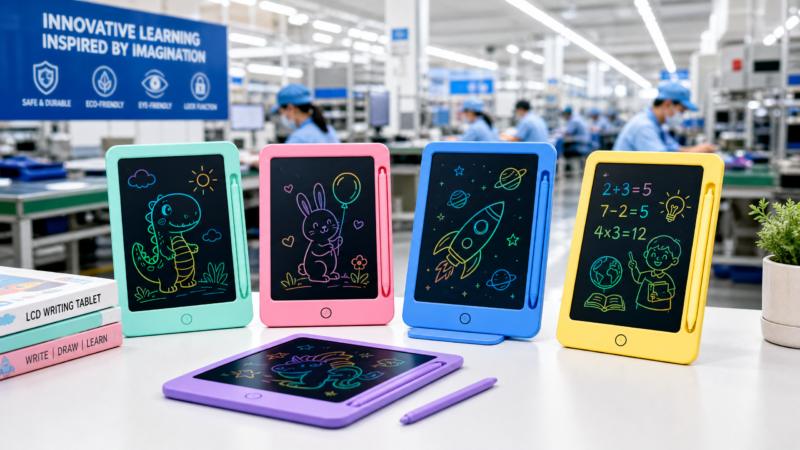
LCD writing tablets are often described vaguely as “electronic drawing boards,” but understanding the actual technology behind them explains why they perform so well in the specific context of restaurant dining. The technology is elegant in its simplicity, and its particular characteristics align remarkably well with the demands of a restaurant environment.
The Technology: Pressure-Sensitive Liquid Crystal Display
A standard LCD writing tablet consists of a thin layer of liquid crystal material sandwiched between two flexible layers. At rest, the liquid crystals are randomly oriented and appear gray or colored.
When pressure is applied through the stylus or a fingernail, the crystals align in the compressed area, changing how they refract light and creating a visible dark line against the lighter background.
This is a purely physical, mechanical process — no electricity flows through the display layer itself during writing, which is why these tablets are extremely energy efficient.
Manufacturers like GY-industries in Shenzhen produce LCD writing tablets at a range of screen sizes — typically ranging from 4.4 inches to 20 inches diagonally — with different display colors, frame materials, and stylus designs.
The restaurant use case is particularly well served by mid-range sizes, typically 8 to 12 inches, which are large enough to provide a satisfying drawing surface while still fitting comfortably on a restaurant table alongside place settings.
Why “No Sound” Is the Key Feature for Restaurants
This may seem obvious, but it deserves careful examination because the implications are significant. The primary problem parents want to solve in restaurants is noise — specifically, their child’s noise. The solution should not introduce a different kind of noise.
Electronic toys, educational apps on smartphones, and even some “learning tablets” produce sound as part of their engagement loop: reward sounds, music, voice feedback, notification chimes. In a quiet or moderately busy restaurant, a child playing an app with the sound on is audible to nearby tables.
Even with headphones, the parent is now managing headphone cables and the risk of the child pulling out the earbuds.
Comparison with Smartphones and Traditional Paper Alternatives
Parents have three main categories of tools they use to manage restaurant dining with children: traditional paper and crayons, electronic screens (smartphones or tablets), and drawing-based electronic tools like LCD writing tablets. Each has a distinct profile of advantages and disadvantages in this context.
Practical Strategies: Getting the Most Out of an LCD Tablet at the Table
Having the right tool is necessary but not sufficient. How parents introduce and use an LCD writing tablet at a restaurant significantly affects how well it works. The following strategies are based on the child development principles discussed earlier and on the specific characteristics of the technology.
Timing the Introduction: Don’t Lead With the Tablet
One of the most effective strategies is to not immediately hand over the tablet when you sit down . This might feel counterintuitive — surely earlier is better? — but there is a practical reason to wait.
If the tablet is the first thing that happens at the table, children quickly understand that it will always be available on demand, which reduces its novelty value and may cause them to disengage from it sooner, or to demand something else when they’ve exhausted their immediate interest in it.
Drawing Prompts and Collaborative Games That Work at Restaurants
LCD writing tablets work best when parents engage with them actively, at least initially. The drawing surface invites participation, and a parent who draws something and then hands the tablet to the child — or asks the child to add to a picture — creates a collaborative activity that is more engaging than solo drawing and more conversational than watching a screen.
Some specific prompts that work well at restaurant tables include:
- Draw what you want to eat: Ask the child to draw the food they’ve ordered or the food they wish they could have. This is open-ended, connects to the restaurant context, and often results in charmingly elaborate drawings.
- The menu challenge: Look at a picture on the menu and ask the child to copy it. This develops observation skills and is absorbing for children who respond to challenge.
- Collaborative storytelling: One person draws a character, the next person adds something to the picture, continuing until the plate arrives. This works well with multiple children.
- Letter and number practice: For children who are learning to write, the restaurant is actually an excellent low-pressure practice environment. The erasable surface means mistakes disappear without any consequence.
- Restaurant observations: Ask the child to draw something they can see in the restaurant — a candle, a plant, another diner’s funny hat. This turns the waiting period into an observation game.
Age-Appropriate Expectations and Tablet Selection
LCD writing tablets are genuinely useful across a wide age range, but the way they’re used effectively varies significantly by age, and choosing the right tablet size and stylus type matters.
Safety, Durability, and Real-World Performance
In any public or restaurant context, parents reasonably expect a child’s toy to be safe, durable enough to survive the particular hazards of restaurant use (drops, spills, table edge impacts), and certified to the standards required in their market. This section covers the technical and safety dimensions that matter for restaurant-specific use.
Drop Resistance and Physical Durability
Restaurant tables present specific physical risks. Tablets get knocked off tables, dropped on hard floors, and sometimes used as impromptu projectiles by younger children.
LCD writing tablets have a genuine advantage here compared to glass-screened devices: the LCD writing surface itself is a flexible material rather than glass, and there is no breakable screen in the conventional sense. The display layer is a pressure-sensitive film, not a rigid panel.
Safety Standards and Certifications for Restaurant and Consumer Use
For parents purchasing LCD writing tablets for use with children, particularly in shared or public settings like restaurants, safety certifications are a meaningful indicator of product quality. The relevant standards depend on the target market:
- ASTM F963: The US Consumer Product Safety Commission’s standard for toy safety, covering physical and mechanical properties, flammability, chemical requirements (including heavy metals in surface coatings), and electrical safety. Any LCD writing tablet sold as a toy in the US market should comply with this standard and have a Children’s Product Certificate (CPC).
- EN71: The European toy safety standard, covering similar areas to ASTM F963 but with European-specific requirements. Required for CE marking and sale in EU markets.
- RoHS Compliance: The Restriction of Hazardous Substances directive restricts the use of specific hazardous materials (including lead, mercury, cadmium, and certain flame retardants) in electronic equipment. LCD writing tablets, being electronic products, should be RoHS compliant for EU sale.
- California Proposition 65: For US market products, compliance with California’s Proposition 65 chemical exposure standards is increasingly expected by major retailers.
Battery Life and the No-Charging Advantage in Restaurant Settings
One of the most practical advantages of LCD writing tablets for restaurant use is their battery behavior. A smartphone or tablet needs to be charged regularly and may run low at precisely the moment you’re at a restaurant and need it.
LCD writing tablets use so little power — only the brief electrical pulse for each erase operation consumes energy — that a single small battery (typically a CR2016, CR2025, or CR2032 lithium cell, or occasionally AAA batteries) provides thousands of hours of use.
For B2B Buyers: Sourcing LCD Tablets for Family and Hospitality Markets
For importers, Amazon sellers, toy brands, and hospitality businesses considering LCD writing tablets as a product opportunity, the restaurant use case is a compelling and underserved market positioning. This section addresses the sourcing, specification, and commercial considerations relevant to B2B buyers.
Market Positioning: The Restaurant Bag Category
Consumer behavior data from major e-commerce platforms consistently shows that parents search for “restaurant toys,” “quiet activities for kids in restaurants,” “toddler restaurant bag,” and related phrases — indicating a distinct and commercially valuable product category that many sellers fail to address directly in their product positioning.
Most LCD writing tablets are positioned as general drawing toys or educational tools. A product explicitly positioned as a “restaurant kit” or “family dining activity” occupies a more specific and less crowded market position.
Minimum Order Quantities, Lead Times, and OEM Specifications
For B2B buyers evaluating LCD writing tablets from Chinese manufacturers, understanding the typical production parameters helps in planning inventory and product development.
Standard MOQs for LCD writing tablets vary by manufacturer and customization level. For off-the-shelf models with standard packaging, MOQs of 500 to 2,000 units are common from quality manufacturers. For OEM products with custom branding (logo, packaging, color), MOQs typically start at 1,000 to 3,000 units.
For fully custom ODM designs (new mold, custom shape, unique features), MOQs are generally higher — typically 5,000 units and above — and require tooling investment that may run from a few thousand to GY-industries · Factory Direct · Shenzhen Ready to Source LCD Writing Tablets?
Get factory pricing, free samples, CE/FCC/CPC certificates, and OEM/ODM consultation. Response within 24 hours. 📄 Get Free Quote 📱 WhatsApp Us ✉ Email Us ✓ Free samples available ✓ MOQ from 500 units ✓ CE / FCC / CPC certified ✓ 15+ years experience References [1] National Association for the Education of Young Children.
The importance of play in early childhood. https://www.naeyc.org/resources/topics/play [2] Centers for Disease Control and Prevention. Child development milestones. https://www.cdc.gov/act-early/milestones/index.html Related Articles Why Choose a Professional OEM/ODM Manufacturer for LCD Writing Tablets?
Are LCD Writing Tablets Truly Safe for Children’s Eyes? What Customization Options Are Available for LCD Writing Tablets? How Does GY-industries Ensure Every Tablet Passes Safety Testing?
LCD Writing Tablet Buyer Review Table
| Area | Buyer check | Evidence |
|---|---|---|
| Buyer review area | What to clarify | Evidence to keep |
| Product scope | Confirm the final model and use case | Approved specification |
| Commercial terms | Agree responsibilities and milestones | Written purchase terms |
| Quality control | Define key acceptance checks | Inspection record |
Explore the LCD writing tablet product catalog to compare relevant product configurations for this sourcing decision.
For independent background guidance, buyers can consult ISO quality-management guidance and confirm the requirements that apply to their exact product and market.