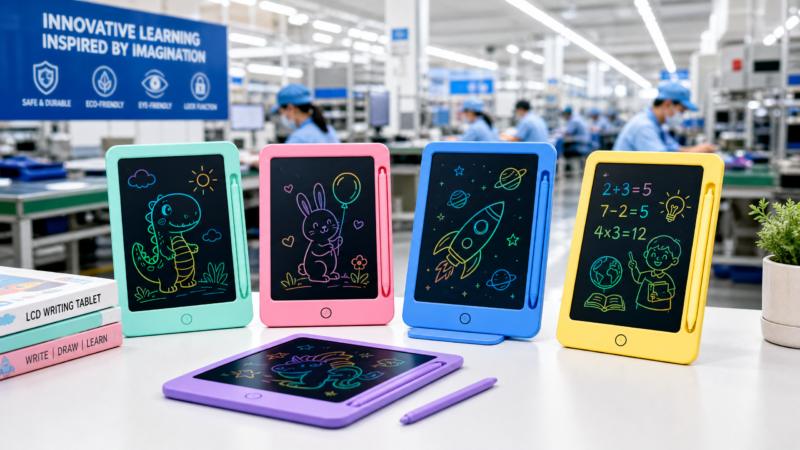
Yes, ordering physical evaluation samples before committing to a commercial bulk manufacturing run is an essential standard operational practice in international B2B procurement for custom consumer electronics and educational devices.
For global brand owners, wholesale distributors, and retail buyers sourcing custom hardware, validating functional prototypes ensures that technical specifications, writing display performance, and structural durability meet strict market expectations.
Evaluating physical samples firsthand minimizes commercial risks across international supply chains, verifying that future mass production aligns precisely with brand quality requirements, retail packaging standards, compliance protocols, and end-user safety expectations across diverse international distribution channels worldwide today.
Why Pre-Production Sample Evaluation is Critical for OEM and ODM Projects
Procuring prototype units allows procurement teams to rigorously assess mechanical integrity, structural assembly, and user interaction before authorizing capital expenditure for volume manufacturing.
When developing proprietary electronics such as an LCD writing tablet product catalog item, physical samples reveal critical nuances in plastic resin quality, stylus ergonomics, pressure sensitivity responsiveness, and battery compartment security that digital blueprints cannot fully convey.
This physical verification stage protects brand reputation and prevents costly discrepancies during volume fulfillment.
Furthermore, structural samples enable buyers to verify compliance with regional safety regulations and toy standards.
For educational toy lines distributed in North America and international markets, referencing frameworks like the ASTM F963 toy safety standard overview helps guide mechanical hazard assessments, drop durability tests, and non-toxic material verification.
Buyers must review these safety guidelines alongside their manufacturing partners to establish clear testing protocols for prototype approval and regulatory compliance across target markets.
Key Considerations for Prototype Assessment and Verification
Conducting a thorough evaluation requires testing multiple operational parameters under simulated real-world conditions. Procurement teams should inspect writing smoothness, erase-button responsiveness, screen contrast under varying ambient light, and overall casing rigidity.
Documenting every observation during the evaluation phase ensures that any necessary design adjustments are addressed before finalizing mass production molds, injection parameters, and tooling instructions.
Evaluating Sample Costs, Lead Times, and Order Dependencies
Navigating sample logistics requires understanding that sample fees, shipping expenses, evaluation timeframes, and potential refund policies are never uniform across projects. These variables depend entirely on product configuration complexity, whether existing tooling can be utilized, the scope of customized branding, and specific packaging requirements.
Rather than operating under fixed schedules, international manufacturers evaluate sample requests case-by-case based on engineering workload, material availability, and destination logistics. Buyers should provide comprehensive project parameters to receive precise quotations and estimated dispatch timelines.
Similarly, standard bulk manufacturing lead times—such as baseline volume production cycles or expedited dispatch requests—fluctuate according to factory capacity, seasonal demand, component sourcing, and destination freight conditions.
Specific production lead times and rush capabilities cannot be universally guaranteed without reviewing formal purchase order terms and finalized technical specifications. Establishing transparent communication early in the sourcing cycle ensures operational alignment and mitigates potential supply chain disruptions.
Procurement Decision Factors for Sample and Bulk Orders
To assist procurement managers in planning their sourcing timeline, the decision matrix below outlines key evaluation criteria, operational considerations, and required documentation across different project stages.
| Project Stage | Key Objective | Variable Factors | Buyer Action Required |
|---|---|---|---|
| Initial Prototype | Verify core function & ergonomics | Tooling availability, custom color matching | Submit 2D/3D drawings and target specs |
| Pre-Production Sample (PPS) | Confirm mass-production readiness | Revision rounds, material sealing, packaging | Review physical sample and sign written approval |
| Bulk Manufacturing | Execute volume order fulfillment | Factory capacity, seasonal scheduling, freight | Issue formal purchase order and deposit |
| Quality Assurance | Ensure bulk consistency | Golden sample matching, AQL inspection | Define acceptance criteria and inspection terms |
Managing Pre-Production Samples (PPS) and Bulk Consistency
Securing uniform quality between approved evaluation samples and final mass production relies on disciplined procurement methodologies and robust change control protocols.
Professional manufacturing agreements typically incorporate formal written approval of Pre-Production Samples (PPS) and golden samples, establishing physical benchmarks for color matching, raw material composition, structural integrity, and retail packaging presentation.
Critical function checks and approved manufacturing records prevent unauthorized design drift during volume assembly.
Maintaining strict batch consistency requires comprehensive documentation, structured inspection milestones, and rigorous tracking of engineering change notices. Buyers should establish clear acceptance criteria and third-party inspection protocols prior to production launch.
Engaging in structured technical dialogue ensures that any potential design or quality deviations are identified and resolved before bulk goods leave the factory floor.
LCD Writing Tablet Buyer Checklist: Order A Sample Before Placing A Bulk Order
Initiate Your OEM and ODM Project Assessment
To obtain an executable sample quotation, professional production evaluation, and tailored manufacturing schedule for your brand portfolio, please contact our OEM/ODM team .
When submitting your inquiry, please provide your target order quantity, target market distribution region, detailed product specifications, logo and packaging artwork files, specific sample testing standards, and desired project timeline so our engineering and production specialists can deliver a comprehensive assessment.
Explore the LCD writing tablet product catalog to compare relevant product configurations for this sourcing decision.
For independent background guidance, buyers can consult ISO quality-management guidance and confirm the requirements that apply to their exact product and market.