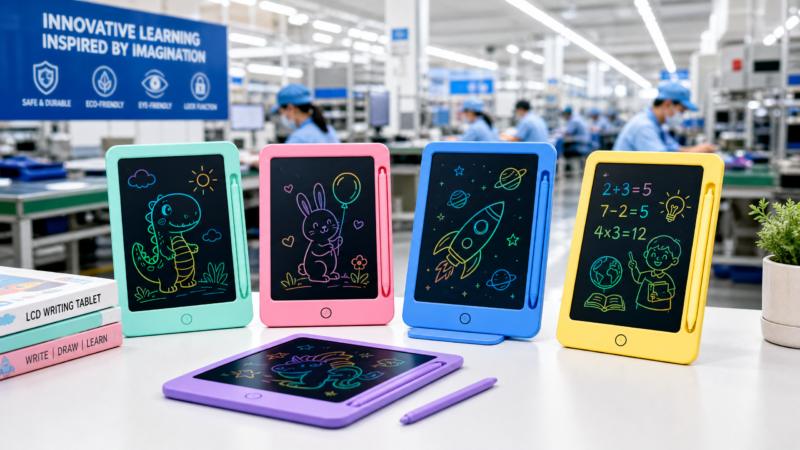
Developing a custom-shaped mold for a new OEM or ODM product is a critical milestone for brand owners, wholesalers, and Amazon sellers seeking unique market differentiation.
The timeline required to complete a custom mold for an LCD writing tablet typically spans several weeks to a few months, depending heavily on design complexity, prototype iterations, tooling precision, and material specifications.
Rather than adhering to generalized estimates, B2B buyers must evaluate how each engineering and fabrication phase impacts their overall product launch schedule, supply chain coordination, and inventory planning.
1. Phase Breakdown of Custom Mold Development
The custom mold development journey begins long before steel cutting commences. It starts with comprehensive industrial design (ID) and mechanical engineering (ME) reviews.
During this foundational phase, our engineering team collaborates closely with brand stakeholders to translate initial concept sketches into manufacturable 3D computer-aided design (CAD) models.
Factors such as wall thickness uniformity, draft angles for easy part ejection, rib placements for structural rigidity, and internal component layouts for LCD panels, circuit boards, and battery compartments are meticulously analyzed and optimized for mass production efficiency.
Following CAD finalization, the project transitions into prototyping and design for manufacturing (DFM) verification. Rapid prototyping technologies—such as stereolithography (SLA) or selective laser sintering (SLS)—allow brand buyers to evaluate ergonomics, aesthetic appeal, and mechanical fit before committing to expensive steel tooling.
This iterative testing phase minimizes costly design flaws and ensures that the final product aligns perfectly with brand expectations and user experience standards. Buyers seeking standard baseline configurations or reviewing existing product specifications can also examine our LCD writing tablet product catalog to benchmark design parameters.
2. Key Factors Influencing Tooling Timelines and Quality
Once the DFM report and prototype samples are formally approved, actual mold fabrication begins. Tooling lead times are largely determined by the complexity of the mold cavity and core geometry, surface texturing requirements, and the grade of steel selected for production durability.
High-precision CNC machining, electrical discharge machining (EDM), and manual hand-polishing are employed to shape the steel blocks. Multi-cavity molds or intricate sliding mechanisms naturally demand additional fabrication time and rigorous calibration to ensure flawless part demolding, clean parting lines, and consistent wall thickness.
Quality assurance is embedded throughout every tier of the manufacturing and tooling workflow. Adhering to structured ISO 9001 quality-management principles guarantees systematic documentation, dimensional inspection, and traceability from raw material intake to final sample testing.
Furthermore, finished mass-produced items and electronic components should always be cross-checked against applicable regional market safety regulations and environmental directives in destination countries to ensure seamless customs clearance, regulatory compliance, and consumer safety.
Evaluating Tooling Complexity and Lead Times
To assist procurement specialists and project managers in forecasting complex project schedules accurately, understanding the sequential milestones of mold development is vital. The structured table below outlines the core phases, key engineering activities, verification checkpoints, and primary deliverables associated with custom enclosure manufacturing.
| Development Phase | Key Technical Activities | Verification Checkpoint | Primary Deliverable |
|---|---|---|---|
| Design & Engineering | CAD optimization, draft analysis, structural simulation | Design review & DFM sign-off | Final 3D CAD & DFM Report |
| Prototyping | SLA/SLS 3D printing or soft tooling tests | Ergonomic & functional assembly test | Physical Functional Prototype |
| Tooling Fabrication | CNC machining, EDM cutting, mold polishing | T1 trial shot & dimensional audit | T1 Mold Sample |
| Sample Refinement | Surface texturing, gate adjustment, fine-tuning | T2 trial shot & cosmetic inspection | Golden Sample Approval |
3. Structuring Your Project Schedule and Risk Management
Following mold fabrication, the initial trial shot—known as the T1 sample—is produced for evaluation. The T1 phase is critical for identifying minor imperfections, such as sink marks, flash, warping, or gate mark visibility. Adjustments and fine-tuning are performed on the steel mold based on dimensional audits and cosmetic assessments.
Subsequent T2 and golden sample approvals validate that the tooling is fully optimized for stable, high-volume mass production without compromising structural integrity or visual appeal.
Navigating project timelines successfully also requires establishing robust communication protocols and realistic buffer windows. Unforeseen engineering refinements during trial shots are standard industry practice and should be factored into overall launch planning.
Transparent milestones, clear feedback loops, and structured contractual terms ensure that both manufacturing partners and brand buyers maintain synchronized expectations regarding quality benchmarks, cost controls, risk mitigation, and delivery schedules throughout the entire product lifecycle.
LCD Writing Tablet Buyer Checklist: How Long Does It Take To Develop A Custom Mold For A New Shape
4. Initiate Your Custom OEM Project Evaluation
Executing a successful custom OEM product line requires a dedicated partnership tailored to your specific commercial goals and operational scale. To initiate a comprehensive evaluation of your next custom project without financial guesswork, we invite you to contact our OEM/ODM team .
Please share your expected order quantities, target distribution markets, brand artwork files, packaging preferences, and projected timeline so our engineering experts can deliver an actionable, customized proposal.
Explore the LCD writing tablet product catalog to compare relevant product configurations for this sourcing decision.
For independent background guidance, buyers can consult ISO quality-management guidance and confirm the requirements that apply to their exact product and market.