Yes, comprehensive OEM and ODM partnerships for educational electronics and writing tablets routinely accommodate custom multi-language instruction manuals to support diverse international retail markets.
When expanding product distribution across Europe, North America, or Latin America, brand owners must provide localized documentation that aligns with regional consumer protection laws, retail compliance standards, and user experience best practices.
Incorporating tailored multilingual guides ensures that end users receive clear operational directions while helping wholesale distributors maintain legal compliance across multiple foreign jurisdictions.
Because print dimensions, paper stock grades, and language translations vary significantly by project scope, close collaboration between the brand owner and the manufacturing partner is essential to establish precise structural specifications before bulk production commences.
Understanding Regulatory Compliance and Multilingual Documentation
Navigating international regulatory frameworks requires meticulous attention to product labeling, safety disclosures, and accompanying literature. In many export destinations, safety warnings, battery replacement instructions, and operational guidance must be provided in the official language of the target market to satisfy consumer protection statutes.
For instance, brands distributing electronic toys and writing tablets within the European Economic Area must review official directives and harmonized standards, such as those outlined in the European Commission CE-marking information portal, to ensure alignment with statutory information mandates.
Manufacturers do not provide legal certification guarantees; rather, all compliance claims and mandatory text translations should be verified against applicable market requirements by the brand’s legal advisors before commercial release.
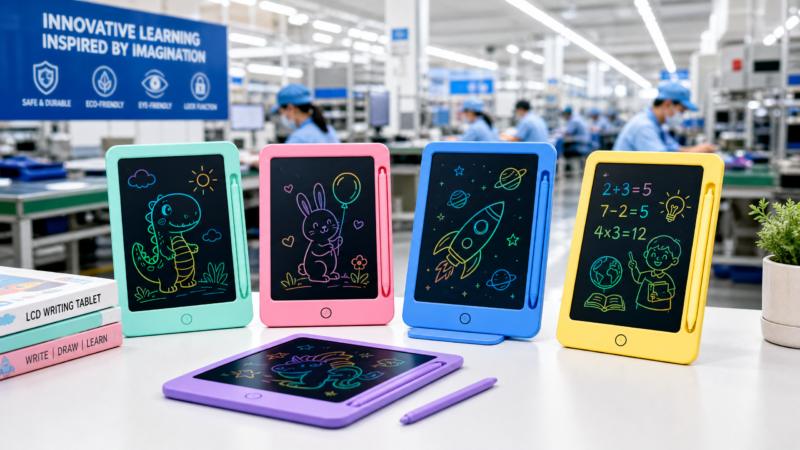
To assist brand buyers in structuring their product lines effectively, our LCD writing tablet product catalog offers various baseline models that accommodate different packaging layouts and manual insert dimensions.
Integrating multiple languages into a single physical booklet or utilizing hybrid digital-print solutions helps brands optimize packaging weight and reduce per-unit logistical overhead across supply chain networks.
However, development timelines, tooling investments, and final documentation specifications depend heavily on design complexity, regulatory verification steps, material selection, order structure, and specific contract terms negotiated between parties.
Structuring Instruction Manuals for Global Distribution
Designing an effective multi-language manual involves balancing legibility, physical space constraints, and linguistic accuracy. Brand buyers must supply finalized, translated text files formatted by native speakers to avoid technical misinterpretations and ensure seamless customer onboarding across diverse demographics.
Furthermore, layout planning must account for text expansion when translating from English into Romanized or non-Romanized scripts such as German, French, Spanish, or Japanese, ensuring that typographic hierarchies remain consistent and easy to read.
Best Practices for Manual Formatting and Layout Integration
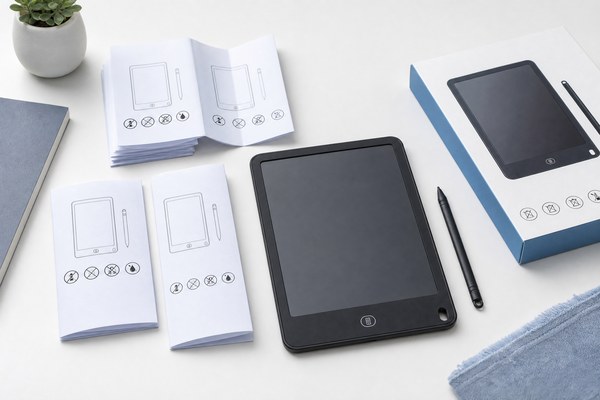
Effective manual integration begins with determining whether a folded leaflet, a bound booklet, or a QR-code-enabled digital insert best serves the specific product category and user base. For compact educational toys and writing tablets, miniature booklets or fold-out sheets represent industry standards that fit neatly inside retail boxes.
Brand owners must ensure that font sizes remain legible without requiring magnification tools, adhering strictly to regional consumer safety guidelines. Collaborating closely with production engineers ensures that the chosen manual format folds correctly within retail box dimensions without causing packaging distortion or transit damage.
Additionally, brand owners must consider environmental and recycling labeling regulations applicable in target export regions. Many modern retail compliance frameworks mandate specific material symbols or disposal instructions on printed collateral.
Incorporating these standardized symbols during the pre-production layout phase prevents costly packaging redesigns and ensures smooth customs clearance during international freight forwarding.
Comparing Manual Format Options for OEM/ODM Orders
Choosing the correct manual format impacts unit economics, user experience, and supply chain logistics. The table below outlines key considerations for four common manual integration formats used in OEM and ODM wholesale manufacturing.
| Format Type | Language Capacity | Cost Impact | Logistical Suitability |
|---|---|---|---|
| Folded Leaflet Insert | Up to 4 Languages (Compact) | Low per-unit cost | Ideal for slim gift boxes |
| Bound Mini Booklet | 6+ Languages (Multi-page) | Moderate tooling/print cost | Best for premium retail sets |
| QR Code Digital Manual | Unlimited Global Languages | Minimal physical print cost | Requires internet access |
| Dual-Language Card | 2 Languages (Bilingual) | Very low cost & weight | Suited for blister packaging |
LCD Writing Tablet Buyer Checklist: Include A Custom Instruction Manual In Multiple Languages
Next Steps for Your Custom OEM/ODM Project
Developing tailored packaging and multi-language documentation requires careful synchronization across design, engineering, and mass production stages. We invite brand owners, wholesalers, and Amazon sellers to contact our OEM/ODM team to discuss your upcoming product line.
Please submit your project requirements—including expected volume, target market, brand assets, packaging requirements, and project timeline—to receive a comprehensive, actionable custom assessment for your manufacturing project.
Explore the LCD writing tablet product catalog to compare relevant product configurations for this sourcing decision.
For independent background guidance, buyers can consult ISO quality-management guidance and confirm the requirements that apply to their exact product and market.