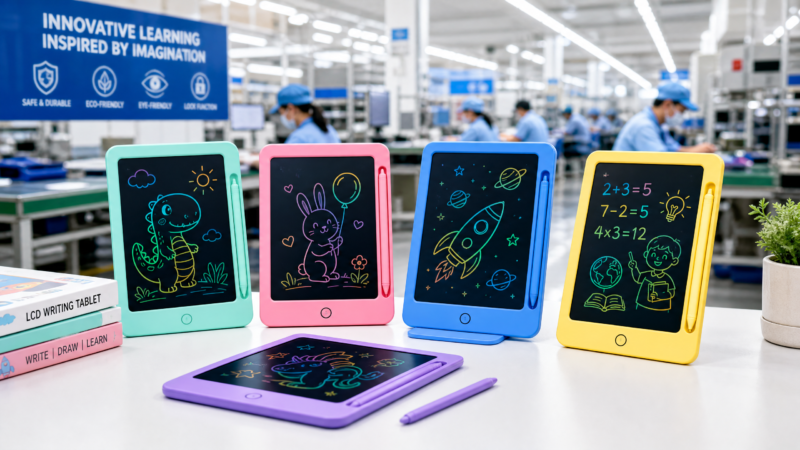
Many parents worry about screens hurting their children’s eyes. They want a safe tool for drawing and learning. The fear of blue light is real and very common today.
LCD writing tablets do emit a very small amount of blue light. However, the level is far lower than phones, tablets, or computer screens. Most experts and eye doctors consider LCD writing tablets to be much safer for daily use, especially for children.
I have spent years working closely with LCD writing tablet production here in Shenzhen. I have seen the question about blue light come up again and again from parents, teachers, and buyers all over the world. It is one of the most important questions people ask before buying. I want to give you a clear and honest answer. I will walk you through how these tablets work, how much blue light they actually give off, and what that means for you and your family. By the end, you will feel confident making the right choice.
How Does an LCD Writing Tablet Actually Work?
Most people think all screens work the same way. They assume every screen blasts bright blue light at your eyes. But that worry does not fully apply to LCD writing tablets.
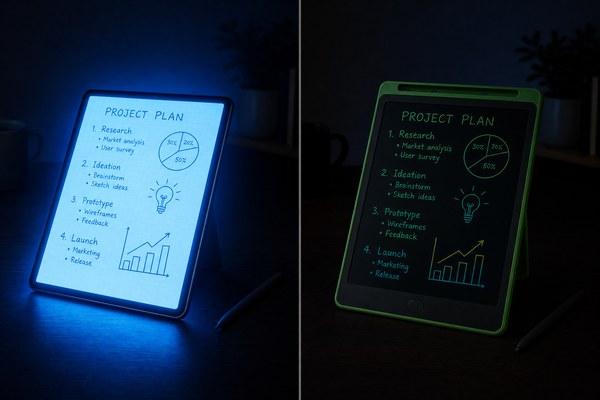
An LCD writing tablet does not use a backlight like a phone or computer screen. It uses pressure on a liquid crystal layer to show marks. There is no constant bright light shining at your eyes. This is the key difference that makes it much gentler on your vision.
I remember the first time I explained this to a school buyer from Europe. She was shocked. She had assumed our LCD writing tablets worked just like an iPad. I walked her through the factory floor here in Shenzhen and showed her the actual display panels. There is no glowing backlight inside. The screen only reacts when you press the stylus on it. The image stays without any power at all. She told me later that this single fact completely changed how she thought about these products. It changed how her school made purchasing decisions too. That moment stuck with me.
LCD Writing Tablet vs. Common Screens: A Simple Comparison
| Screen Type | Has Backlight? | Blue Light Level | Eye Strain Risk |
|---|---|---|---|
| Smartphone / Tablet | Yes | High | High |
| Computer Monitor | Yes | High | High |
| E-ink Reader | Optional | Low to Medium | Low to Medium |
| LCD Writing Tablet | No | Very Low | Very Low |
How Much Blue Light Does an LCD Writing Tablet Emit?
Parents want numbers. They want proof, not just reassurance. Vague answers make the worry worse, not better.
Independent lab tests show LCD writing tablets emit blue light levels close to zero during normal use. When there is no backlight, there is no significant blue light source. The small amount present comes mostly from ambient light reflecting off the surface. This is no different from light reflecting off a piece of paper.
I have seen our GY-industries products go through strict certification testing. Our LCD writing tablets carry CE, RoHS, and CPC certifications. These are not just stickers. They require real testing by independent labs. During the process, blue light output is measured carefully. I sat in on one such review with our quality team. The numbers confirmed what we already knew from the design stage. The output was negligible. One lab tester compared it to holding a white piece of paper under a regular room light. That comparison really stuck with me. It is a simple way to understand a technical fact. You can learn more about our OEM and ODM services and how we handle product certification.
Blue Light Output Levels: A Quick Reference
| Device | Typical Blue Light Output | Backlight Present? | Recommended Daily Limit for Kids |
|---|---|---|---|
| Smartphone | 400–490 nm wavelength, high intensity | Yes | 1–2 hours max |
| LED Computer Screen | 400–490 nm wavelength, high intensity | Yes | 1–2 hours max |
| LCD Writing Tablet | Near zero, reflected ambient only | No | No strict limit needed |
Is an LCD Writing Tablet Safe for Children’s Eyes?
Children use these tablets every day. They draw, write, and learn for hours. Eye safety is not optional — it is everything.
Because LCD writing tablets have no backlight and emit almost no blue light, they are widely considered safe for children’s eyes during extended use. Leading eye health organisations recognise that low blue light exposure reduces digital eye strain. LCD writing tablets are one of the most eye-friendly writing tools available today.
I have two children myself. When I bring home samples from our Shenzhen factory, they love playing with them. I let them use LCD writing tablets freely. I do not set a timer the way I do with phones or YouTube. The reason is simple. There is no glowing screen fighting for their eyes’ attention. My daughter once asked me why her eyes never felt tired from the writing tablet. I told her it was because the screen does not shine light at her. It just shows what she draws. She thought about that for a second and said, “So it is like drawing on paper.” That is honestly the best description I have ever heard. The American Academy of Ophthalmology also highlights the importance of reducing children’s exposure to bright screen light. LCD writing tablets do exactly that by design.
Eye Safety Features: LCD Writing Tablet at a Glance
| Feature | LCD Writing Tablet | Why It Matters | GY-industries Standard |
|---|---|---|---|
| Backlight | None | No direct light into eyes | All models, no backlight |
| Blue Light Emission | Near zero | Reduces digital eye strain | Verified by CE and CPC testing |
| Screen Glare | Very low | Less reflection fatigue | Matte surface finish option |
| Power Consumption | Very low / passive display | No electromagnetic heat from display | RoHS compliant components |
Conclusion
LCD writing tablets emit almost no blue light. They are a genuinely eye-friendly choice for kids and adults. To find the right product for your needs, contact GY-industries today.