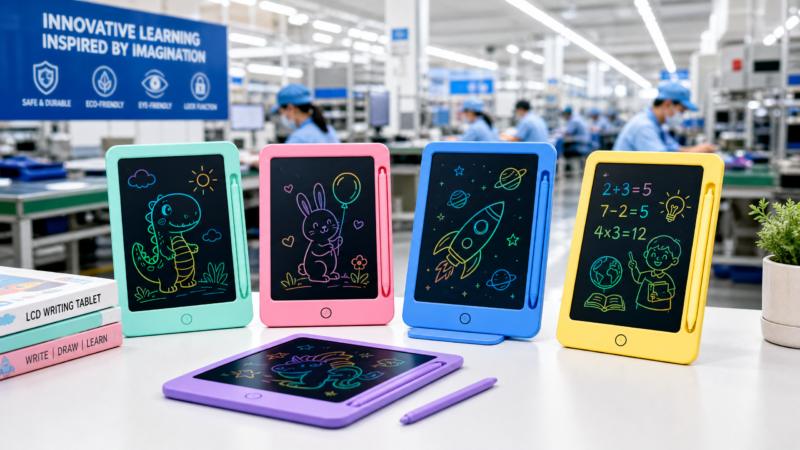
Answer first: An electronic tablet paperless LCD writing pad is usually an erase-only LCD board that lets a user write or draw on a reflective liquid-crystal surface and clear the whole surface electronically. For importers, distributors, retailers, schools and private-label buyers, the purchasing decision is less about calling it a “tablet” and more about confirming the exact erase method, writing area, color presentation, accessory set, package, battery arrangement, market documents and sample-approved configuration. GY Industries offers several LCD writing tablet formats, from compact 8.5-inch models to a 16-inch professional drawing board, while final commercial and technical details must be confirmed in the quotation and approved pre-production sample.
What does electronic tablet paperless LCD writing pad mean?
The phrase combines several search terms that buyers and customers use for the same broad product family. “Electronic tablet” describes a handheld board with an electronic writing surface. “Paperless” describes the reduction of disposable paper for temporary notes, practice or drawing. “LCD writing pad” identifies the reflective liquid-crystal panel used to display marks. In a wholesale catalogue, the most accurate product name should tell a buyer whether the item is an erase-only board, a connected device, or a file-saving digital tool.
Most products in this category are simple, screen-free writing boards. A mark appears when the surface is pressed with the supplied writing implement or another approved input object. A clear control removes the visible writing, normally as a full-screen erase. Some models include an anti-erase lock or similar protection against accidental clearing. These functions should be checked on the physical sample rather than inferred from the word “paperless.”
An erase-only LCD writing pad is not automatically a computer tablet, e-paper notebook or graphic tablet. Unless the quotation and approved sample specifically confirm otherwise, do not describe it as connected to a phone or computer, or as able to save, transfer, synchronize or export files. USB, Bluetooth, Wi-Fi, save, memory, storage and rechargeable functions are not assumed. If a buyer needs any of those functions, they belong in the RFQ as explicit requirements and must be confirmed before production.
Why product naming matters in B2B purchasing
Product naming affects search traffic, quotations, packaging, customs descriptions, product listings and customer expectations. A retailer may search for “paperless writing pad,” while a distributor may ask for an “electronic LCD writing tablet.” A school supplier may need a writing board for repeated practice, while a private-label brand may want a “digital paperless writing tablet” position for a higher-value range. These phrases can attract the same buyer, but they do not define identical technical requirements.
Use the name as a category entry point, then add a precise model description. For example, a quote can identify an 8.5-inch LCD writing tablet, a 10-inch color LCD writing tablet, a 12.8-inch LCD writing tablet or a 16-inch professional LCD drawing board. The quotation should then state the confirmed product version, writing area, housing color, clear function, lock function if applicable, included accessories, retail package, battery configuration and documentation scope.
For a private-label launch, the front-of-pack name should also make the limitation clear. “LCD writing pad” is safer than “digital notebook” when the product does not save files. “Erase-only electronic writing tablet” is even clearer for a buyer who wants to prevent returns caused by an incorrect assumption about connectivity or storage.
Erase-only LCD boards versus connected or file-saving devices
| Buyer requirement | Erase-only LCD writing board | Connected or file-saving device | RFQ decision |
|---|---|---|---|
| Primary job | Temporary handwriting, drawing, practice or quick visual communication | Retain, edit, transmit or organize digital content | State the intended workflow in one sentence |
| Clear behavior | Usually a full-surface electronic erase; lock behavior may vary | May include selective editing, app controls or file management | Request a demonstrated erase sequence and confirm the exact function |
| Data handling | Do not assume save, memory, storage, USB, Bluetooth or Wi-Fi | Must specify interface, operating compatibility and file behavior | List each required connection or data function separately |
| Commercial fit | Simple retail, distribution, education-supply and private-label programs | Technology-led programs requiring software or support | Choose the category before comparing unit price |
| Approval evidence | Physical sample, erase test, surface inspection and package check | Physical sample plus connection, software and file-retention tests | Make acceptance tests part of the sample record |
This distinction protects every channel. A distributor can build an accurate catalogue, a school buyer can specify a repeatable activity, and a retailer can avoid presenting a simple board as a storage device. If a project requires file retention, ask GY Industries to confirm whether the requested product platform supports it. If the requirement is not confirmed, position the item as an erase-only LCD electronic writing pad.
How to choose a format from the GY Industries range
The right format depends on the writing area, shelf position, audience, shipping plan and intended price architecture. GY Industries’ wholesale LCD writing tablet range is a useful starting point because it frames selection around channel, product reference, quantity, packaging, sample approval and target market.
Compact entry format: 8.5-inch
The 8.5-inch model is a compact option for a buyer testing the category or building a lower-price assortment. Its product page identifies an 8.5-inch active area, flexible liquid-crystal panel and ABS frame. It also describes one-click erase and an anti-erase lock. The page lists a CR2025 button cell, approximate dimensions and approximate weight, but those details still need to be checked against the quotation and approved sample for the selected configuration.
This format can fit a channel that values a simple product story and a small retail footprint. Do not approve it only from a product title. Confirm the actual writing area, surface contrast, erase response, lock operation, included writing implement, housing color, packaging and label language. Review the 8.5-inch LCD writing tablet page for the catalogue reference, then ask for the current version in the RFQ.
Color-led retail format: 10-inch
The 10-inch color LCD writing tablet is positioned for a larger writing area and color-led retail or education-supply assortment. The approved source page lists pink, blue and black options, a 250 × 170 × 6 mm product size, a 204 g product weight, a CR2032 battery and 100 pieces per carton. Those are useful planning references, not permission to omit confirmation. Final color mix, package, battery presentation, carton plan and documents should be written into the quotation and checked against the sample.
This is a good format to compare when the buyer wants more visible shelf presence than a compact board without moving immediately to a professional large-format product. Use the 10-inch color LCD writing tablet page as the model reference. If the private label needs a different housing color, artwork or instruction language, separate standard-product approval from customization approval.
Larger writing area: 12.8-inch
The 12.8-inch model gives a distributor a larger-format option for handwriting practice, drawing and educational product collections. The source page lists pink, light blue and black options, a 285 × 195 × 7 mm product size, a 342 g product weight, a CR2032 button battery and 50 pieces per carton. Confirm all of these details for the final version, particularly if the package, color mix, accessory or destination market changes.
A larger board can justify a different shelf tier, carton plan and retail message. It can also increase freight volume and package requirements. Ask for the retail-box dimensions, carton quantity, gross weight, carton marks and shipping terms in the quote. The 12.8-inch LCD writing tablet page provides the starting reference.
Premium large-format route: 16-inch
The 16-inch professional drawing board is a large-format option for buyers whose customers need more working area or a premium presentation. The source page describes a 16-inch active area, flexible liquid-crystal panel, ABS frame, anti-erase lock and options described as monochrome or multi-color. It lists approximate dimensions and weight and identifies a CR2025 button cell. Confirm whether the selected quotation covers the monochrome or multi-color version, the exact accessory set, the erase and lock behavior, the package and all market documents.
This model may suit a premium gift, design, specialist retail or professional-use channel, but channel fit should be tested rather than assumed. A larger product needs a different merchandising story, shipping calculation and sample inspection. Review the 16-inch professional drawing board page before writing the product brief.
Purchasing fit by buyer type
Importers
Importers should define the destination country before selecting the model. The same electronic LCD writing tablet may need different instruction language, label treatment, barcode, warning text or document package by market. Ask GY Industries to identify which documents are available for the exact configuration. Certification and safety details are not universal assumptions; the applicable set must be confirmed for the product, market and shipment.
Distributors
Distributors should build a small, logical range rather than buying several similar formats without a role for each. A compact model can create an entry tier, a 10-inch or 12.8-inch model can create a core tier, and the 16-inch board can create a premium tier. Confirm whether mixed models or mixed colors are commercially feasible, then request separate carton, package and documentation assumptions for each line.
Retailers
Retail buyers should evaluate shelf communication and return risk. The package should state what the board does and should not imply file saving or connectivity unless those capabilities are confirmed. Check the physical color, printed contrast, clear button, lock control, accessory presentation, barcode area and package durability. A retail sample is not approved until the physical item and its printed presentation match the agreed product record.
Schools and education suppliers
School-oriented buyers should specify the activity, user group, quantity per site, replacement plan and documentation needs. Confirm whether the product is intended for temporary writing only. If teachers or administrators need records retained, an erase-only LCD electronic writing pad may not satisfy the workflow. Ask for an approved sample so staff can test writing pressure, visibility, full erase, lock operation, accessory handling and package labeling before a larger purchase.
Private-label buyers
Private-label buyers should separate four approvals: the product, the branding, the packaging and the market documentation. Logo placement, color, artwork, instruction language, accessory presentation and carton marks can be discussed, but the available option depends on model, quantity and production conditions. Never treat a digital artwork proof as final product approval. Record the approved physical sample, artwork version and quotation assumptions together.
RFQ fields that produce a usable quotation
A vague request for “best price for electronic writing tablet” creates avoidable revisions. A useful RFQ identifies the product reference and the business context. Use the GY Industries request-a-quote page and include the following fields:
- Product reference: model page, preferred format, reference image and whether the request is for an erase-only board.
- Target market: country, customer type, sales channel and intended age or user group where relevant.
- Quantity: initial order, expected repeat order, preferred color mix and any trial quantity.
- Branding: logo file, placement, print method requested and whether the brand is new or existing.
- Packaging: retail box, sleeve, bulk carton, barcode, language, inserts, warning text and carton marks.
- Accessory list: writing implement, replacement parts or other inclusions, all subject to confirmation.
- Performance request: writing visibility, full erase, anti-erase lock, color effect or other requirements to be demonstrated.
- Sample route: standard sample, branded sample, packaging sample or pre-production sample.
- Delivery: required delivery window, destination, shipping term and carton information needed for landed-cost planning.
- Documents: destination-market certificates, test reports, labels, inspection records and other requested business documents.
Ask the supplier to mark each item as standard, optional, custom, unavailable or pending confirmation. This makes it easier to compare quotations without treating an unconfirmed feature as included.
Sample approval and quality checkpoints
Sample approval should be a controlled decision, not a quick visual reaction. First, identify the sample type. A standard sample checks the base product. A branded sample checks logo position and finish. A packaging sample checks the retail presentation. A pre-production sample should represent the approved configuration before mass production.
Product-function checks
Write several line weights and patterns across the intended working area. Check that the surface responds consistently, that marks are visible under normal lighting and that the erase control clears the intended area. Test any lock control repeatedly. Confirm whether the board is full-erase only. If the buyer requested file saving, connection or selective erase, require a demonstrated and written confirmation; do not accept a verbal assumption.
Physical and visual checks
Compare the sample with the quotation for model identity, writing-area format, housing color, panel appearance, frame fit, button feel, seams and surface damage. Check the writing implement, attachment or storage method if included. Confirm any ruler detail, logo, printed mark or accessory only when it appears in the approved specification. Dimensions, weight and battery details should be measured or otherwise confirmed for the final configuration.
Packaging and documentation checks
Review the retail box, barcode location, language, warnings, instructions, carton quantity and carton marks. Match the product inside to the package artwork. Ask for the exact certification and safety documentation applicable to the selected destination market and product configuration. “CE,” “FCC,” “RoHS,” “EN71,” “CPC,” ISO or any other document must be confirmed for the specific order rather than copied from a generic listing.
Commercial checkpoints
MOQ, unit price, sample charge, customization charge, lead time, production start point and shipping details must be confirmed in writing. Battery type, dimensions, certification, safety details, packaging, accessories, lead time and MOQ are subject to quotation and approved sample whenever they are not explicitly confirmed for the selected order. The same rule applies to USB, Bluetooth, Wi-Fi, save, memory, storage, rechargeable, waterproof and partial-erase claims.
Buyer checklist before placing an order
- Have we named the exact model and linked the correct GY Industries product page?
- Have we decided whether the product is erase-only or requires connectivity and file retention?
- Have we confirmed the writing area, housing color and display presentation?
- Have we listed all required accessories instead of assuming they are included?
- Have we specified logo placement, packaging format, barcode and instruction language?
- Have we identified the target country, sales channel and market-document requirements?
- Have we requested the exact battery, dimensions, weight, carton and shipping details in the quote?
- Have we agreed on standard, branded, packaging and pre-production sample stages?
- Have we tested writing, visibility, full erase and lock behavior on the physical sample?
- Have we recorded the approved artwork, product version and revision date?
- Have we confirmed MOQ, price, lead time and production assumptions in writing?
- Have we retained the quotation and sample approval record for purchase-order comparison?
Frequently asked questions
1. Is an electronic tablet paperless LCD writing pad the same as a computer tablet?
No. The term can describe an erase-only LCD writing board. Unless the quotation and approved sample confirm otherwise, do not assume an operating system, app, connection, file saving or digital storage.
2. Can an LCD electronic writing pad save drawings?
Do not assume it can. Many boards in this category are designed for temporary writing and full-surface erase. Save, memory and storage functions must be requested and confirmed for a specific model.
3. Does a paperless writing pad connect by USB, Bluetooth or Wi-Fi?
Not unless the selected configuration explicitly confirms it. USB, Bluetooth and Wi-Fi are quotation-dependent requirements, not category-wide features.
4. Which size should a distributor start with?
Start with the channel and price tier. Compare the compact 8.5-inch, color-led 10-inch, larger 12.8-inch and professional 16-inch references, then request a sample and landed-cost comparison for the model that matches the intended shelf position.
5. Are the listed battery details final?
No. Product pages may show a battery reference for a model, but the battery type, installation, presentation and documentation must be confirmed in the quotation and approved pre-production sample for the exact order.
6. Can GY Industries provide private-label packaging?
Private-label packaging can be discussed, including logo, artwork, language and carton requirements. Final feasibility, charges, MOQ and approval steps depend on the selected model and project.
7. What sample should a private-label buyer request?
Request a standard sample first when the product fit is unknown. Then use a branded sample and packaging sample when artwork affects the launch. Approve a pre-production sample before bulk production if the final configuration has changed.
8. Are dimensions and carton quantities guaranteed by a product page?
No. They are useful catalogue references, but the quotation and approved sample control the order. Reconfirm dimensions, weight, carton quantity and gross weight after any package, color or accessory change.
9. Can a school order a digital paperless writing tablet for record keeping?
Only if the selected device demonstrably saves or transfers work. An erase-only LCD board is suitable for temporary activities but does not replace a record-retention workflow unless a confirmed connected solution is specified.
10. Which compliance documents should an importer request?
State the destination market and ask for the exact documents and test information applicable to the selected configuration. Do not rely on a generic certification list or assume that one market’s documents satisfy another market’s requirements.
11. What should be written into the purchase order?
Include the model, product version, color mix, accessories, package, artwork revision, instruction language, quantity, sample reference, inspection expectations, delivery terms and any quotation-dependent details. Attach or identify the approved sample record.
Request a quote for the right paperless LCD writing pad
A well-defined electronic tablet paperless LCD writing pad project starts with a category decision: temporary erase-only writing or a connected, file-saving workflow. After that, match the writing area and presentation to the channel, identify every quotation-dependent field, approve the physical sample and preserve the final product record.
GY Industries supports B2B product discussions for importers, distributors, retailers, schools and private-label buyers. Review the GY Industries product catalogue, compare the wholesale LCD writing tablet range, and send your target market, quantity, model reference, color, packaging, artwork, sample request and documentation needs through the Request a Quote page. Ask the team to mark all unconfirmed specifications, including battery, dimensions, MOQ, lead time, certification and safety details, for written confirmation and approval before production.
For company background and the broader B2B manufacturing context, buyers can also review About GY Industries. The final decision should be based on the quotation, the approved pre-production sample and the requirements of the destination market.