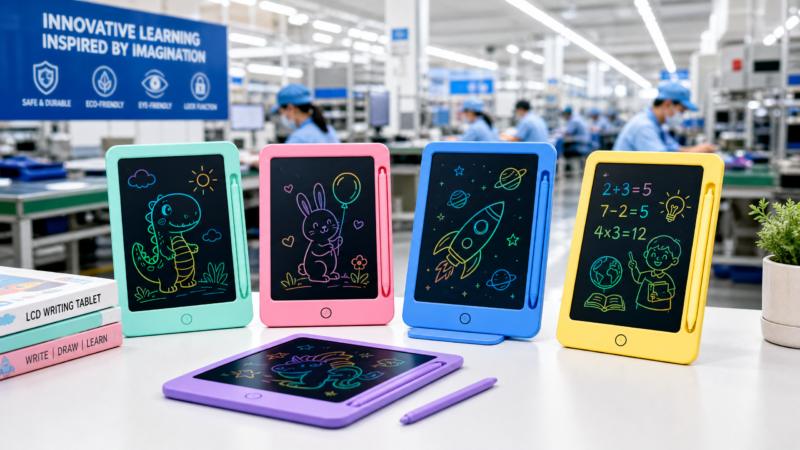
Answer first: An erasable writing tablet is an LCD writing device for temporary handwriting, drawing, practice work, and quick messages: the user writes on the display and clears the visible content with the erase control. For importers, distributors, retailers, schools, and private-label buyers, the key decision is not simply the screen format. It is whether an erase-only LCD product fits the channel, required product story, packaging plan, target market documents, sample process, and landed-cost model. GY Industries presents 8.5-inch, 10-inch, 12.8-inch, and 16-inch product references; the exact configuration, accessories, commercial terms, and compliance documents must be confirmed in the quotation and approved pre-production sample.
What is an erasable writing tablet?
An erasable writing tablet uses a liquid-crystal writing surface that displays marks made with the supplied writing implement. A clear or erase control removes the visible content, allowing the surface to be used again. In B2B language, the category is usually an erasable writing pad, re writable LCD writing pad, or reusable writing pad. These phrases describe a product family, not one universal technical specification.
Most importantly, buyers should separate an erase-only LCD product from a connected or file-saving device. An erase-only product is intended for temporary content. It does not automatically mean that the content can be transferred to a phone, saved as a file, synchronized, printed, or recovered after erasure. USB, Bluetooth, Wi-Fi, save, memory, storage, and rechargeable functions are not assumed for the GY references in this article. If a project needs any of those functions, the requirement must be written into the RFQ and verified against a proposed model and sample.
That distinction affects customer expectations, packaging copy, returns, advertising, and channel fit. A retailer selling a simple practice product can lead with quick erase and screen-free use. A distributor serving professional users may need a larger writing area or an anti-erase lock. A private-label brand that wants digital file management needs a different product brief rather than treating an LCD erase-only tablet as a connected note device.
Why the category can work for B2B channels
An erasable writing tablet has a straightforward retail explanation: write, review, and erase. That simplicity can help an importer build a focused assortment without teaching customers a complicated software workflow. GY’s wholesale page identifies importers, toy distributors, educational suppliers, gift retailers, and brands as potential buyers, while the company’s about page describes its B2B focus and support for brands, distributors, and e-commerce sellers.
The commercial opportunity depends on matching the product promise to the selling channel. Retailers may need a clean front-of-pack message, color choices, barcode space, and an easy-to-understand instruction panel. Distributors may need a consistent assortment, carton information, product references, and repeat-order clarity. Schools and education-focused buyers may prioritize a sample that shows writing response, erase behavior, included items, and documentation for the destination market. Private-label buyers may need brand artwork, language versions, packaging control, and a documented approval trail.
The category should not be presented as a replacement for a smartphone, a tablet computer, or a digital document system. The value is in temporary writing and drawing with a low-complexity product format. If buyers promise digital archiving, app integration, charging, or data transfer without written confirmation, they create avoidable claims and return risk.
Which GY product reference may fit the program?
GY’s approved product pages show several reference points. They are useful for building an initial brief, but they are not a substitute for a project quotation. The following table is a channel decision aid, not a size comparison.
| Buyer decision | Relevant GY reference | Why it may fit | Confirm before approval |
|---|---|---|---|
| Need a compact entry product for a simple retail offer | 8.5-inch LCD writing tablet | The page presents a flexible LCD panel, one-click erase, an anti-erase lock, and several listed color options. | Exact version, battery presentation, included items, packaging, documents, and all commercial terms. |
| Need a color assortment for retail or distribution | 10-inch color LCD writing tablet | The page lists pink, blue, and black options and discusses color, packaging, logo, and private-label discussions. | Final color mix, printed claims, package artwork, product reference, battery arrangement, and sample. |
| Need a larger writing area for practice-focused collections | 12.8-inch LCD writing tablet | The page describes a larger format with listed pink, light blue, and black options and 50 pieces per carton. | Carton plan, exact dimensions and weight, packaging, accessories, market documents, and quotation assumptions. |
| Need a premium or professional-positioned product concept | 16-inch professional LCD drawing board | The page positions the reference for artists, designers, professionals, and larger-format work, with an anti-erase lock described. | Display variant, material, battery, included items, branding scope, safety documents, and intended-user claims. |
The pages list model-specific figures such as product dimensions, weight, battery type, carton quantity, and lead-time ranges. Treat those as published reference information that still requires confirmation for the exact configuration. A color change, packaging change, accessory change, destination market, or sample revision can alter the final offer. Do not place those figures into a purchase order unless they are repeated in the quotation and matched by the approved sample.
How to choose an erasable writing pad for a channel
Importers: start with the landed product definition
An importer should first define the destination country, route to market, and forecast quantity. Then identify whether the product is being sold as a children’s learning item, stationery-adjacent product, gift, family activity product, or professional large-format item. Those descriptions affect the packaging language, warning review, documentation request, and customer-service script.
Ask GY to quote the exact product reference, color mix, retail package, carton quantity, destination, and shipping assumptions. Request any documents needed for the market and selected configuration. Certification and safety status must be confirmed for the exact product and destination; do not rely on a general site badge or an old report.
Distributors: build a range that sales teams can explain
A distributor can reduce confusion by giving each reference a distinct role. One product can serve as the compact, accessible entry option. Another can support a larger writing area. A larger professional-positioned reference can sit in a premium assortment. The point is not to stock every format. The point is to make each SKU’s customer, use case, packaging, and price position clear.
Before committing to several references, ask whether mixed models or mixed colors are commercially possible for the requested quantity. GY’s wholesale page says that buyers should include each requested model and estimated quantity in the RFQ. That detail helps the quotation address assortment feasibility instead of assuming that all combinations are available.
Retailers: approve the shelf story as well as the product
Retail buyers should review the physical sample and the retail package together. Check whether the front panel explains the temporary erase-only function without suggesting file saving. Confirm that product images, color names, included items, language, barcode area, warning information, and age or user claims are appropriate for the destination market.
A retailer should also test the unboxing experience. Is the erase control easy to identify? Does the writing implement sit securely in the package? Does the instruction panel explain how to write, protect content if the model has a lock, and clear the display? These are sample-approval questions, not assumptions to resolve after mass production.
Schools and education buyers: define the activity before the specification
Education buyers should describe the activity the product needs to support. Examples include handwriting practice, quick-response exercises, drawing prompts, individual practice, or a quiet activity station. Then request a sample for repeated-use observation. Check writing visibility, erase consistency, lock behavior where applicable, package language, and the replacement or service position for the target program.
Do not assume that a model’s intended audience on a product page is the same as the buyer’s procurement requirement. Ask for the exact user guidance, market documents, and safety information for the selected configuration. Any age claim, testing claim, or safety statement should be approved for the destination market before publication or purchase.
Private-label buyers: treat artwork and sample approval as controls
A private-label project needs more than a logo file. The RFQ should identify logo placement, color or housing direction, retail packaging, instruction language, barcode, carton marks, accessory presentation, and the intended sales channel. GY’s RFQ page separates standard products, logo or private label, color or housing changes, and new shape or design as different customization routes.
Ask for a branded sample when the logo, housing color, printed claim, or retail package affects the launch decision. Keep a dated approval record that identifies the product version, artwork revision, accessories, packaging, and any open points. A verbal approval or a screen image is not enough when color, fit, print position, or user instructions matter.
Erase-only LCD versus connected or file-saving products
This category decision deserves a clear product brief. An erase-only LCD writing tablet is designed for temporary visible content. The user writes, reviews, and clears. It may include an erase control and, on some references, an anti-erase lock. It should not be described as a file-saving product unless the exact model has a documented function that has been tested and approved.
A connected or file-saving device would require a different set of questions: what connection standard is used, what software or app is required, where files are stored, how data is exported, whether the device needs charging, and what support is provided after sale. USB, Bluetooth, Wi-Fi, save, memory, and storage are all to be confirmed in the quotation and approved pre-production sample. The same applies to rechargeable operation.
For an erase-only program, write the limitation directly into the sales content: content is temporary unless the user separately records it by an approved method. Do not imply recovery after erase. Do not claim cloud access, synchronization, digital backup, or electronic transfer without documented evidence for the selected product.
What to put in the RFQ
GY’s Request a Quote page asks buyers to provide a product or URL, target country or market, estimated quantity, customization, sample requirement, and packaging or documentation requirements. A strong RFQ adds enough detail for the quotation to distinguish standard supply from project-specific work.
- Product reference: include the approved GY page, preferred model, alternative model if acceptable, and the intended customer.
- Quantity: provide the first order estimate, expected repeat order, model split, and color mix. MOQ is to be confirmed in the quotation.
- Market: state country, sales channel, user group, language, and any retailer or marketplace requirements.
- Product configuration: request confirmation of display type, erase behavior, lock function, writing implement, battery, dimensions, weight, colors, and included items.
- Packaging: specify retail box, barcode, artwork, instruction language, warning panel, carton marks, carton quantity, and shipping configuration.
- Branding: attach the best available logo file and identify placement, print method, color direction, and private-label name.
- Sample: state whether you need a standard sample, branded sample, packaging sample, or development sample.
- Documents: list the destination-market documents and testing information required. Certification and safety details are to be confirmed for the exact configuration.
- Timing: give the target delivery window, but treat lead time as subject to quotation, quantity, customization, packaging, destination, and sample approval.
- Commercial terms: ask the quote to identify price basis, payment terms, freight assumptions, taxes or duties, and validity period.
Sample approval and quality checkpoints
Approve the product sample first
Start by matching the sample to the quoted product reference. Record the visible product name or reference, color, finish, writing area, erase control, lock control if applicable, writing implement, battery presentation, and any included accessory. Check that the physical sample performs the function described in the approved sales copy.
Test repeated writing and erase cycles during the buyer’s own review. Observe whether marks are clear, whether the erase action is complete, and whether the lock prevents an unintended clear where the selected model claims that function. These checks are practical acceptance criteria; they should be converted into written requirements if the buyer expects them to govern production.
Approve the package and printed information
Review the retail box, inner protection, instruction sheet, barcode, warning information, logo placement, color reproduction, and carton marks. Check that the package does not promise connected functions that the product does not provide. Confirm the language for each destination market and ensure that the product description matches the approved configuration.
Close the unknowns before mass production
USB, Bluetooth, Wi-Fi, save, memory, storage, rechargeable operation, waterproofing, partial erase, battery, dimensions, MOQ, lead time, certification, and safety are all to be confirmed in the quotation and approved pre-production sample when they are relevant to the project. Do not leave these fields as informal assumptions. If a requirement is not available, the quotation should say so clearly.
For a private-label launch, the final approval pack should include the product sample, packaging sample, artwork revision, instruction language, accessories, quoted specification, document list, and open-issue register. The buyer should approve one controlled version, not a collection of changing screenshots.
Buyer checklist for an erasable writing tablet
- Have we defined the target channel, country, user, and product story?
- Are we buying an erase-only LCD device, or do we need connected or file-saving capability?
- Is the GY product reference written into the RFQ and quotation?
- Have we specified quantity by model and color, with MOQ to be confirmed?
- Have we asked for the exact dimensions, weight, battery, accessory list, and carton plan?
- Have we stated that USB, Bluetooth, Wi-Fi, save, memory, storage, rechargeable, waterproof, partial erase, and similar functions require confirmation?
- Have we requested the destination-market certification and safety documents for the exact configuration?
- Will the sample be standard, branded, packaging, or development level?
- Have we approved logo, color, packaging, language, barcode, warnings, and carton marks?
- Does the quotation state price assumptions, lead time, freight basis, and what remains subject to sample approval?
- Have we tested writing, erase, lock behavior where applicable, and the physical package?
- Does the final product copy avoid promising digital storage or transfer that is not documented?
Frequently asked questions
1. What does “erasable writing tablet” mean?
It usually means an LCD writing product that displays handwriting or drawing and clears the visible content through an erase control. The exact erase behavior and lock function depend on the selected model and must be confirmed in the quotation and sample.
2. Is an erasable writing pad the same as a digital note-taking tablet?
No. An erase-only LCD pad is generally for temporary visible content. A digital note-taking product may connect to another device or save files. USB, Bluetooth, Wi-Fi, save, memory, and storage are not assumed and must be confirmed for the exact model.
3. Can the user save the writing?
Do not promise saving unless the selected product has a documented, tested save function. The approved GY references should be treated as erase-oriented products unless a different capability is specifically confirmed in the quotation and approved sample.
4. Which GY reference should a distributor quote first?
That depends on the channel and assortment plan. The 8.5-inch reference may suit a compact entry offer, the 10-inch reference has listed color options, the 12.8-inch reference presents a larger writing area, and the 16-inch reference is positioned for larger-format professional use. Ask GY to confirm the best route for the target market.
5. Can GY provide a private-label package?
Packaging, logo, color, instruction language, and other branding requirements can be discussed. Final feasibility, quantity, artwork, pricing, and timing must be confirmed in the quotation and approved sample.
6. Is a sample necessary before a wholesale order?
A sample is strongly recommended when product appearance, writing response, erase behavior, packaging, branding, or market documents affect the buying decision. Choose the sample type that matches the risk: standard, branded, packaging, or development.
7. What battery does the product use?
GY’s approved pages list CR2025 or CR2032 batteries for specific references. Battery type, installation, replacement method, packaging presentation, and final configuration must be confirmed in the quotation and approved pre-production sample. Rechargeable operation is also to be confirmed, not assumed.
8. Can the tablet connect through USB, Bluetooth, or Wi-Fi?
Those functions are not assumed for an erase-only LCD product. If connectivity is required, state it in the RFQ and request a model-specific written confirmation and sample demonstration.
9. Can the tablet partially erase one area?
Partial erase is not assumed. Many erase-oriented products clear the visible writing area together, while a lock may protect the content from accidental clearing. Confirm the exact erase method in the quotation and sample.
10. What should be checked for certification and safety?
State the destination market and request the applicable document set for the exact product configuration. Certification, safety, and testing must be confirmed for the selected model and market rather than inferred from another page or another batch.
11. What are the MOQ and lead time?
Both are quotation fields. GY pages show reference commercial information for some products, but the applicable MOQ and lead time depend on the exact model, quantity, customization, packaging, sample approval, and destination. Obtain the final terms in writing.
12. How do I request a quotation from GY Industries?
Use the GY Industries Request a Quote page. Include the product reference, target market, quantity, color, packaging, branding, sample requirement, delivery window, and documentation needs. A complete brief helps GY distinguish a standard product from a custom project.
Request a quote for your erasable writing tablet program
Send GY Industries your preferred product page, target country, sales channel, estimated quantity, color mix, private-label requirements, packaging direction, sample type, and required documents. Ask the quotation to identify the exact model, accessories, battery, dimensions, carton plan, MOQ, lead time, certification and safety information, and all functions that remain subject to confirmation.
For direct procurement, use Request a Quote. You can also review the wholesale LCD writing tablet range and GY Industries product catalog before sending the RFQ. Approve the relevant product and packaging samples before mass production, and keep the final quotation and sample as the controlled reference for the order.