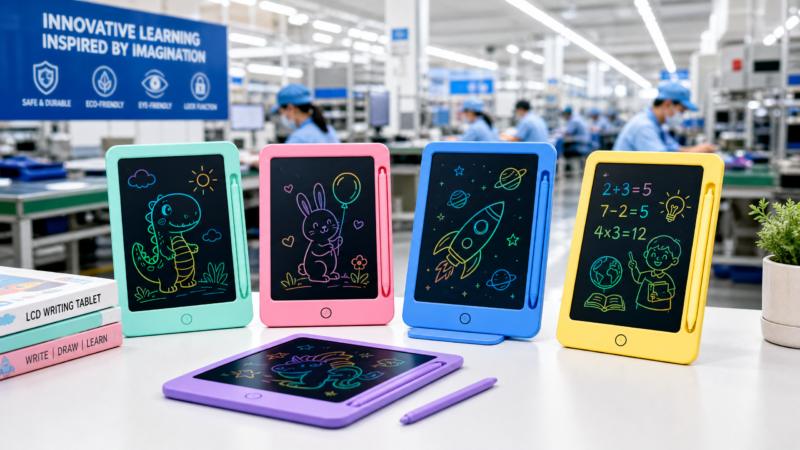
A language school should pilot a talking flash card machine for language schools with one defined age group, one limited card-and-language scope, and a repeatable teacher routine before committing to a larger order. Test the approved sample in real classes, record learner participation and teacher effort, confirm shared-use logistics, and set written scale-up criteria. Final content, audio, battery, compatibility, MOQ, price, lead time, documents, and service terms are to be confirmed in quotation and approved pre-production sample.
Who should use this pilot framework?
This guide is for language-school owners, academic managers, preschool operators, education distributors, and suppliers who need evidence before expanding a talking flash card machine program. It is not a recommendation to place a large order based on a product photograph or a short demonstration. The purpose of a pilot is to turn a promising classroom aid into a controlled purchasing decision.
A school may be considering a classroom set, lending library, parent-facing program, or supplier partnership. Each route changes the questions that matter. A teacher using one unit with a small group may value fast transitions and easy sharing. A distributor may care more about packaging, language versions, content ownership, and replenishment.
Design the pilot as a procurement test, not only as a lesson activity. It should answer six practical questions:
- Is the selected age group able to use the cards and device with appropriate teacher support?
- Does the content reinforce the school’s existing language objectives?
- Can a teacher introduce, share, clean, store, and charge the units without excessive work?
- Does the same sample work for individual, pair, and small-group use?
- Can the school collect feedback that is more useful than general enthusiasm?
- What evidence would justify a larger order, a revised configuration, or a decision not to proceed?
Start with one age band and one teaching problem
The phrase “language school” covers very different learners. A preschool class, a beginner primary group, a conversation club, and an adult foundation course will not use a talking flash card machine in the same way. A pilot becomes difficult to interpret when it mixes several ages, levels, languages, and lesson purposes at once.
Define the learner profile
For younger learners, begin with recognition, listening, repetition, and turn-taking. For older learners, the same activity may be a vocabulary prompt, pronunciation check, retrieval exercise, or warm-up. The machine should support a defined teaching job rather than carry the entire curriculum.
Define the teaching problem
Examples include introducing a small set of everyday nouns, reinforcing pronunciation after a story, giving quieter learners a structured speaking turn, or creating a short review station. A precise problem makes the pilot measurable. “Make English more engaging” is too broad. “Help beginner learners recognize and say ten target words after three short review sessions” gives the teacher something to observe.
Keep the first card scope narrow. The Rabbit talking flash card machine page currently describes a rabbit-themed model with a supplied configuration of 112 cards and 224 listed contents, along with blue and pink options. That published configuration is a starting point, not proof that every language, audio version, or curriculum set will suit the school. The final card list, language, pronunciation, audio, and artwork should be reviewed in the approved sample.
How to align a talking flash card machine for language schools with curriculum content
Content alignment is more important than the novelty of a device. A school should map the proposed cards to its own lesson objectives, vocabulary sequence, and assessment language. If the school uses an established framework, the pilot can borrow its learner-facing “can-do” style. The Council of Europe’s CEFR Companion Volume resource provides a useful reference for describing language activities and learner capabilities, but it does not certify this product or determine the school’s curriculum.
Create a content map
Build a simple table before the sample arrives. List the lesson unit, target words or expressions, visual meaning, expected learner action, and evidence of progress. Mark whether each item is new, familiar, or used for review. If a card set contains categories that are not part of the current course, decide whether they are useful enrichment or unnecessary scope.
Check the language at four levels: learner-appropriate wording; translation and spelling for the destination market; audio that matches the school’s preferred pronunciation; and images that communicate the same concept without cultural ambiguity.
Do not assume that card count equals curriculum coverage. A larger set may increase choice while also increasing sorting, storage, and version-control work. A focused subset can be more informative than using every supplied card.
Set an instructional boundary
A talking flash card machine can prompt listening and speaking practice, but the teacher remains responsible for explanation, modelling, correction, interaction, and safeguarding the pace of the lesson. Define when the device is used and when it is put away. For example, the teacher may introduce the target vocabulary, use the cards for guided practice, then move to a non-device pair activity. This prevents the pilot from measuring only short-term excitement.
Choose a sample configuration that can be approved
Treat the sample as a controlled reference unit. Record model name, housing color, card set, language, audio version, package contents, and date received. Do not use an unapproved sample as evidence of the final production configuration.
The current Rabbit product page lists blue and pink housing options, a Type-C charging cable, an instruction manual, one suction cup, and 112 cards in the supplied package description. It also lists a 300mAh or 100mAh battery option. These details must be matched to the quotation and the actual approved sample because a different project scope, market, or revision may change the configuration.
Use a sample approval record
Give the sample a reference number. Attach the approved card artwork or card list, audio review notes, packaging artwork, instruction copy, and any agreed changes. Ask the supplier to state whether the sample is representative of the intended production version. If changes are requested after the first sample, mark them as open, approved, or rejected rather than relying on informal messages.
Design the classroom workflow before measuring results
The most useful pilot is easy for teachers to repeat. Write a short operating procedure that covers preparation, introduction, use, transition, cleaning, storage, charging, and reporting. The procedure should fit the school’s real timetable, not an ideal demonstration.
A practical five-stage lesson routine
- Prepare: Select a small card group, check the device and audio, and place the cards where learners can reach them safely.
- Model: The teacher demonstrates the card action and says the target word or phrase. Learners should know when to listen, repeat, point, or answer.
- Practise: Use a controlled turn-taking pattern. In a small group, each learner can choose or receive a card while the teacher observes.
- Transfer: Move the vocabulary into a picture sort, role-play, sentence frame, movement activity, or other course task without the machine.
- Record: Note what worked, what required intervention, and which cards or audio items need review.
Run the routine more than once. A first session may be inflated by novelty, while a later session reveals whether setup remains manageable. Ask a second teacher to use the sample if possible.
Measure teacher workflow
Track preparation time, instruction time, transition time, charging or storage steps, and the number of teacher interventions. Record whether cards are easy to sort and whether learners understand turn-taking. Also record what happens when a card is misplaced, a learner presses at the wrong time, or the device is shared by several students.
Teacher effort is a scale-up criterion. A machine that creates a strong lesson but requires extensive daily sorting or troubleshooting may not be suitable for every classroom. Conversely, a short, predictable activity may scale well even if it is not the entire lesson.
Plan shared use for classes, stations, and lending
Language schools often buy fewer devices than learners because equipment is shared. That makes logistics part of the product decision. Decide whether the pilot will use one teacher-led unit, a pair station, a small-group rotation, or a take-home lending model.
For one-unit teacher-led use, the key questions are visibility, audibility, turn-taking, and whether all learners remain engaged while one learner handles the device. For station use, test how groups start and finish without constant teacher intervention. For lending, add a sign-out process, parent instructions, storage protection, and a process for reporting missing cards or accessories.
Do not promise a classroom coverage ratio without measuring the school’s own classes. Quantity depends on room size, group size, lesson design, budget, and simultaneous-use needs. Ask for alternative quantities rather than assuming a package or carton quantity is the correct school set.
Check charging and storage routines
The Rabbit page identifies Type-C charging and includes a charging cable in the supplied package description. Confirm the exact cable, charger responsibility, battery configuration, charging instructions, and any destination-market requirements before ordering. Do not assume a school’s existing chargers, adapters, or charging cabinet will be compatible.
Use a labelled storage tray or pouch during the pilot. Count cards at the start and end of each session. If a suction cup or another accessory is included in the approved configuration, decide whether it is used in class or stored separately. These small controls reveal the operational cost of shared use.
Collect feedback that supports a buying decision
Use a short teacher form
After each session, ask the teacher to rate or describe:
- Ease of preparing the selected card set.
- Clarity of the written content and audio.
- How much teacher prompting learners needed.
- Whether all learners received meaningful turns.
- Whether the activity fitted the planned lesson time.
- Any card, audio, charging, storage, or handling issue.
- What should change before a larger order.
Keep comments tied to observed events. “Audio was difficult to use” is less useful than “learners could not hear the sample clearly during the group turn, so the teacher repeated it.” Specific notes help decide whether to change group size, room arrangement, audio content, or device quantity.
Capture learner evidence carefully
Choose a small number of outcomes such as accurate recognition, prompted repetition, independent recall, or appropriate use in a later activity. Compare the learner’s performance with the school’s normal teaching routine where practical. Do not claim that a short pilot proves long-term language acquisition. The pilot can show fit, usability, and early classroom signals; longer educational outcomes require a broader evaluation design.
Obtain the school’s required permissions for observations, recordings, photographs, or learner data. A supplier should not receive identifiable learner information unless the school has a lawful and appropriate process. This article does not make a legal or safeguarding determination for any particular country.
Compare standard, semi-custom, and private-label pilot paths
A school does not need to begin with the most customized route. The right path depends on what it needs to learn before a larger commitment.
| Pilot path | Best use | What to confirm | Scale-up signal |
|---|---|---|---|
| Standard sample | Test classroom workflow and general learner fit quickly. | Exact model, supplied card set, language, audio, package contents, battery and charging details. | Teachers can repeat the routine and learners engage with the intended activity. |
| Semi-custom sample | Test a selected language, card theme, color, or packaging direction before broader customization. | Artwork scope, translation, pronunciation, audio, sample cost, revision points, MOQ and lead time. | Content fits the curriculum and changes are limited and clearly documented. |
| Private-label pilot | Test a school-branded or distributor-branded offer and parent-facing presentation. | Logo method, box artwork, manual, warnings, barcodes, documents, destination market and approval sequence. | School stakeholders approve the presentation and operational requirements. |
| Broader custom or ODM review | Explore a differentiated product, new shell, new card system, or deeper content program. | Design scope, development stages, tooling, OID or recognition requirements, ownership, testing, MOQ and schedule. | There is a clear business case beyond what the standard platform can provide. |
Set scale-up criteria before the pilot begins
Green: proceed to quotation and expanded sample review
Use green when the intended age group can follow the activity with reasonable teacher support, the card content matches the course, audio and artwork are approved in principle, the shared-use routine is practical, and teachers can record issues consistently. Green does not mean “place the final order.” It means request a detailed quotation and agree the pre-production approval path.
Amber: revise and retest
Use amber when the concept works but one material issue remains. Examples include translation changes, pronunciation review, a card theme that needs editing, a packaging change, unclear instructions, insufficient units for the planned rotation, or a charging process that needs adjustment. Identify the owner and due date for each change, then run a targeted retest.
Red: stop or change direction
Use red when learners cannot use the activity safely or meaningfully, the content does not support the course, the teacher workload is too high, the sample cannot be controlled, or the commercial assumptions do not fit the school. A clear stop decision protects the school from paying for a larger configuration before the core problem is resolved.
Project risks to control before a larger order
Risk 1: Age and content mismatch
A card set may be attractive but too difficult, too easy, or culturally unsuitable. Control this risk with a content map, teacher review, and a defined learner profile. Keep approved and rejected cards in the project record.
Risk 2: Sample-to-production drift
Changes to card artwork, audio, housing color, battery option, packaging, or accessories can create a different product from the one tested. Control the risk with a signed or otherwise documented sample approval record. List every open change and require confirmation of the production reference.
Risk 3: Version confusion
Language schools may use several languages or course levels. Similar card sets can be mixed if they do not have clear internal identifiers. Ask for a version naming convention and retain the approved artwork, scripts, audio notes, and packing list together.
Risk 4: Shared-use loss
Cards and small accessories can be misplaced in busy classrooms. Count items, assign storage, and decide how the school will report missing components. Ask in the quotation how replacement cards or accessories can be handled; availability, pricing, and support terms are to be confirmed in quotation.
Risk 5: Compliance and market documentation
The exact documents depend on the product configuration and destination market. The Rabbit page references product-documentation points that should be confirmed for the exact model, battery configuration, and market. Do not print a certificate mark or make a compliance claim based only on a general page image. Request the applicable document set during quotation and sample review.
Risk 6: Unclear commercial assumptions
MOQ, sample charges, price breaks, lead time, carton plan, shipping responsibilities, inspection arrangements, payment terms, and after-sales support can materially change a school’s decision. Keep them separate from classroom findings and ask for each item in writing. Any unverified specification, MOQ, price, lead time, certification, battery, interface, compatibility, OID, audio, or service detail is to be confirmed in quotation and approved pre-production sample.
Buyer checklist for a language-school pilot
Copy this checklist into an RFQ or internal approval brief:
- Target country, language, age band, class size, and sales or teaching channel.
- Course unit, vocabulary theme, learning objective, and expected learner action.
- Preferred standard sample or requested card, language, color, packaging, and logo changes.
- Exact model reference and whether the Rabbit talking flash card machine is the intended starting point.
- Card list, written language, translation review, pronunciation preference, and audio approval method.
- Device package contents, charging cable, battery option, charging instructions, and storage plan.
- Shared-use model: teacher-led, pair work, station rotation, classroom set, or lending.
- Sample quantity, sample cost, revision allowance, and approval responsibilities.
- MOQ, unit-price structure, carton details, lead time, shipping terms, and inspection plan.
- Applicable destination-market documents and any school procurement requirements.
- Artwork ownership, content ownership, audio rights, version control, and reorder process.
- Replacement-card, accessory, warranty, and service expectations, all to be confirmed in quotation.
- Scale-up criteria, decision date, and the person authorized to approve production.
FAQ
How many units should a language school buy for a pilot?
Start with enough units to test the intended teaching pattern, not an assumed classroom ratio. One teacher-led unit may test lesson fit; multiple units may be needed to test pair work or stations. Quantity, package contents, and any carton arrangement are to be confirmed in quotation and approved pre-production sample.
Can the school use its own vocabulary and language?
Custom card themes, language, translation, pronunciation, audio, and artwork can be discussed for the selected project. Do not assume that a standard model includes the school’s curriculum. The final content scope, feasibility, cost, MOQ, lead time, and approval process are to be confirmed in quotation and approved pre-production sample.
Is the Rabbit model suitable for preschool language classes?
The product page describes the Rabbit model for early learning and language practice, with a rabbit-themed form and a supplied configuration of 112 cards and 224 listed contents. Suitability for a particular preschool depends on age, curriculum, language, classroom workflow, and approved sample testing.
Does the product include a rechargeable battery?
The current product page shows Type-C charging and lists a 300mAh or 100mAh battery option. Confirm the selected battery configuration, charging requirements, cable, documents, and final package in quotation and approved pre-production sample.
Can a school order private-label packaging?
Logo placement, housing color, packaging artwork, instruction language, card themes, and retail presentation can be discussed for the selected project. Artwork, labeling, warnings, barcodes, destination-market documents, MOQ, lead time, and sample approval must be agreed in writing.
Does a successful classroom pilot guarantee learning improvement?
No. A pilot can show classroom fit, learner participation, teacher workload, and early evidence against defined objectives. It does not by itself prove long-term language acquisition or replace the school’s normal assessment process.
Can the same sample be used for a larger production order?
The sample should be the reference for approval, but production readiness still requires confirmation of the final card content, audio, artwork, packaging, configuration, documents, and inspection plan. The supplier should confirm what will remain unchanged and what will be revised before production.
What should be included in the quotation request?
Include the target market, age band, language, card theme, quantity, shared-use model, packaging, logo, sample plan, content and audio requirements, delivery location, target schedule, and required documents. A detailed brief helps separate standard supply from semi-custom, private-label, or ODM work.
Request a quote for your institutional pilot
GY Industries can review a language-school pilot brief around the selected age group, curriculum content, teacher workflow, shared-use model, feedback plan, and scale-up criteria. For a product starting point, review the Rabbit talking flash card machine for language-school pilots. For broader OEM or ODM discussion, visit the talking flash card machine OEM/ODM landing page.
Request a Quote with your target age, language, card themes, classroom quantity, packaging direction, sample requirements, destination market, and decision schedule. Product specifications, MOQ, price, lead time, certification, battery, interface, compatibility, OID, audio, and service details are to be confirmed in quotation and approved pre-production sample.