Traditional dry-erase whiteboards have been a classroom staple for decades. But LCD writing tablets are rapidly displacing them in homes and schools. Understanding the key differences helps retailers position these products effectively and helps buyers make the right choice for their needs.
The Core Problem with Traditional Whiteboards
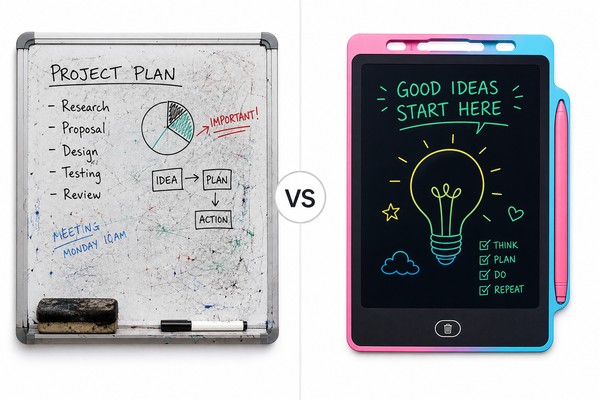
Dry-erase whiteboards require markers that dry out, leave ghosting residue, and contain chemical solvents. The erasers become permanently stained, and the board surface degrades over time. For children, the chemical smell of whiteboard markers is a health concern, and the mess factor makes them impractical for home use.
Head-to-Head Comparison
| Feature | Traditional Whiteboard | LCD Writing Tablet |
|---|---|---|
| Writing Tool | Dry-erase markers (chemical, dries out) | Stylus (no ink, no chemicals, no drying out) |
| Erasing | Manual wiping (leaves ghosting) | One-button instant erase (perfectly clean) |
| Portability | Fixed to wall or large frame | Lightweight, fits in a backpack |
| Mess Factor | High (marker on hands, clothes) | Zero (completely clean) |
| Ongoing Cost | Continuous marker replacement | Zero (one battery lasts 1+ year) |
| Screen Glow | None | None (ambient light only) |
The Verdict for Retailers
LCD writing tablets are objectively superior to traditional whiteboards for home and personal use in almost every measurable dimension. The only area where whiteboards retain an advantage is large-format group collaboration (e.g., a 4-foot classroom board). For individual use, the LCD tablet wins decisively. GY-industries offers a full range of sizes to meet every use case. Contact us for wholesale pricing.