Answer: A brand should evaluate a flash card machine factory by tracing one controlled specification from brief to approved sample and then into production records. Review separate versions for cards, audio, recognition behavior, packaging, and the physical unit. Sample approval confirms only the defined sample and scope; it should not be treated as a blanket guarantee for every batch. Final details remain subject to quotation and an approved pre-production sample.
Who this review is for
This guide is for brand owners, importers, distributors, and quality teams sourcing a talking flash card machine for a retail, education, or early-learning range. It is especially useful when the product is more than an off-the-shelf device. A private-label project may change the logo, colors, card artwork, language, audio, packaging, or instruction materials. Each change can create a new approval point.
The central question is not simply, “Did the sample work?” It is, “Can the factory show exactly which approved version was tested, which files were released, and how the same decisions will be checked during production?” That distinction matters because a talking flash card machine combines several linked deliverables. A card can be printed correctly but mapped to the wrong audio. A package can carry the right artwork but contain a different card set. A device can recognize a card in a sample while a later content or firmware change affects the interaction.
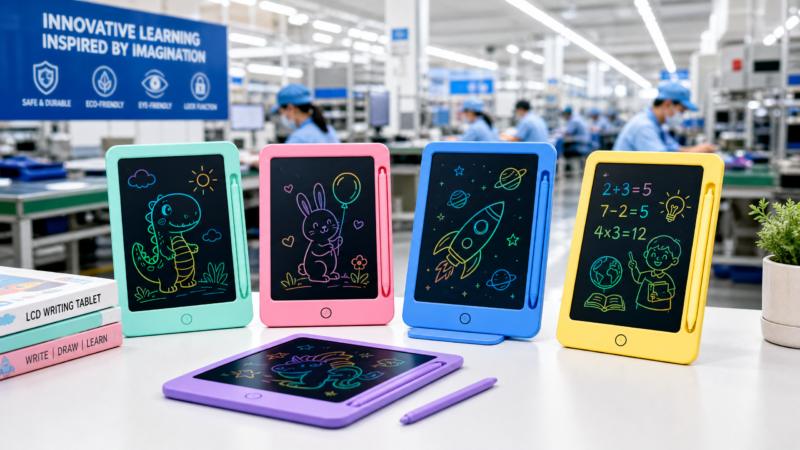
GY Industries presents the talking flash card machine category as an OEM/ODM option for brands, distributors, retailers, and education-focused buyers. Its public product information describes the dinosaur model as a themed learning device with a listed set of 112 cards and 224 contents, green and pink options, Type-C charging, and battery options shown on the product page. Those are useful starting points for a review, not substitutes for a project-specific quotation and approved pre-production sample.
Why sample-to-production control is the real buying question
A sample is a decision instrument. It lets a buyer review the appearance, card handling, audio, recognition, package presentation, and instructions before authorizing production. However, a sample is also a snapshot. It may represent a standard configuration, a development build, or a particular artwork revision. Unless the approval record identifies the exact version and scope, different people can interpret “approved” in different ways.
For a brand, the most useful control system creates a traceable chain:
- Project brief: the target market, age positioning, language, sales channel, product concept, quantity, packaging, and required documents.
- Quotation: the commercial scope, included content, sample charges, order assumptions, lead-time basis, and items that remain to be confirmed.
- File register: the controlled card artwork, translations, audio scripts, recordings, packaging artwork, manual, and product specification.
- Approved sample: the physical reference identified by date, revision, and approval owner.
- Production release: the exact files and configuration authorized for manufacturing.
- Batch checks: inspections that compare production output with the released version, without implying that one sample guarantees every unit.
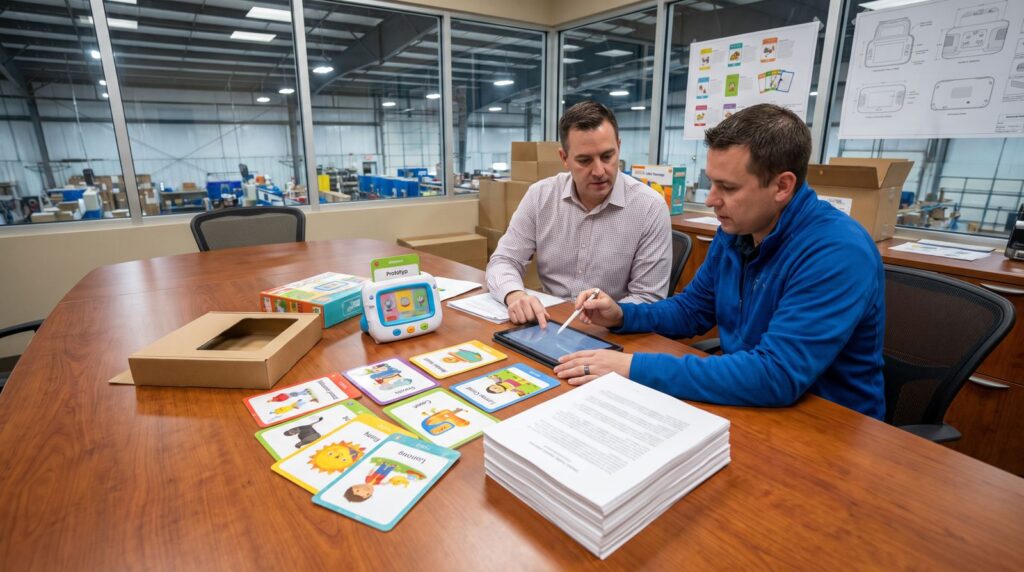
Ask the factory to explain who owns each hand-off. A strong answer names the responsible person, the document or record created, the revision identifier, and what happens when a change is requested. A vague answer such as “we will follow the sample” leaves too much room for silent substitutions.
How should a brand evaluate a flash card machine factory?
Use a control review that follows the product in the same order that risk enters the project. Start with the commercial brief, then inspect the content system, physical device, packaging, release process, and production verification. The goal is to make important decisions visible before they become expensive to correct.
1. Freeze the project brief before reviewing the sample
Write down what the sample must prove. Include the intended market and sales channel, target age range, product theme, selected model, color direction, card subjects, language, pronunciation expectations, packaging level, instruction language, quantity, delivery destination, and any requested market documents. If the brand is considering the dinosaur model, the brief can identify the dinosaur theme and the public starting configuration, while stating that final card content, language, package contents, battery, and documentation are to be confirmed in quotation and approved pre-production sample.
Do not leave “custom content” as a single line. Break it into card names, image references, translations, pronunciation scripts, audio files, recognition mapping, and artwork ownership. If the brand supplies content, identify the file format and approval owner. If the factory supplies content or translation, require a review stage before printing or recording.
2. Build one version register for cards and content
Every card set should have an identifier. The register can include card number, front artwork revision, back artwork revision, text, translation status, image status, audio filename, recognition code or mapping reference where applicable, and approval date. The exact technical method used by the factory is to be confirmed in quotation and approved pre-production sample; the control principle does not depend on a particular coding technology.
Use meaningful revision names rather than filenames such as “final-final-new.” For example, a brand might use “DINO-EN-CARDS-R03” and record that the matching audio script is “DINO-EN-AUDIO-R02.” If one word changes, the affected audio and recognition mapping should be reviewed instead of assuming that the old files remain valid.
Request a change log. It should show what changed, who requested it, which related files were affected, who approved it, and whether a new physical sample or functional check is required. This is particularly important for translations. A language correction can alter the printed card, pronunciation, audio script, packaging claim, and instruction manual at the same time.
3. Review audio as a controlled production asset
Audio is not merely a feature to hear once during a demonstration. Treat each recording as a file with a defined script, language, speaker or voice direction, filename, duration if relevant to the project, and approval status. Ask whether the audio heard on the sample is the same audio released for production. If the answer is yes, request the release reference. If the answer is no, require a new audio approval step.
Listen for pronunciation, word-to-card matching, volume consistency, unwanted noise, pauses, and the intended language variant. The buyer should decide whether a word is acceptable for the target market rather than relying on a generic “English” label. Audio style, speaker, language coverage, and recording service are project-specific and are to be confirmed in quotation and approved pre-production sample.
Ask how audio changes are controlled after approval. A replacement recording should not be copied into a production folder without updating the register and checking the related card mapping. Ask for a short functional test list that connects selected cards to their expected responses. The test list should be based on the approved project scope, not on an assumed feature set.
4. Test recognition with both ordinary and changed content
Recognition deserves its own review because it sits between printed content and device behavior. A buyer should test representative cards from different categories, card orientations if relevant, repeated insertions, and any cards that were changed late in the artwork process. Check whether the device gives the intended response, whether the response matches the printed content, and whether an unapproved or incorrect card produces an unexpected result.
Do not assume that a product name proves a particular recognition method, interface, memory, compatibility range, or coding system. OID, NFC, RFID, optical recognition, app connectivity, Bluetooth, USB behavior, and compatibility with other card libraries are not confirmed unless stated for the exact project. These details are to be confirmed in quotation and approved pre-production sample.
Ask the factory to identify the production check for recognition. It may be a sample-based functional test, a file comparison, a programmed-content check, or another agreed method. The method, sample size, acceptance criteria, and record format are to be confirmed in quotation and approved pre-production sample. What matters is that the buyer and factory agree before production begins.
5. Approve the physical unit separately from the content
Inspect the housing, color, buttons, charging arrangement, card slot or reading area, accessories, labels, and instruction manual as separate approval items. A device can look correct while containing the wrong card set. A correct card set can be packed with the wrong cable or manual. Record the model name, color, visible artwork, package contents, and any agreed changes in the sample report.
The dinosaur product page lists green and pink options, Type-C charging, a charging cable, an instruction manual, a suction cup, and a battery option shown as 300mAh or 100mAh. For procurement purposes, those points should be checked against the physical sample and formal quotation. Battery selection, charging behavior, safety documentation, labeling, runtime, and market compatibility are to be confirmed in quotation and approved pre-production sample.
6. Treat packaging as a separate version-controlled product
Packaging is often where a content change escapes notice. Compare the retail box artwork, product name, language, warning text, barcode, quantity statement, color reference, card description, and instruction manual with the approved product scope. Check that the box actually contains the approved device, card set, accessories, and language version.
Use a packaging approval sheet that records the artwork revision and a photographed or physical proof. If the brand changes a card count, language, battery statement, or included accessory, review the box and manual again. Do not approve packaging from a screen image alone when color, fit, insert arrangement, or printed content is commercially important.
7. Define the production release gate
Before mass production, ask for a written release gate. It should identify the selected model, physical sample revision, card artwork revision, audio revision, recognition or content mapping reference, packaging revision, manual revision, approved colors, accessory list, and applicable destination-market documents. It should also state open items, if any, and who may authorize a change.
The release gate is not a promise that every unit will be identical without inspection. It is the baseline against which production is checked. ISO describes quality management as a formal system of requirements and has moved from ISO 9001:2015 to a newer 2026 edition; the useful lesson for a buyer is the general value of documented, repeatable processes, not an assumption that a supplier holds a particular certification. Ask for the exact documents applicable to the selected model and destination market. Certification status is to be confirmed in quotation and approved pre-production sample.
Comparison: what different project scopes require
The control burden changes with the scope of customization. A standard project may need fewer file approvals, while a private-label or fully custom project can create many linked revisions. The table below is a procurement framework, not a promise of fixed MOQ, pricing, lead time, or included services.
| Project scope | Typical control focus | Buyer approval points | What must be confirmed |
|---|---|---|---|
| Standard configuration | Existing device, card set, audio, accessories, and package | Working sample, contents, language, visible condition, destination-market needs | Exact model, card library, battery, charging, MOQ, price, lead time, documents |
| Private label | Logo, color direction, retail box, manual, and brand assets | Logo proof, color proof, packaging proof, sample with brand treatment | Artwork method, package contents, labels, barcode, order assumptions, approval timing |
| Semi-custom content | Selected card topics, translation, audio, and recognition mapping | Content register, translation, audio samples, card proof, functional sample | Content ownership, recording scope, language, mapping method, revision rules |
| Fully custom or ODM | New design direction, interaction, content system, packaging, and development stages | Design brief, engineering samples, content sample, package proof, pre-production sample | Development scope, tooling, compatibility, MOQ, milestones, lead time, ownership |
For a first review, a buyer can use the Dinosaur talking flash card machine for sample-to-production review as a concrete product reference. The model page is useful for identifying the starting product concept, but the buyer should not copy its public information into a purchase order without confirming the exact configuration.
Buyer checklist for an RFQ and sample review
Copy the following questions into the project brief and ask the factory to answer each one in writing:
- Which exact model and product revision are included in the quotation?
- Which card set, card count, subjects, languages, translations, and artwork files are included?
- Which audio files or recording services are included, and who approves scripts, pronunciation, and final recordings?
- How is each card linked to its intended audio or recognition response?
- Which card, audio, recognition, firmware, device, packaging, and manual revisions will be listed on the sample approval?
- What happens if the buyer changes a word, image, translation, voice, color, accessory, or package statement after sample approval?
- Will a new functional or physical sample be required after a linked file changes?
- What exactly is included in the package, including cards, cable, manual, suction cup, battery, labels, and inserts?
- Which battery configuration and charging details apply to this quotation?
- Which interface, recognition method, compatibility, OID, app, or connectivity details are actually supported by the selected configuration?
- What MOQ, sample cost, unit price, tooling or development fee, and lead time apply to this scope?
- Which compliance, test, labeling, and destination-market documents are applicable?
- What production checks compare cards, audio, recognition, packaging, and accessories with the released version?
- How will batch inspection results and nonconforming units be recorded and resolved?
- What support is available for repeat orders, revised content, spare accessories, and packaging replenishment?
Any specification, MOQ, price, lead time, certification, battery, interface, compatibility, OID, audio, or service detail not verified on the exact quotation and sample should be written as to be confirmed in quotation and approved pre-production sample.
Project risks that a controlled review can reduce
Specification drift
Specification drift occurs when the brief, quotation, sample, and production file describe slightly different products. It often starts with an informal message: a different color is available, a card is replaced, or an accessory is omitted. Reduce this risk by maintaining one current specification and requiring written confirmation for changes.
Content and translation mismatch
A translation correction can be made in artwork but missed in audio. A revised image can change the intended vocabulary but leave the recognition mapping unchanged. Reduce this risk with a card-level register and a final cross-check that reads the printed card, plays the audio, and tests the response together.
Packaging and product mismatch
A box may show an earlier card count, language, color, or accessory list. A manual may describe a feature that is not included in the selected version. Reduce this risk by checking a packed sample, not only loose components, and by adding packaging to the same release gate as the device and cards.
Sample overconfidence
The most important commercial risk is treating a successful sample as a universal batch guarantee. A sample demonstrates the agreed reference under the conditions of that sample. It does not remove the need for production checks, inspection, corrective action, or a clear remedy process. Agree what will be checked, when it will be checked, and what happens if production does not match the approved release.
Late changes without impact review
Late artwork or audio changes can affect printing, programming, packaging, instructions, and delivery timing. Ask the factory to identify the impact before accepting a change. Any revised cost, MOQ, lead time, certification review, or sample requirement is to be confirmed in quotation and approved pre-production sample.
How to use the approved sample during production
Keep the approved sample, approval report, photographs, and released files together. Mark the sample with a reference that cannot be confused with an internal development unit. When production starts, ask the factory to use the release register at incoming, in-process, or final checks as appropriate to the project. The exact inspection plan is to be confirmed in quotation and approved pre-production sample.
For higher-risk launches, arrange an independent inspection or a buyer-side inspection before shipment if commercially appropriate. Define the inspection scope in advance: visual appearance, card print, content count, audio response, recognition response, packaging, accessories, labels, and carton condition. Do not describe an inspection plan as a factory guarantee. It is a separate verification step that helps the buyer make a shipment decision.
For repeat orders, do not automatically reuse the first release. Confirm whether the card files, audio, device version, battery, package, manual, and market documents remain unchanged. A reorder should have its own written confirmation, even when the buyer intends to keep the same design.
FAQ
Does sample approval guarantee the entire production batch?
No. Sample approval confirms the identified sample and agreed scope. It should be followed by production controls and, where appropriate, batch inspection. The quotation should define the applicable acceptance and remedy process.
What should a sample approval record include?
Include the model, physical sample reference, card and artwork revisions, audio revision, recognition or content mapping reference, packaging and manual revisions, accessories, color, approval date, open issues, and authorized approvers.
Should card artwork and audio be approved separately?
Yes. Approve the printed card content and the audio files as separate assets, then test them together. A translation or artwork change can require a related audio and recognition review.
How can a buyer check recognition without knowing the factory’s technology?
Test representative approved cards and compare the device response with the expected response. Ask the factory to document the agreed test method. Do not assume OID, NFC, RFID, app, Bluetooth, or another interface unless the exact project confirms it.
What if the brand changes packaging after the sample?
Record the change, identify affected files and components, and ask whether a revised package proof or packed sample is required. Any cost, lead-time, MOQ, or document impact is to be confirmed in quotation and approved pre-production sample.
Are the dinosaur model’s public specifications automatically the production specification?
No. The public page is a product starting point. Its listed 112 cards, 224 contents, green and pink options, Type-C charging, package items, and battery options should be checked against the exact quotation and approved pre-production sample.
Can the factory confirm the MOQ and lead time in an article?
No. MOQ and lead time depend on the selected model, quantity, artwork, content, packaging, customization, and approval status. They are to be confirmed in quotation and approved pre-production sample.
What should a buyer do if the production unit differs from the sample?
Compare the unit with the release register and document the difference with photographs, affected serial or carton information if available, and a description of the failed requirement. Then follow the agreed nonconformance, rework, replacement, credit, or shipment decision process.
Request a Quote with a controlled sample plan
A reliable sample-to-production review starts with a clear brief, not with a request for a generic “best price.” Send the target market, channel, selected product direction, card topics, languages, audio expectations, packaging, quantity, battery or charging requirements, document needs, delivery location, and the version-control points that matter to your brand. Ask the factory to separate standard supply from private label, semi-custom content, and ODM work.
Use the OEM/ODM talking flash card machine page to frame the product discussion, then request a written scope for your exact project. When you are ready to align the device, cards, audio, recognition, packaging, and release process, Request a Quote from GY Industries. The final configuration, commercial terms, documents, and production basis should be confirmed in the quotation and approved pre-production sample.
Sources
- GY Industries OEM/ODM Talking Flash Card Machine
- GY Industries Dinosaur Talking Flash Card Machine
- ISO 9001:2015 Quality management systems — Requirements (official ISO page; current edition status and general quality-management context)