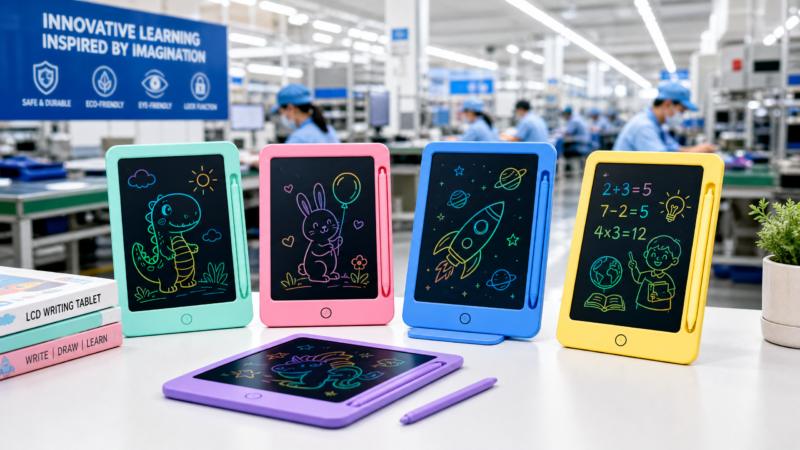
For a distributor comparing an LCD writing tablet size range supplier, the best assortment is rarely the widest one. Start with channel role, shelf or parcel constraints, user context, display space, and a clear price ladder. Then map one or more verified models to each job, such as compact impulse retail, online multipacks, education supply, or gift presentation. Final dimensions, options, commercial terms, compliance documents, MOQ, lead time, and customization should be confirmed in quotation and approved pre-production sample.
Who should use this size-assortment guide?
This guide is for toy distributors, importers, retail buyers, private-label brand owners, educational suppliers, and product managers deciding whether an LCD writing tablet range deserves more than one SKU. It is not a recommendation to place every available size in every market. It is a framework for matching a product role to a selling environment before a buyer commits inventory.
A channel assortment has two different jobs. First, it must give shoppers a simple reason to choose. Second, it must give the distributor enough commercial coverage to serve different baskets, displays, and customer missions. A small tablet may work as an add-on or travel activity. A larger writing area may make more sense for a learning supply pack, family use, or a gift-led presentation. Those statements describe planning contexts, not guaranteed performance or a fixed product specification.
GY Industries’ wholesale LCD writing tablet page presents the category for importers, toy distributors, educational suppliers, gift retailers, and brands. It also advises buyers to define the intended channel before selecting a model. Review the wholesale LCD writing tablet range as the starting point, then ask for a quotation that separates model, quantity, packaging, artwork, sample, and destination-market requirements.
Why size range should follow the channel, not the catalogue
Size is visible, but it is not the whole assortment decision. A distributor is really choosing a combination of product footprint, perceived value, price position, packaging volume, display use, and replenishment logic. If the assortment is built by copying a supplier’s catalogue, the result can be too broad for a small store, too undifferentiated for an online listing, or too expensive to explain to a buyer.
Physical retail: make the display role obvious
Physical retail rewards fast recognition. A compact size can support checkout, travel, seasonal, or small-gift merchandising when the package is easy to handle and the product story is clear. A larger size can act as a more visible shelf or end-cap option when the retailer has room to demonstrate the writing area. The right comparison is not simply “small versus large”; it is “which size earns its space and gives the shopper a distinct reason to trade up?”
Ask the retailer for the actual shelf bay, peg, tray, or counter dimensions. Confirm whether the package will be displayed front-facing, stacked, hung, or placed in a mixed educational display. Request packaging artwork and physical samples when the fit, printed language, barcode position, warning information, or color accuracy affects the launch. Packaging configuration, labels, instructions, and accessory presentation are to be confirmed in quotation and approved pre-production sample.
Online retail: sell the use case and the comparison
Online channels can carry more assortment depth, but too many similar listings create choice friction. Separate sizes by a meaningful use case, bundle, audience, or gift tier rather than uploading near-duplicate pages. A compact model can be positioned around portability or a lower entry price. A larger model can be positioned around a more generous writing area. Do not describe a size as more durable, more educational, or more suitable for a particular age unless the applicable evidence and market documentation are confirmed.
For online launch planning, request consistent product photography, dimensions, package measurements, included-item lists, color options, and approved wording for each SKU. Confirm whether the same battery, stylus, erase control, frame material, interface, or compatibility applies across the range. If any detail is not verified for the exact configuration, state it as to be confirmed in quotation and approved pre-production sample.
Education and institutional supply: prioritize task and handling
School suppliers and learning-product distributors often need a product brief before they need a large catalogue. Ask how the tablet will be used: individual practice, waiting-time activity, home-school carryover, teacher demonstration, or a shared resource. Consider writing area, storage, cleaning and handling instructions, replacement planning, and the language of the documentation. Do not infer institutional suitability from screen size alone.
Institutional buyers may also request samples for review by procurement, teachers, safeguarding teams, or compliance staff. Build time for the buyer’s approval process. Battery type and replacement method, materials, testing, certification, audio, interface, connectivity, OID, software compatibility, and service scope are to be confirmed for the selected product and market, not assumed from a category name.
Gift, seasonal, and promotional channels: design for the event
Gift and promotional channels often need a clear price ladder and a presentation that works at a particular event or season. A compact writing tablet may suit an entry gift or a high-volume campaign. A larger format may support a premium gift box or a family-oriented display. If the buyer wants logo printing, custom colors, a special package, inserts, or a campaign message, treat those as project variables rather than standard features.
The distributor should ask whether the promotion needs one delivery or several batches. Confirm artwork deadlines, sample approval, carton marking, destination, and the consequences of late changes. A low unit price does not solve a missed seasonal window. Production timing and any event-dependent delivery plan must be confirmed in the quotation for the exact quantity, customization scope, and approval status.
How to build a channel-based size ladder
A useful size ladder has roles, not just measurements. The following sequence keeps the decision practical.
1. Define the channel mission
Write one sentence for each channel: “This SKU is for a compact impulse purchase,” “This SKU supports an online value tier,” or “This SKU gives an education distributor a larger writing-area option.” If two sizes serve the same sentence, the range may be too wide. If no size serves a high-value customer mission, ask the supplier whether another verified model or a custom development route is appropriate.
2. Set the display and logistics envelope
Record shelf depth, package orientation, peg or tray dimensions, carton limits, parcel fees, warehouse locations, and expected return-handling requirements. Compare both product dimensions and packed dimensions. A product that fits a shelf may not fit the retailer’s standard package or shipping carton. Ask for carton packing information, master-carton dimensions, and loading assumptions in the quotation instead of estimating them from a product photograph.
3. Choose distinct user contexts
Use context to prevent internal cannibalization. Examples include travel activity, home drawing, classroom practice, gift retail, and promotional distribution. These are planning examples only. Validate the actual intended use with the buyer, especially when the product is marketed to children or supplied to an institution.
4. Create a price ladder without inventing prices
A price ladder can be built before exact pricing is known. Label positions as entry, core, and premium, then request a quotation for each proposed configuration. Compare the complete offer, including product, packaging, artwork, samples, accessories, documents, freight assumptions, and any development work. Do not publish a target price, fixed MOQ, or guaranteed discount until GY Industries confirms it for the exact project.
5. Give each size a replenishment rule
Decide what will trigger a reorder. The core SKU may be replenished when stock reaches a defined cover level. A seasonal or premium SKU may be reordered only after a retailer confirms the next campaign. A distributor should also decide whether colors are replenished separately or as a mixed assortment. The live 8.5-inch product page mentions color options and mixed-color ordering, but the applicable mix, minimums, packaging, and commercial terms must be confirmed in quotation for the proposed order.
LCD writing tablet size range supplier: comparison framework
Use this table as a briefing tool, not as a specification sheet. It compares assortment roles that a buyer can ask GY Industries to confirm.
| Assortment role | Typical channel job | Display or user question | What to request from the supplier |
|---|---|---|---|
| Compact entry | Checkout, travel, small gift, promotional volume | Does the packed product fit the intended counter, peg, parcel, or campaign pack? | Verified dimensions, packed dimensions, colors, included items, artwork options, MOQ, and sample route. |
| Core everyday | General toy retail, online bestseller, distributor stock item | Does it have a clear use case and enough margin without duplicating the entry SKU? | Exact model specification, packaging, channel images, quotation assumptions, reorder terms, and market documents. |
| Larger writing area | Education supply, family use, premium shelf or gift display | Does the display and use context justify the additional footprint and price position? | Verified active area and overall dimensions, package size, handling guidance, accessories, sample, and price ladder. |
| Custom or private label | Brand program, campaign, retailer-exclusive range | Is the change a logo and package update, or a genuine product-development project? | Artwork brief, color and mold feasibility, development sample, testing and documents, MOQ, lead time, and approval gates. |
GY Industries’ current public pages identify an 8.5-inch LCD writing tablet and a separate 12.8-inch LCD writing tablet as possible reference points for a compact and larger writing-area discussion. The 8.5-inch product page gives model-specific details, but a distributor should still match the exact version to the approved sample. If you want to evaluate the compact reference in a channel assortment, use the anchor 8.5-inch LCD writing tablet and ask which other model, color, package, and order combination is commercially available for your market.
What the RFQ should say about every proposed size
A strong request for quotation lets the supplier answer the assortment question instead of returning an unstructured catalogue. Include the destination country or region, sales channels, expected first order, forecast range, target retail positioning, and whether the products will be sold together or in separate programs.
For each proposed size, list the intended role, target user context, required product color, package style, labeling language, barcode needs, included accessories, and artwork. Ask for a line-by-line quotation that identifies standard product cost, customization cost, packaging cost, sample cost, tooling or development cost if applicable, and freight assumptions. If a line item does not apply, ask the supplier to mark it clearly rather than leaving a silent assumption.
Request the exact product data sheet and approval sample for each SKU. Confirm the active writing area, overall dimensions, weight, screen or panel description, erase operation, lock function if applicable, stylus, battery, battery access, interface, audio, OID, compatibility, and any other feature used in the sales copy. These details are not interchangeable between sizes. Any unverified specification is to be confirmed in quotation and approved pre-production sample.
Buyer checklist for a multi-size tablet program
- Have we named the retail, online, education, gift, or promotional channel for each proposed size?
- Have we measured the intended shelf, peg, tray, parcel, and master-carton constraints?
- Does each SKU have a distinct user context and reason to trade up or down?
- Have we separated product dimensions from package dimensions?
- Have we requested model-specific photos, data sheets, included-item lists, colors, and packaging details?
- Have we asked which options are standard and which require customization or development?
- Have we requested MOQ, unit pricing, tooling or artwork costs, sample costs, and payment terms for each configuration?
- Have we asked for lead time by model, quantity, customization, sample approval, and delivery batch?
- Have we identified destination-market testing, labeling, warnings, and documentation requirements?
- Have we confirmed battery type, replacement method, interface, compatibility, OID, audio, service, and accessories rather than inferring them?
- Have we approved a physical product sample and, where needed, a branded and packaging sample?
- Have we defined reorder rules, spare-part questions, color mix, and version-control responsibilities?
Project risks that can make a size range unprofitable
Risk 1: SKU overlap
Two sizes can compete for the same customer while creating extra inventory, photography, packaging, and customer-service work. Prevent this by assigning a channel mission and a price position before requesting the final quote. If the use cases cannot be explained in one sentence each, reduce the initial range or pilot one core SKU.
Risk 2: Display fit is checked too late
Product dimensions alone do not prove that a package fits a shelf or parcel. Require packed dimensions, orientation, carton details, and a physical sample where fit matters. Keep the approved package drawing with the order record. Any change in package size, inserts, labels, or carton arrangement should trigger a new review.
Risk 3: The product page becomes the specification
Public product pages are useful starting points, but they cannot replace an order-specific quotation and approved pre-production sample. A model name may be reused across colors, packages, or markets. Before publishing claims, reconcile the data sheet, quotation, sample, artwork, and required market documents.
Risk 4: Battery and accessory assumptions
Retailers may ask about battery access, replacement, stylus supply, or after-sales support. Do not promise a battery life, interface, spare-parts policy, or service level unless it is confirmed for the exact configuration. Record the answer in the quotation and sample approval file, then keep the product listing aligned with that approved version.
Risk 5: Seasonal timing is treated as a guarantee
A short public lead-time indication is not a delivery guarantee for every size, quantity, customization, or destination. Request a written schedule that begins after the relevant approvals. For seasonal goods, set a latest artwork date, sample decision date, production window, inspection point, and contingency plan.
Risk 6: Compliance is generalized across markets
Destination-market requirements depend on product configuration, age grading, battery arrangement, labeling, and the buyer’s legal responsibilities. The U.S. Consumer Product Safety Commission’s toy-safety materials illustrate why battery access and child-safety hazards deserve specific review; a recall example on the agency site describes risks when button-cell batteries become accessible. Use the CPSC toy-safety resource as a reference, then obtain the documents and testing information applicable to the exact product and market.
Frequently asked questions
Should a distributor launch every available LCD writing tablet size?
No. Start with the channel mission, display constraints, user context, and price ladder. A focused launch with a clear core SKU can be easier to replenish and explain. Add a second size when it serves a genuinely different job.
Is the 8.5-inch LCD writing tablet suitable as a core SKU?
It can be evaluated as a compact reference for retail and learning programs, but suitability depends on the channel, package, market, and commercial terms. Confirm the exact model, options, and approved sample before making a core-SKU decision.
Can I combine multiple sizes in one wholesale order?
Possibly, depending on the product combination and commercial terms. List each model, quantity, color mix, packaging configuration, and destination in the RFQ. Mixed-order feasibility, MOQ, and pricing are to be confirmed in quotation.
How should I compare the price of two sizes?
Compare landed-cost assumptions and the complete selling offer, not just unit price. Include packaging, artwork, samples, documents, freight, duties where relevant, inventory risk, and expected retail role. Final pricing is to be confirmed for the exact project.
Do larger writing tablets always belong in education channels?
No. A larger writing area may suit some education or family contexts, but channel fit depends on the task, handling, storage, display, budget, and buyer requirements. Do not infer institutional suitability from size alone.
What sample should a distributor request?
Request a standard sample to check the product, a branded sample to check logo execution, and a packaging sample when presentation or printed information matters. The appropriate sample sequence should be agreed before production.
Are MOQ and lead time fixed for all sizes?
No. MOQ and lead time can change with model, quantity, color mix, logo, packaging, development work, destination, and approval status. They are to be confirmed in quotation and approved pre-production sample.
Can the same product copy be used for every size?
Only after model-specific details are checked. Dimensions, battery, accessories, interface, compatibility, OID, audio, certifications, and service claims must match the exact configuration and market documentation. Unknown items should be marked as to be confirmed in quotation and approved pre-production sample.
What should be included in a reorder plan?
Record the approved model, color mix, packaging version, artwork files, sample reference, quantity by SKU, reorder trigger, accessory assumptions, and market documents. Ask GY Industries how changes will be controlled before a repeat order is released.
Request a quote for a channel-ready size assortment
Share your target market, channels, estimated quantity by size, shelf or parcel constraints, user contexts, price positions, colors, packaging direction, artwork, accessory needs, and sample requirements. GY Industries can then confirm which models and configurations are available for the project, what needs customization, and which commercial and compliance details require approval.
Request a Quote for an LCD writing tablet size assortment and ask for a model-by-model quotation. Include the 8.5-inch LCD writing tablet as a compact reference if it fits your channel brief, then request written confirmation of every size, package, MOQ, price, lead time, battery, interface, compatibility, OID, audio, certification, and service detail before placing an order.