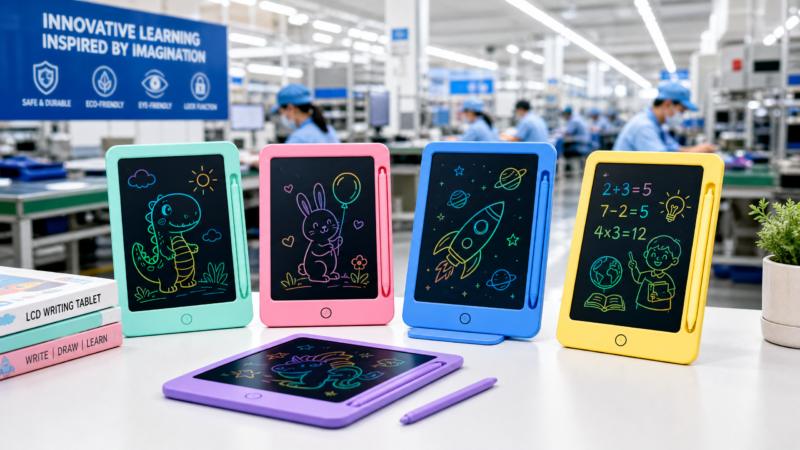
For a distributor, the safest way to plan spare styluses and replacement batteries is to create an accessory policy before the first purchase order: identify which parts are supplied, estimate demand by channel, separate sellable spares from service stock, and record every approved configuration. An LCD writing tablet spare stylus supplier should confirm the exact accessory, battery, packaging, MOQ, price, lead time, documentation, and support scope in the quotation and approved pre-production sample.
Who this guide is for
This guide is for importers, distributors, retail brands, educational suppliers, and after-sales teams building a reusable LCD writing tablet range. It is especially relevant when the distributor expects to support several sales channels at once. A toy retailer may need a simple replacement option at the point of sale. A school supplier may need controlled service stock for a program. An online seller may need a customer-support process for missing or damaged accessories. These are different inventory problems, even when the tablet itself is the same.
The purpose is not to promise a universal spare-parts policy. Accessory availability depends on the selected model, the approved configuration, the order quantity, the target market, and the supplier’s written quotation. Instead, use this article to prepare a decision framework that can be checked against the product sample and the commercial terms.
Why accessory planning belongs in the first RFQ
Distributors often treat the tablet unit as the whole product. In practice, a customer may judge the product through a small accessory: a stylus that is missing from the box, a battery that cannot be replaced as expected, or an instruction sheet that does not match the delivered configuration. If the accessory question is raised only after mass production, the buyer may face a new minimum order, a different packing process, or a longer replenishment route.
Accessory planning also affects the product record. The public GY Industries product page for the 12.8-inch LCD writing tablet describes a supplied stylus and lists a CR2032 button battery in its visible specification table. The same page says that the configuration should be confirmed in the formal quotation and approved sample. A distributor should therefore record the listed information as a starting reference, not as a blanket promise for every future order or every market.
The wholesale landing page presents LCD writing tablets for retail, educational, gift, and distribution programs. It also recommends confirming the model, options, packaging, quantity, sample requirements, and destination-market requirements before ordering. That sequence is useful for accessories: decide the sales and service model first, then ask the supplier to map the accessory details to the exact SKU.
How an LCD writing tablet spare stylus supplier should support the plan
A useful supplier response does more than state that a stylus is included. Ask for an accessory schedule connected to the product reference and sample version. The schedule should identify what is packed with each tablet, what can be ordered separately, and what remains subject to project confirmation. It should also state whether an accessory is supplied loose, inserted in the retail package, packed in a service bag, or handled in another approved way.
1. Confirm the baseline configuration
Begin with the exact product reference, product size, color mix, packaging version, and destination market. For the 12.8-inch page, the visible information includes a 285 × 195 × 7 mm product size, pink, light blue, and black color options, a listed retail box, and 50 pieces per carton. These details help the distributor connect accessories to an actual SKU and carton plan. They do not establish the replacement-part policy for all colors, packages, or future revisions.
Ask the supplier to identify whether the stylus shown or supplied with the sample is the standard accessory for the quoted configuration. Confirm its appearance, attachment or storage method if relevant, packing location, and whether the same accessory is intended for replacement sales. If the supplier proposes a visually similar alternative, treat it as a change requiring sample approval rather than an automatic substitution.
2. Separate included accessories from replacement stock
Included accessories are part of the sellable unit. Replacement stock is an additional inventory category with its own purchase, storage, labeling, and customer-support rules. A distributor can request three separate quantities in the RFQ:
- Accessories packed with the initial tablet order.
- Replacement accessories ordered with the initial shipment.
- Potential replenishment accessories for later after-sales demand.
This separation prevents an apparently attractive tablet price from hiding a service requirement. It also makes it easier to compare suppliers without assuming that included accessories can be reordered indefinitely.
3. Define the battery question without guessing lifespan
The product page currently lists a CR2032 button battery for the 12.8-inch model. A distributor should still ask the supplier to confirm the battery fitted in the approved sample, the battery supplied in the quotation, the battery arrangement at packing, and any market-specific handling or labeling requirements. Do not publish a claimed operating life, shelf life, replacement interval, or performance guarantee unless the supplier provides a documented basis and the buyer approves it.
Battery planning has two sides. The first is commercial: will the distributor hold batteries as separate service stock, or will the supplier provide them only as part of a replacement unit? The second is operational: how will the distributor store, pack, ship, and dispose of the battery under the destination market’s rules? The exact answer should be confirmed with the supplier, logistics provider, and compliance adviser for the destination market.
For general U.S. guidance, the U.S. Environmental Protection Agency explains that button-cell or coin batteries can be a swallowing hazard, should be stored out of the reach of young children, and should be managed according to their chemistry and local collection options. The EPA also advises checking the battery marking rather than identifying a battery by shape alone. These are general handling principles, not a product-specific certification or a substitute for destination-market review.
4. Ask for an accessory change-control rule
Accessory substitutions can affect fit, appearance, packaging, instructions, customer expectations, and compliance files. Ask the supplier to notify the buyer before changing the stylus, battery arrangement, retail insert, or accessory packaging. The quotation and approved pre-production sample should state the version that controls the order. If a later change is necessary, request a revised sample or documented approval route before accepting production.
How much spare inventory should a distributor hold?
There is no responsible universal percentage for spare styluses or batteries because demand depends on the channel, customer behavior, product configuration, packaging, returns process, and replenishment time. A distributor should build an estimate from its own evidence and then ask the supplier to quote the resulting quantities. Start with a planning model rather than a fixed promise.
Use a three-bucket inventory model
Bucket A: launch and fulfillment stock. This covers accessories required to complete the first shipment and correct foreseeable packing exceptions. Confirm whether every tablet unit is intended to ship with one stylus and the listed battery configuration. If the buyer wants a different pack-out, document it in the sample and quotation.
Bucket B: customer-service stock. This is reserved for verified cases such as a missing accessory, transit damage, or a documented after-sales request. Keep this stock physically and financially separate from retail inventory. A small service reserve can be useful, but its size should be based on the distributor’s order history or pilot results rather than an invented failure rate.
Bucket C: replenishment stock. This supports future orders, service continuity, or channel-specific programs. Replenishment should be reviewed against the supplier’s quoted MOQ, pack quantity, lead time, and shipment terms. If the supplier cannot quote a standalone accessory, the distributor should identify an alternative service process before launch.
Build the estimate from real channel inputs
Ask each sales channel for a basic forecast. Record expected tablet units, number of retail doors or institutional customers, launch timing, expected reorder timing, and the type of after-sales support promised to the customer. Then identify the accessory exposure: missing-item cases, lost styluses, battery questions, and returns that require inspection. At pilot stage, capture actual cases by model and color rather than combining every LCD writing tablet into one number.
Use a review cycle for the inventory plan. A distributor may review after the first shipment, after the first significant reorder, and whenever the product, packaging, destination, or channel changes. The review should compare opening stock, shipped spares, unresolved cases, write-offs, and supplier replenishment time. This creates a defensible planning record without claiming that any particular failure rate or battery life applies to the product.
Comparison: four accessory-support approaches
The following table helps a buyer compare commercial approaches. It does not imply that every approach is available for every GY Industries model. Availability, MOQ, price, lead time, and service details are to be confirmed in quotation and approved pre-production sample.
| Approach | What the distributor holds | When it can fit | Questions to confirm |
|---|---|---|---|
| Included-accessory only | The accessories packed with each sellable tablet | Simple retail programs with limited after-sales service | What is included, how is it packed, and how are missing-item cases handled? |
| Launch reserve | A planned quantity of separate styluses and/or batteries for the initial sales period | New launches where early demand and service cases are not yet known | Can the items be ordered separately, and what pack quantity and replenishment terms apply? |
| Channel service stock | Controlled stock allocated to a retailer, school supplier, or distributor service team | Programs with a defined support contact and documented case process | Which cases qualify, who approves release, and how is stock reconciled? |
| Supplier-coordinated replenishment | Minimal local stock with future accessory requests placed through the supplier | Predictable reorder programs where the quoted schedule supports the channel | What are MOQ, lead time, shipping terms, and configuration controls for a repeat order? |
Plan the accessory workflow from sample to customer
A strong plan connects five checkpoints. First, the RFQ identifies the product reference, target market, expected quantity, color mix, packaging, and accessory questions. Second, the quotation separates the tablet, included accessories, optional spares, and any project-specific service. Third, the approved pre-production sample shows the physical arrangement and printed information. Fourth, receiving inspection checks the delivered configuration against the approved record. Fifth, customer service logs every accessory case against the model and order.
For the sample review, inspect the stylus presence, appearance, fit or storage presentation, and packing location. Check the battery marking and arrangement against the approved record. Review the retail box, instruction language, warnings, barcode area, and carton marks. If the distributor will sell a replacement battery separately, ask whether the separate pack requires different labeling, packaging, or shipping treatment. If those details are not verified, write them as “to be confirmed in quotation and approved pre-production sample.”
At receiving, sample cartons from the delivered batch according to the buyer’s quality procedure. Confirm that the product reference, color, accessory count, and package version match the purchase documents. Keep photos or inspection records that identify the batch and date. The goal is not to claim that every shipment has a guaranteed result; it is to create evidence for a practical release decision and a clear supplier discussion if something differs.
Buyer checklist for an accessory and after-sales RFQ
Copy the questions below into the request for quotation and adapt them to the target market:
- Which exact LCD writing tablet model and color mix are being quoted?
- What stylus is included with each unit, and how is it presented in the approved sample?
- Can replacement styluses be ordered separately from the tablet?
- Are replacement batteries available separately, and does the quoted item match the battery in the approved sample?
- What accessory quantities and pack units apply to the initial order and a repeat order?
- Are MOQ, unit price, lead time, and shipping terms different for spare accessories?
- What retail, service, or shipping packaging is proposed for loose accessories?
- Which instruction language, warning information, labels, and destination-market documents are required?
- How should the distributor report a missing, damaged, or incorrect accessory?
- What evidence is needed for a service request, such as order number, batch record, or photos?
- Can the supplier provide a replacement-accessory sample before mass production?
- How will a future change to the stylus, battery arrangement, packaging, or instruction sheet be approved?
- Which service, compatibility, interface, OID, audio, certification, or documentation details are applicable to the selected configuration?
- Which details remain to be confirmed in quotation and approved pre-production sample?
Project risks distributors should control
Risk 1: A generic spare part is assumed to fit
A stylus can look similar while differing in dimensions, storage, color, or customer presentation. Avoid a compatibility promise based on appearance. Tie every spare to the model, sample, and approved accessory record. If a distributor carries several LCD writing tablet sizes, use separate stock codes unless the supplier confirms interchangeability in writing.
Risk 2: Battery details are copied from an old listing
Battery arrangements may vary by product revision, packaging, or market requirement. Do not copy a battery model, lifespan, replacement interval, or service promise from another SKU. For the 12.8-inch page, the current visible table lists CR2032, but the selected order still requires confirmation in the quotation and approved sample.
Risk 3: A service reserve is mistaken for a guarantee
Holding spare stock can improve response time, but it does not prove a defect rate or create a supplier guarantee. Define the internal purpose of the reserve, the approval authority, and the evidence required for release. Ask the supplier to state any actual service terms in writing rather than implying them from the existence of spare accessories.
Risk 4: Packaging changes create a mismatch
Moving a stylus or battery from the retail box to a separate service pack can change artwork, warnings, barcode handling, carton count, and shipping review. Approve the physical package, not just a screen image. Record the version and keep the signed or otherwise approved sample tied to the purchase order.
Risk 5: Reorder timing is not accessory timing
A tablet reorder and a spare-accessory reorder may have different commercial terms. Ask whether the supplier can combine them, whether an accessory has a separate MOQ, and what lead time applies after artwork or sample approval. Never use a general product-page lead-time range as a guaranteed accessory schedule; the applicable timing is to be confirmed in quotation for the exact order.
FAQ: spare styluses, batteries, and distributor support
Should every distributor stock spare styluses?
Not necessarily. A distributor should compare channel expectations, service commitments, reorder timing, and the supplier’s accessory terms. If the channel expects quick replacement, a controlled reserve may be sensible. The quantity and commercial terms are to be confirmed in quotation and approved pre-production sample.
Can the 12.8-inch LCD writing tablet be quoted with extra styluses?
Request this as a separate line in the RFQ. The product page shows a supplied stylus, but a separate spare-stylus program, pack quantity, MOQ, price, and lead time are to be confirmed in quotation and approved pre-production sample.
What battery should a distributor reorder?
Use the battery marking and configuration shown in the approved sample and written quotation. The current product page lists a CR2032 button battery for the 12.8-inch model, but the distributor should not assume that the same arrangement applies to another model, revision, or market. Battery details are to be confirmed in quotation and approved pre-production sample.
Can a distributor promise a battery lifespan to retail customers?
Only if the supplier has provided an appropriate documented basis and the buyer has approved the wording for the target market. This article does not establish a lifespan, operating time, storage period, or replacement interval. Do not turn an unverified estimate into a retail guarantee.
Does GY Industries publish a fixed spare-part policy?
The public pages reviewed for this article do not establish a universal fixed spare-part policy. Ask for the accessory and after-sales scope for the selected model, quantity, market, and package. The response should be recorded in the quotation and approved pre-production sample.
How should a distributor store replacement button batteries?
Follow the battery manufacturer’s instructions, local rules, and the destination-market logistics guidance. The EPA advises keeping button-cell or coin batteries out of the reach of young children and managing them according to their chemistry and local collection options. Confirm product-specific packaging and shipping requirements before holding or distributing separate batteries.
Are spare styluses compatible across different LCD writing tablet sizes?
Do not assume compatibility across sizes or model families. Request written confirmation tied to each product reference and verify the accessory in a sample. If interchangeability is not confirmed, use separate stock codes and customer-service instructions.
What should happen when a customer reports a missing stylus?
Use a simple case record with the order number, model, color, batch or shipment reference when available, photos if appropriate, and the requested resolution. Release a spare only under the distributor’s approved policy. Escalate repeated cases to the supplier with evidence rather than changing the inventory percentage without review.
Can accessories be private-labeled?
Logo, color, packaging, instruction language, and private-label presentation can be discussed, but feasibility depends on the selected product, artwork, order quantity, and sample. Any branding or accessory change is to be confirmed in quotation and approved pre-production sample.
Turn the plan into a focused quotation request
A distributor does not need to predict every future service case before contacting a supplier. It does need to make the accessory question visible. Send the model, target market, sales channel, initial quantity, color mix, packaging direction, desired spare categories, expected service route, and sample requirements. Ask the supplier to return a line-by-line answer that distinguishes included accessories, optional spares, and details that remain open.
For a broader model comparison, start with GY Industries’ wholesale LCD writing tablet range. For the larger-format reference discussed here, use the 12.8-inch product page and request confirmation of the accessory arrangement before publishing a retail claim or placing a repeat order.
Request a quote for your accessory plan
Ready to align tablet units, spare styluses, replacement batteries, packaging, and after-sales handling? Request a quote from GY Industries and include the model, quantity, destination market, color mix, packaging, accessory quantities, sample requirements, and service questions. Product specifications, MOQ, price, lead time, certification, battery, interface, compatibility, OID, audio, and service details are to be confirmed in quotation and approved pre-production sample.
Sources
- U.S. Environmental Protection Agency: Used Household Batteries — general guidance on button-cell battery handling and end-of-life management.
- GY Industries: Wholesale LCD Writing Tablets — current public wholesale positioning and quotation workflow.
- GY Industries: 12.8-Inch LCD Writing Tablet — current public product-page information used as the factual boundary for the model reference.