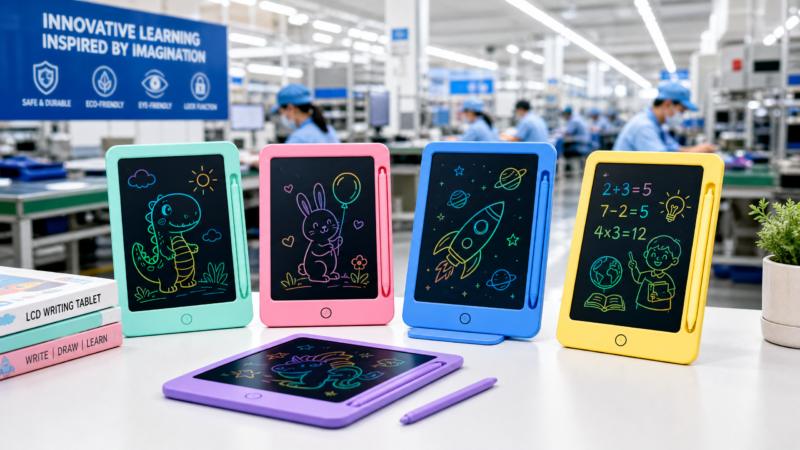
Answer first: Choose one hero SKU when your channel needs a simple, low-complexity launch and the selected model can serve most of your target shoppers. Choose a multi-size LCD writing tablet range when channel roles, shelf formats, use cases, or price points genuinely differ. Treat the LCD writing tablet product range as a merchandising decision first, then confirm models, packaging, quantities, and any custom requirements in the quotation and approved pre-production sample.
What decision is the retailer really making?
A retailer deciding between one hero LCD writing tablet and several sizes is not simply choosing between a small product list and a large one. The decision affects shelf clarity, purchasing complexity, inventory exposure, product education, packaging development, online navigation, and the way a distributor or retail team explains the range to customers.
A single model can make a new category easier to understand. One product page, one main set of images, one core pack architecture, and one replenishment conversation may be enough for an initial test. A broader assortment can create more ways to match different shoppers and channels, but it also requires a stronger reason for every additional SKU. If the sizes do not have clearly different jobs, the range may create choice without adding useful coverage.
For that reason, the right question is not “How many sizes can the supplier offer?” It is “Which model structure gives our retail program a clear customer promise while keeping the quotation, sample approval, packaging, and replenishment process manageable?” A retailer should answer that question using channel evidence and approved product information rather than assumptions about demand or performance.
When a hero SKU is the better starting point
A hero SKU is a single lead model that carries the initial retail message. It is often appropriate when the retailer is introducing LCD writing tablets to a new market, testing a new category, or supplying stores with limited display space. It can also suit a distributor that wants a straightforward product story before adding variants.
1. The buyer needs a simple shelf message
One model gives the sales team a clear answer when a customer asks what to buy. Product photography, copy, barcode planning, carton identification, and online merchandising can be organized around one reference point. This does not guarantee better sell-through, but it can reduce the number of decisions that the buyer and retailer must coordinate before launch.
2. The channel is still being tested
If the retailer has limited evidence about preferred dimensions, shopper use cases, or acceptable retail positioning, a hero SKU may be a disciplined way to learn. The initial brief can focus on one catalogue option, the intended sales channel, target quantity, packaging level, and sample review. After the first commercial cycle, the retailer can decide whether a second size addresses a proven gap.
3. The retailer wants to control assortment complexity
Every additional model can require separate product data, imagery, stock planning, packaging references, and internal approvals. The exact workload depends on the project and is not assumed here. A one-model launch may therefore be easier to coordinate, especially when the retailer is managing several new products at the same time.
4. One catalogue option fits the primary use case
A hero SKU makes more sense when the retailer can describe one principal customer need without adding a second model merely for visual variety. For a compact program, an 8.5-inch LCD writing tablet for compact retail programs may be a useful product reference to review. The page should be treated as a starting point for model evaluation; final included contents, packaging, artwork, order conditions, and other commercial details should be confirmed in the quotation and approved pre-production sample.
When a multi-size LCD tablet range earns its shelf space
A multi-size LCD tablet range can be justified when each model has a distinct retail role. The role may relate to shelf footprint, display format, target shopper, channel, price architecture, gifting context, or a planned progression from entry option to larger writing area. The retailer should document the reason before requesting a full range quotation.
1. Different channels need different product roles
A specialist educational retailer, a general merchandise chain, an online marketplace, and a distributor serving institutional buyers may not need the same assortment. One compact model may be easier to place in a small impulse area, while a different catalogue size may be more suitable for a product page that emphasizes writing area. Those are merchandising hypotheses, not confirmed product-performance claims. The supplier should confirm the available catalogue options and provide samples for comparison.
2. The retailer can explain the difference in one sentence
Each size in a range should have a clear job. Examples of a useful role statement include “compact option for limited display space,” “standard option for the core assortment,” or “larger-area option for customers who prioritize writing space.” Avoid descriptions that promise unverified durability, battery life, compatibility, safety, or educational outcomes. If a difference cannot be explained clearly, it may not deserve a separate SKU.
3. The assortment supports a deliberate price ladder
A range may help a retailer organize good-better-best navigation, but the actual prices, margins, and commercial thresholds are project-specific. Do not assume that a larger size automatically has a particular price relationship or that a multi-size order qualifies for a particular MOQ. Request a quotation that lists each model, packaging level, quantity assumption, sample requirement, and any artwork or accessory variation separately.
4. The retailer can manage the additional approvals
A multi-size launch should have a controlled approval process. The team should know which product images belong to which model, which box artwork maps to which item, and whether the same retail copy applies to every size. Where a change is not clearly catalogue-standard, it should be treated as custom or sample-dependent until GY-Industries confirms it in writing and the approved pre-production sample reflects it.
How to compare an LCD writing tablet product range
Use the following sequence before selecting a hero SKU or a broader assortment. It helps the buyer distinguish a real portfolio need from an attractive but unsupported increase in SKU count.
Start with the retail job, not the number of sizes
Write down the customer problem the range is intended to solve. Is the program designed for a compact shelf, a broad online category, a seasonal gift set, an educational-products section, or a distributor catalogue? The answer should guide the initial model shortlist. It should not be used to infer technical specifications that have not been supplied.
Map each candidate to a channel and shopper
For each possible model, record the channel, expected display context, shopper question, and reason for inclusion. If two models serve the same channel and shopper with no clear distinction, compare them carefully before adding both. If a size is intended for a different market or pack format, ask for separate packaging and artwork confirmation rather than assuming the same retail presentation applies.
Separate catalogue options from custom options
Catalogue options are models and configurations the supplier can identify as available for review. A catalogue listing does not automatically confirm your desired logo, color, packaging, accessory set, language, barcode, or order quantity. Custom or sample-dependent options include changes to artwork, packaging, included contents, dimensions, materials, or other project requirements that are not explicitly confirmed as standard. These details are to be confirmed in the quotation and approved pre-production sample.
Ask for a model-by-model quotation
A range quotation should make comparison possible. Ask the supplier to identify the model reference, product size or designation, packaging level, requested quantity, sample requirement, artwork status, and any assumptions. Ask which details are catalogue-standard and which depend on customization or sample approval. MOQ, price, lead time, certifications, battery life, compatibility, and performance details must not be assumed; they should be confirmed in the quotation and approved pre-production sample where relevant.
Retail buyers can compare wholesale LCD writing tablet ranges as part of this review, then send a focused brief rather than asking for an undefined selection of every possible model.
Hero SKU versus multi-size range: compact comparison
| Decision area | One hero SKU | Multi-size LCD tablet range | What to confirm |
|---|---|---|---|
| Retail message | One central product story | Several role-based stories | Whether each model has a distinct customer-facing job |
| Launch complexity | Usually fewer product and packaging references to coordinate | More model mapping and approval work may be required | Model list, artwork, packaging, included contents, and sample plan |
| Channel coverage | Best when one primary channel or use case dominates | Useful when channels or shelf contexts are materially different | Which channel receives which model and why |
| Inventory approach | Concentrates planning around one SKU | Spreads planning across multiple SKU references | Target quantities and commercial terms for each model |
| Customer choice | Simple selection, fewer comparison questions | More choice if differences are easy to explain | Clear size descriptions without unsupported claims |
| Best next step | Review one catalogue option and approve the launch brief | Review a controlled sample set and confirm the role of each size | Quotation and approved pre-production sample |
Build a retail assortment without creating SKU confusion
The phrase “retail assortment” should describe a deliberate structure, not simply a list of products. A practical range architecture can begin with a core model, add one clearly differentiated alternative, and expand only when the channel or customer evidence supports it. The actual number of models is not prescribed here because the appropriate assortment depends on your market, display plan, target quantity, and approved product options.
Give every proposed SKU a role name for internal planning. “Core,” “compact,” or “larger-area” can be useful working labels if they match the confirmed product information. Do not turn those labels into technical promises. Keep the internal model matrix separate from the consumer-facing copy until the supplier confirms the exact dimensions, packaging, included contents, artwork, and other relevant details.
Use the same discipline for online merchandising. A product title, image set, comparison chart, and FAQ should make it obvious why a shopper would choose one size over another. If a detail is not confirmed, write that it is available on request or subject to quotation and approved pre-production sample rather than filling the gap with a generic claim.
For distributor programs, also consider whether the distributor wants one universal reference or a small set of channel-specific references. The answer may be different from a retailer’s own shelf plan. Discuss the destination market, packaging language, artwork, target quantities, and sample requirements with the supplier before treating a proposed range as a confirmed commercial program.
Catalogue options, custom options, and sample approval
Retail buyers should keep three categories visible in their sourcing notes:
- Catalogue option: a model or size presented by the supplier for review. It still requires confirmation of current availability, packaging, included contents, commercial terms, and the buyer’s requested configuration.
- Requested customization: a buyer requirement such as logo artwork, retail box design, language, barcode, color, accessory set, or other change. It is not a confirmed feature until included in the quotation and reflected in the approved sample where applicable.
- Sample-dependent decision: a matter that the buyer needs to inspect physically, such as the final appearance, printed artwork, pack contents, or a project-specific requirement. The sample review should be recorded before production approval.
This separation protects both sides from a common sourcing error: treating a general catalogue reference as if it already included every requested retail detail. It also gives the buyer a cleaner basis for comparing a hero SKU with a multi-size program.
Buyer checklist for selecting the range
Before requesting a final quotation, the retail buyer, brand product manager, or distributor should prepare the following information:
- Channel and shopper: identify the target retail channel, destination market, expected display context, and the main customer question the product should answer.
- Assortment logic: state whether the goal is one hero SKU, a compact-plus-core structure, or a broader multi-size LCD tablet range, and explain the job of each proposed model.
- Model references: list the catalogue options to review and ask the supplier to confirm the relevant dimensions, model designations, and available configurations.
- Quantity plan: provide the target quantity by model or explain the planned test quantity. Do not assume MOQ, price breaks, or mixed-model terms.
- Packaging: specify whether you need standard packaging, retail packaging, language changes, barcode placement, carton markings, or a separate pack for each size.
- Artwork: provide logo files, product naming, required languages, regulatory or market text supplied by your compliance team, and the intended approval sequence.
- Included contents: ask the supplier to confirm what is included with each model and identify any requested accessory or insert. Do not assume that two sizes share identical contents.
- Commercial confirmations: request written confirmation of price, MOQ, lead time, payment or shipping assumptions, certifications, and any other project-specific requirement rather than relying on a general product page.
- Sample approval: define who approves the product, packaging, artwork, and final configuration, and record which changes must be resolved before production.
Frequently asked questions
Is a hero SKU always safer than a multi-size range?
No. A hero SKU can simplify a launch, but it may not cover channels or shopper needs that genuinely differ. A multi-size range can be appropriate when each model has a documented role and the buyer can manage the additional quotation, packaging, sample, and inventory decisions. Neither structure guarantees sales or reduces risk automatically. Select the smallest assortment that answers the proven retail need and confirm the details in the quotation and approved pre-production sample.
How many sizes should a retailer include in the initial range?
There is no universal number. Start with the channel plan, display context, target shopper, and the reason each model is needed. If the retailer cannot explain the difference between two proposed sizes, keep the shortlist narrower until the supplier provides clearer catalogue information or samples. The final model count, commercial terms, and packaging plan should be confirmed in the quotation.
Can one package design be used for every size?
It may be possible, but it should not be assumed. Product dimensions, model references, included contents, barcode requirements, language, and retail presentation can affect the packaging. Ask GY-Industries to identify what is catalogue-standard and what requires artwork or packaging confirmation. Any final packaging design should be approved before production.
Should a retailer test a product before adding a second size?
A sample review is a prudent step when the retailer needs to compare physical size, appearance, packaging, or a project-specific configuration. The decision to add a second size should also consider channel evidence and the commercial quotation. A sample is not a substitute for written confirmation of MOQ, price, lead time, certification, compatibility, battery life, or performance details; those remain quotation- and sample-dependent where applicable.
What should a distributor include in a range enquiry?
Include the destination market, sales channels, proposed model references, target quantity by model, packaging level, artwork and language needs, intended assortment roles, and sample requirements. Ask the supplier to separate catalogue options from requested customization. This makes it easier to compare one hero SKU with a multi-size program without treating unconfirmed details as part of the offer.
Choose the smallest range that can serve the channel clearly
The strongest retail decision is usually the one that can be explained, quoted, sampled, and managed without ambiguity. A hero SKU is a sensible starting point when simplicity and learning matter most. A multi-size LCD tablet range is more defensible when each model addresses a different channel, shopper, display context, or assortment role. In both cases, use catalogue information as the shortlist, and use the quotation and approved pre-production sample to confirm the final commercial and product details.
Compare suitable LCD writing tablet models for your retail range by sending GY-Industries your target channel, proposed model structure, quantity by model, packaging level, artwork requirements, destination market, and sample questions.