Understanding the Stylus: What It Is and How It Works with LCD Writing Tablets
Before deciding whether to include an extra stylus, it helps to understand exactly what the stylus does, why it is designed the way it is, and what the consequences are when it is absent or damaged. A stylus for an LCD writing tablet is not a generic pointer.
It is a component engineered to interact with a specific display mechanism, and its physical properties directly determine the quality of what gets drawn on the screen.
How LCD Writing Tablet Technology Actually Works
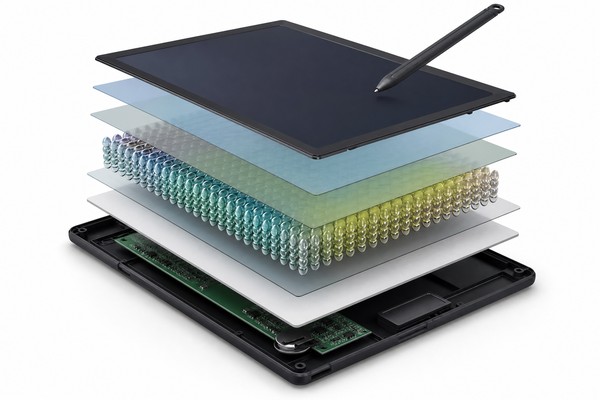
The term “LCD writing tablet” is slightly misleading for those expecting a backlit screen like a phone. In reality, these devices use a bistable cholesteric liquid crystal layer — sometimes called a “pressure-sensitive LCD” — sandwiched between two thin plastic films.
At rest, the liquid crystal molecules align in a way that reflects ambient light, making the surface appear uniformly light-colored or slightly grey-green depending on the pigment used. When the stylus applies localized pressure, it disrupts this molecular alignment in a narrow band, causing those crystals to reorient and absorb light rather than reflect it.
The result is a dark, visible line wherever pressure was applied.
Understanding this mechanism matters because it tells us immediately that the stylus tip shape, tip diameter, and applied pressure all affect line quality.
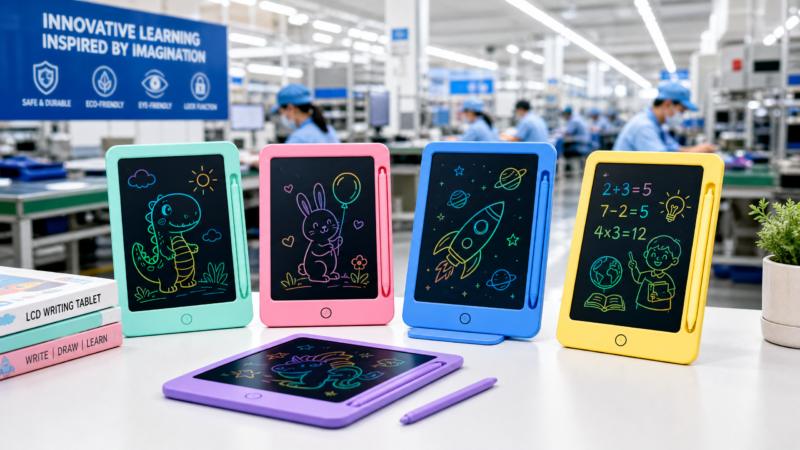
Manufacturers like GY-industries , based in Shenzhen, engineer their stylus tips to produce consistent, age-appropriate line widths across their range of LCD writing tablets — from compact 4.4-inch models designed for toddlers to large 12-inch or 15-inch drawing boards used in classrooms and professional note-taking contexts.
Stylus Design: Materials, Tip Shapes, and Size Variants
Most styluses supplied with consumer LCD writing tablets fall into one of two broad material categories: solid plastic with an integrally molded tip , or a plastic body with a separate rubber or softer-plastic tip insert . The first type is more common in budget devices and is effectively a single piece of injection-molded ABS or polystyrene plastic.
The tip is tapered to a rounded point, typically between 1.5 mm and 3 mm in diameter at the contact point, which determines the minimum line width achievable on that tablet.
The Tether Mechanism: Why It Exists and Why It Often Fails
Nearly all LCD writing tablets ship with the stylus physically attached to the tablet frame via a short cord or a plastic slot holder. This tether is designed to prevent loss — and it works, to a point. Tether cords are typically made from thin polyester or nylon string, sometimes with a small spring coil to allow extension.
Slot holders are molded into the tablet frame, usually on the right-hand side or the top edge.
—
Why Styluses Get Lost, Broken, or Worn Out Faster Than You Expect
The case for including an extra stylus in any LCD writing tablet gift is, in large part, a case built on statistics of everyday use. Parents who have given these tablets as gifts report a predictable pattern: the tablet itself lasts for months or years with minimal issues, while the stylus becomes a recurring point of failure.
Understanding why this happens helps gift-givers and product developers alike make better decisions.
Loss Rates in Household Environments
Small accessories in children’s play environments face a natural attrition that parents of young children know well. The stylus for an LCD writing tablet is, in terms of size and shape, very similar to a pencil stub or a small marker cap — both of which have historically high loss rates in households with children.
It rolls under furniture, gets picked up and carried to another room, ends up in a toy box, or simply disappears into the entropy of a busy family home.
Physical Damage Patterns: Chewing, Snapping, and Tip Degradation
Beyond loss, physical damage is the second major cause of stylus failure. Chewing is particularly common among children aged two to five, who are still in developmental stages where oral exploration of objects remains a reflexive behavior.
A stylus chewed at the tip — even briefly — can have its tip geometry altered enough to produce noticeably wider or irregular lines, or to develop sharp edges that scratch the tablet surface rather than pressing it cleanly. Chewing further up the barrel can crack the plastic, create sharp points, and make the stylus uncomfortable and unsafe to use.
The “Gift Lifespan” Problem: Gifts Need to Keep Working
There is a specific dynamic in gift scenarios that intensifies all of the above concerns. When a parent buys an LCD writing tablet for their own child, they are typically aware of the product category, know where to source a replacement stylus, and can take action relatively quickly.
When a grandparent, aunt, uncle, or family friend buys the same tablet as a gift, the post-purchase support chain is effectively broken. The gift-giver is no longer in the picture after the gift is given, and the recipient’s parent may not immediately know the tablet brand, the stylus specifications, or where to find a compatible replacement.
—
The Gift-Giving Perspective: What Parents and Buyers Should Consider
For anyone buying an LCD writing tablet as a gift — whether for a birthday, a holiday, a “first day of school” present, or a travel kit — the inclusion of an extra stylus is genuinely one of the most practical enhancements available. This section explores the consumer-facing logic in detail, including age considerations, safety factors, and the psychological dimensions of gift-giving.
Age-Specific Considerations: Matching Stylus to Child Development
The importance of an extra stylus varies somewhat by the age of the intended recipient, and so does the type of extra stylus that makes sense to include.
Safety Standards and What They Mean for Stylus Choices
Any stylus included in a gift — whether bundled by the manufacturer or added separately by the gift-giver — should meet applicable toy safety standards. In the United States, this primarily means compliance with ASTM F963 , the Standard Consumer Safety Specification for Toy Safety. In the European Union, the relevant standard is EN 71 .
Both standards address issues including physical hazards (sharp points, sharp edges), chemical safety (restricted substances in surface coatings), and for products intended for children under three, small parts regulations.
Perceived Value and the Psychology of the Complete Gift
Beyond the practical arguments, there is a psychological dimension to gift-giving that the extra stylus addresses directly. A gift that feels complete and ready to use — unboxed and immediately functional with no parts to hunt for or order separately — creates a distinctly better first impression than one that technically works but feels like it is missing something.
—
The B2B and Retail Perspective: How an Extra Stylus Affects Product Positioning and Sales
For importers, Amazon FBA sellers, toy brands, and retail buyers sourcing LCD writing tablets in bulk, the question of whether to include an extra stylus is not just about consumer satisfaction — it is a strategic product and packaging decision that affects cost structures, competitive positioning, review scores, and repeat purchase potential.
This section addresses the business logic comprehensively.
The Amazon Review Ecosystem and Accessory Complaints
For Amazon FBA sellers specifically, product reviews are a primary driver of organic ranking and conversion rate. A recurring pattern in one-star and two-star reviews for LCD writing tablets across multiple product listings centers on accessory failure — and stylus loss or breakage is consistently among the top mentioned issues.
Reviews that read “my daughter lost the stylus after two weeks and now the tablet is useless” or “the stylus snapped and there’s no replacement” are not primarily complaints about the tablet’s core technology. They are complaints about the product’s long-term usability and perceived value for money .
Cost-Benefit Analysis: What an Extra Stylus Actually Costs vs. What It Returns
The unit economics of adding an extra stylus to a product bundle are, in most cases, highly favorable.
A spare stylus at manufacturer cost — depending on size, material, and order volume — typically adds a very small increment to unit cost, often less than the cost impact of a single negative review response, a customer service interaction, or a return and replacement shipment.
Against this, the benefits include improved review scores, lower return rates, higher perceived value at point of purchase (which supports price positioning), and differentiation from competing listings that include only a single stylus.
Packaging Design and Presentation for Gift Markets
If the decision is made to include an extra stylus — whether by the manufacturer in their standard configuration or as an OEM customization — packaging design becomes important. There are several approaches used effectively in the market:
- Blister card insert: The spare stylus is displayed in a molded plastic blister attached to the inner packaging, making it visible through the box window and adding perceived value at point of purchase.
- Velcro or foam slot in the box base: The spare stylus sits in a dedicated slot alongside the tablet, which communicates organization and thoughtfulness in the product design.
- Resealable accessory pouch: A small branded pouch containing the spare stylus (and optionally a screen cloth or other accessories) can be positioned as a “travel kit” inside the main box, adding perceived premium value.
- Printed callout on box: A “Includes 2 Styluses” badge or callout on the outer packaging functions as a decision-making trigger for gift shoppers scanning shelf space or product listings quickly.
—
How to Choose, Source, and Evaluate a Quality Replacement or Bonus Stylus
Whether you are a consumer assembling a thoughtful gift package or a B2B buyer specifying product configuration with a manufacturer, understanding what makes a good stylus — and what distinguishes a high-quality spare from a low-quality one — is essential for making the right choice. This section provides practical, technically grounded guidance on both fronts.
Tip Diameter, Hardness, and Compatibility: The Technical Basics
The single most important technical parameter of an LCD writing tablet stylus is tip diameter , which determines the minimum achievable line width on the screen. Typical consumer tablet styluses range from approximately 1.5 mm (fine-tip, for precision drawing or writing practice) to 3.5 mm or wider (broad-tip, for younger children or bold illustration).
Tip diameter must be matched to the tablet’s intended use: a toddler’s scribble-and-erase toy does not need a 1.5 mm precision tip, and a handwriting practice tablet for a seven-year-old is much less useful with a 3 mm broad tip.
Evaluating Quality in
GY-industries · Factory Direct · Shenzhen
Ready to Source LCD Writing Tablets?
Get factory pricing, free samples, CE/FCC/CPC certificates, and OEM/ODM consultation. Response within 24 hours.
✓ Free samples available
✓ MOQ from 500 units
✓ CE / FCC / CPC certified
✓ 15+ years experience
References
- [1] U.S. Consumer Product Safety Commission. Toy Safety guidelines. https://www.cpsc.gov/Business–Manufacturing/Business-Education/Toy-Safety
- [2] American Academy of Pediatrics. AAP guidelines on children’s media. https://www.aap.org/en/patient-care/media-and-children/
GY-industries · Factory Direct · Shenzhen
Ready to Source LCD Writing Tablets?
Get factory pricing, free samples, CE/FCC/CPC certificates, and OEM/ODM consultation. Response within 24 hours.
✓ MOQ from 500 units
✓ CE / FCC / CPC certified
✓ 15+ years experience
References
- [1] U.S. Consumer Product Safety Commission. Toy Safety guidelines. https://www.cpsc.gov/Business–Manufacturing/Business-Education/Toy-Safety
- [2] American Academy of Pediatrics. AAP guidelines on children’s media. https://www.aap.org/en/patient-care/media-and-children/
Buyer Review Table
| Area | Buyer check | Evidence |
|---|---|---|
| Product factor | Buyer check | Evidence to request |
| Writing response | Test line clarity and pressure response | Sample review |
| Erase function | Confirm reset behavior and lock feature | Functional test |
| Durability | Review surface, stylus, and housing use case | Specification sheet |