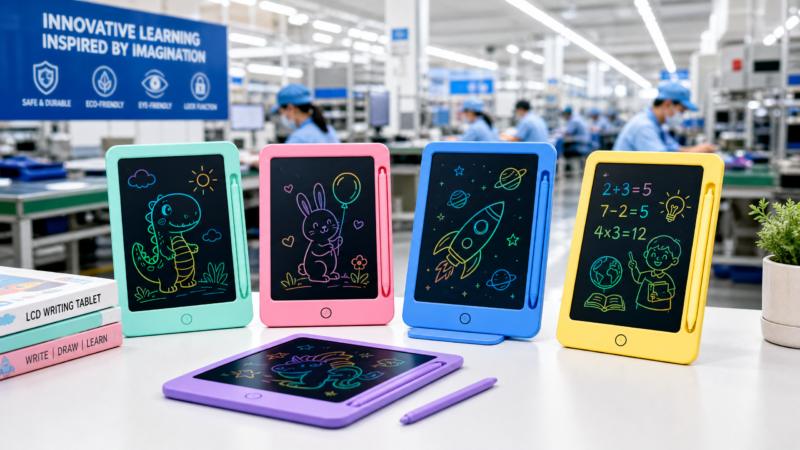
How LCD Writing Tablets Work — and Why It Matters for Siblings
Before deciding whether two children should share one device or each have their own, it helps to understand what an LCD writing tablet actually is and how it behaves under real-world, everyday use.
The technology is elegant in its simplicity, but it has specific physical properties that affect durability, usability, and suitability for different ages — all of which become more important when more than one child is involved.
The Basics of Cholesteric Liquid Crystal Technology
LCD writing tablets use a layer of cholesteric liquid crystals — sometimes called chiral nematic liquid crystals — sandwiched between two thin, flexible plastic sheets. At rest, these crystals align in a twisted, layered helix structure that reflects ambient light and appears as the tablet’s characteristic colored or dark background.
When you press down with the stylus or your fingertip, the localized pressure disrupts that alignment in the contacted area, causing the crystals in that spot to shift orientation and scatter light differently. The result is a visible, contrasting mark — your drawing or handwriting.
Why the Technology Makes Individual Ownership Appealing
One critically underappreciated aspect of LCD writing tablet technology is that the drawing surface retains its last image indefinitely until erased. Unlike a digital screen that can show multiple users’ work simultaneously or save files, an LCD tablet holds exactly one “state” at a time.
That means if one sibling draws an elaborate dinosaur scene and the second child comes along wanting to write their spelling words, someone’s work must be permanently erased. There is no undo, no save, and no split-screen. The single-state nature of the technology is a genuine physical constraint — not a feature limitation that a software update could fix.
Pressure Sensitivity and Why Younger Siblings Write Differently
LCD writing tablets are passive pressure-sensitive surfaces. The clarity and thickness of a mark depends directly on how much force is applied to the stylus or finger. Very young children — typically under age five — tend to press with inconsistent, sometimes excessive force. Older children and adults apply more controlled, lighter pressure.
This difference matters for two reasons when siblings share a device.
Age Gaps, Screen Sizes, and Matching the Right Tablet to Each Child
The single most important variable in the siblings question is the age gap between the children. A two-pack of identical tablets makes perfect sense for twins or children close in age.
But siblings separated by four or more years often have genuinely different needs, and understanding those differences helps parents make a smarter purchase — or helps B2B buyers decide whether to offer size-bundled two-packs as a distinct product variation.
Screen Size Recommendations by Age Group
LCD writing tablet screen sizes are typically measured diagonally across the active drawing area, and they generally fall into a few practical categories. Tablets with approximately 8.5-inch screens are the most common entry-level option and suit children from roughly age three upward.
The drawing area is spacious enough for a small child’s large, expansive marks but not so large that it becomes unwieldy. Tablets in the 10- to 12-inch range offer a more generous writing surface that older children and elementary-school-age kids typically prefer for homework practice, more detailed artwork, or writing longer sentences and stories.
Larger formats — 15 inches and above — are available and are often used by older children and adults who want a surface closer to a full notebook page.
Color Options and Personalization as a Practical Tool
One underrated advantage of buying a two-pack — or two separate units — for siblings is the ability to give each child a distinct color. LCD writing tablet frames and backs are typically made from ABS plastic and are available in a range of colors: pastels, primaries, and neutrals.
When siblings have matching tablets in different colors, ownership boundaries are instantly visible. There is no argument about whose tablet is whose. This may sound trivial, but in households with young children, clear physical differentiation of belongings significantly reduces low-level daily conflict.
Developmental Appropriateness: What Each Age Actually Does with the Tablet
Understanding how children at different developmental stages use an LCD writing tablet clarifies why one tablet rarely satisfies two children at different stages simultaneously.
Children aged two to four primarily use the tablet for scribbling, simple shape recognition, and cause-and-effect exploration — they press and a mark appears, they press the button and it disappears. The erase function is often as entertaining as the drawing itself at this age. The tablet functions more as a sensory-motor toy than a learning tool proper.
The Real Cost of “Just Sharing One”: Conflict, Learning Loss, and Wear
The case for buying two tablets rather than one often comes down to a simple calculation: the marginal cost of the second unit versus the ongoing costs — monetary, emotional, and educational — of forcing siblings to share. This section examines those costs honestly, because they are real, even if they are rarely discussed in product listings.
Conflict and the Hidden Parental Time Cost
Child development researchers have studied sibling conflict extensively, and while it’s beyond the scope of this article to review all of that literature, some general patterns are well established.
Conflict over shared physical resources — toys, screens, tools — is among the most common triggers of sibling disputes, particularly for children between ages two and ten. These disputes are not just emotionally draining; they interrupt whatever each child was doing, often requiring parental intervention that itself consumes time and attention.
Learning Continuity and the Value of Personal Space
For children using an LCD writing tablet as a learning tool — practicing handwriting, working through math facts, tracing letters — continuity of access matters more than parents sometimes realize.
A child who sits down to practice writing their name ten times, only to have the tablet taken midway through, does not get the same benefit as a child who completes the practice session. Educational psychologists refer to this in terms of “task completion” and its relationship to skill consolidation.
While LCD writing tablets do not save work between sessions (the surface holds only the current state), what matters for learning is the ability to work at your own pace, without interruption, for a meaningful block of time.
Physical Wear: How Sharing Accelerates Degradation
LCD writing tablets are durable products by design — a well-manufactured unit from a reputable producer can withstand many thousands of erase cycles before any degradation in display quality is noticeable. However, the number of erase cycles is not the only wear variable.
The stylus groove (the channel on the tablet’s body that holds the stylus when not in use) can loosen with repeated insertion and removal. The erase button can develop a less tactile response over time with heavy use.
The screen surface itself can accumulate fine surface scratches from repeated stylus contact, though quality tablets use a hard-coated top film to minimize this.
What to Look for in a Quality Two-Pack (Technical and Safety Checklist)
Not all two-packs are created equal. Some are simply two units of an inexpensive, poorly manufactured tablet bundled together to create an attractive price point. Others are thoughtfully designed, safety-tested products that represent genuine value. This section gives parents and B2B buyers a detailed technical and safety checklist for evaluating two-pack offerings.
Safety Certifications: What Each Mark Actually Means
For children’s products sold in major markets, safety certifications are not optional niceties — they are legal requirements and genuine indicators of product quality. Understanding what each certification means helps buyers evaluate whether a two-pack is worth purchasing.
Battery Type, Placement, and Child Safety
LCD writing tablets are powered by small batteries — typically a single CR2025 or CR2032 coin cell, or occasionally two AAA batteries depending on the design. Battery safety is a critical consideration for children’s products, particularly for households with children under three.
Coin cell batteries are a serious ingestion hazard; if swallowed, they can cause chemical burns in the esophagus within as little as two hours. Responsible tablet manufacturers address this with battery compartments that require a coin or small screwdriver to open — making them inaccessible to young children under normal play conditions.
The battery compartment cover should fit tightly and not rattle or flex when the tablet is handled normally.
Screen Film Quality, Stylus Material, and Build Specifications
The tactile experience of writing on an LCD tablet is largely determined by the quality of the protective film layer over the liquid crystal panel.
High-quality tablets use a multi-layer film construction: the outermost layer provides surface hardness to resist scratches, while inner layers provide the optical clarity needed for good contrast between drawn marks and the background.
Lower-quality tablets may use a single film layer that scratches easily and develops visible wear marks quickly — particularly relevant for a device that two children will be using.
B2B Perspective: Why Two-Packs Are a Strong SKU for Amazon Sellers and Toy Brands
For importers, Amazon FBA sellers, and toy brands sourcing LCD writing tablets from manufacturers, the two-pack format deserves serious consideration as a distinct product strategy — not just as a bundle of two individual units, but as a purpose-designed product configuration with its own value proposition, pricing logic, and marketing angle.
Two-Packs as a Differentiation Strategy on Amazon
The LCD writing tablet category on Amazon is competitive, with dozens of brands competing primarily on price at the individual-unit level. Listing differentiation is one of the primary levers available to sellers who want to escape pure price competition. A well-positioned two-pack listing addresses a specific, identifiable buyer: a parent with two children.
This buyer has a clear purchase motivation (both children should have one), a specific problem to solve (conflict, fairness, learning support), and a value calculation that is relatively straightforward (two individual units at separate prices versus the two-pack at a small discount).
When a listing’s title, bullet points, and images speak directly to this buyer’s situation, conversion rates typically improve compared to a generic single-unit listing.
Pricing, Margin, and Average Order Value
From a pure margin perspective, two-packs offer several structural advantages over single-unit sales. First, packaging costs per unit decrease when two tablets share an outer carton — the carton itself, desiccant packs, insert cards, and labeling are partially shared costs.
Second, Amazon’s FBA fees are charged per shipment and per unit, but two-packs sold as a single ASIN are processed as one unit through the fulfillment system, which can reduce per-unit fees depending on the size tier the bundled package falls into.
Third, and most importantly, average order value (AOV) is higher for a two-pack purchase — the same customer acquisition cost (whether through PPC advertising, organic search, or external traffic) yields roughly double the revenue.
Gift Occasion Positioning and Seasonal Demand
Two-packs for siblings align naturally with several high-volume gifting occasions. Christmas and holiday season purchases for households with multiple children frequently involve a desire to give each child something equivalent — parents and grandparents buying holiday gifts for two siblings are natural two-pack buyers.
Back-to-school season is another strong window, as parents equipping children for the school year often want both children to have the same learning tools. Birthday gifts for a sibling pair — particularly twins — represent a niche but high-intent segment.
Two-Pack vs. Single-Unit Purchase: Side-by-Side Comparison
| Factor | Single Unit (Shared by Two Siblings) | Two-Pack (One Per Child) |
|---|---|---|
| Conflict potential | High — one child must erase the other’s work to use the tablet | Low — each child owns and controls their surface independently |
| Learning continuity | Interrupted — children must share time and negotiate access | Uninterrupted — both children can practice simultaneously |
| Size appropriateness | Compromise — one size rarely suits both children’s developmental needs | Optimal — different sizes can be chosen for each child’s age |
| Ownership clarity | Ambiguous — frequent disputes over whose turn it is |