Navigating B2B procurement quotations for OEM and ODM electronic educational toys requires a comprehensive, highly granular understanding of what standard manufacturing costs entail across global supply chains.
When sourcing custom LCD writing tablets from Chinese manufacturing partners, brand owners, wholesalers, and procurement managers often question exactly what electronic components, raw materials, packaging options, and support services are bundled into initial price quotations.
Transparent supplier communication ensures that hidden fees do not erode downstream profitability during international wholesale distribution and retail execution.
Establishing clear expectations during early supplier discussions prevents misunderstandings regarding accessory inclusion, safety certifications, and warranty terms.
Because wholesale manufacturing agreements vary by project scale, structural complexity, and customization depth, understanding baseline inclusions helps procurement teams conduct accurate financial forecasting.
Manufacturers structure their initial proposals around baseline hardware configurations, ensuring that buyers can clearly distinguish between standard hardware accessories and advanced custom enhancements for their product lines.
Understanding Standard Quotation Inclusions and Exclusions
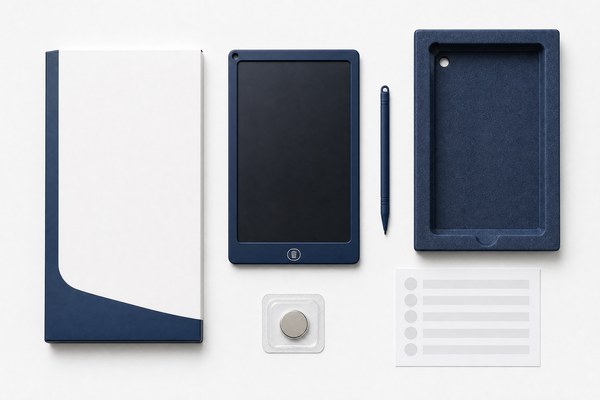
In standard manufacturing quotations for OEM LCD writing tablets, baseline unit costs typically cover the core hardware assembly, electronic components, a standard stylus, and pre-installed or included coin cell batteries necessary for basic functionality.
However, whether custom retail packaging, branded silk-screen printing, compliance documentation, or specialized accessories are included depends heavily on the agreed trade terms, order quantities, and preliminary project specifications discussed during initial negotiations with the supplier.
Procurement professionals should evaluate quotations against international commercial standards. When reviewing shipping liabilities, transit risks, and customs responsibilities, referencing official frameworks such as ICC Incoterms 2020 rules is essential to determine whether quotes reflect EXW, FOB, or CIF terms.
Each trade term shifts the financial responsibility of inland transit, export customs clearance, and ocean freight differently across international supply chains.
Key Components Evaluated in B2B Price Assessments
Because manufacturing costs fluctuate based on raw material availability, screen dimensions, writing pressure sensitivity, and casing materials, suppliers do not provide static price lists. Instead, unit costs are calculated dynamically after reviewing precise technical drawings and functional requirements.
For instance, requesting advanced features such as rechargeable internal lithium batteries, dual-sided writing surfaces, or specialized wrist strap holes requires comprehensive engineering, structural validation, and safety testing assessments before feasibility and tooling adjustments can be confirmed.
Furthermore, raw material price volatility across electronic components and ABS plastics directly influences long-term contract pricing stability. B2B buyers must account for seasonal market shifts and minimum order quantities when negotiating volume tiers.
Manufacturers evaluate order volume commitments alongside technical complexity to determine whether secondary tooling investments or specialized packaging lines are necessary to fulfill large-scale distribution requirements and retail deadlines.
In addition to raw material stability, compliance with international safety standards is a critical evaluation factor. Certifications such as CE, FCC, ASTM F963, and RoHS dictate whether specific testing reports are included in the baseline quotation or billed as separate laboratory fees. Buyers must verify these testing obligations early to avoid unexpected clearance delays at destination ports.
To assist procurement managers in comparing supplier proposals effectively, the following structured decision matrix outlines how various cost elements are categorized and negotiated during custom manufacturing projects.
| Cost Element | Standard Inclusion Status | Customization Impact | Evaluation Factor |
|---|---|---|---|
| Stylus Pen | Included (Standard ABS) | Custom molds or branded logos affect tooling costs | Ergonomics and attachment mechanism |
| Battery Source | Included (CR2032 Coin Cell) | Rechargeable cells require circuit redesign | Safety certifications and transport compliance |
| Retail Packaging | Bulk Polybag or Plain Box | Custom color boxes require minimum order quantities | Retail display and drop-test durability |
| Compliance Testing | Basic Factory QC Inspection | CE, FCC, or RoHS lab reports incur testing fees | Target market regulatory mandates |
Evaluating Landed Cost and Distributor Profit Margins
When calculating retail profitability and wholesale margins, distributors must look beyond the initial factory FOB quotation. Total landed cost incorporates ocean freight, import tariffs, local warehousing, channel distribution expenses, and potential return allowances.
Rather than relying on fixed percentage assumptions, buyers construct robust financial models by assessing competitive retail positioning, logistics overheads, and marketing investments against comprehensive supply chain expenses.
Exploring existing manufacturing capabilities and standard device configurations can streamline initial technical alignment. You can review available models and specifications directly within our LCD writing tablet product catalog before defining your custom project parameters.
LCD Writing Tablet Buyer Checklist: Included In The Quoted Price (Packaging, Stylus, Battery)
Securing an Accurate and Comprehensive Quotation
Docorating dependable, comparable pricing from experienced manufacturers requires clear communication of project parameters. Vague inquiries often result in generalized estimates that lack necessary compliance or packaging details.
Providing structured project briefs ensures that engineering, material sourcing, and logistics teams can deliver transparent, actionable proposals without hidden discrepancies or unexpected supply chain delays.
To receive an actionable quotation or customized assessment for your upcoming educational toy product line, please contact our OEM/ODM team with your expected order quantity, target market, product specifications, brand and packaging requirements, and project timeline.
For independent background guidance, buyers can consult ISO quality-management guidance and confirm the requirements that apply to their exact product and market.