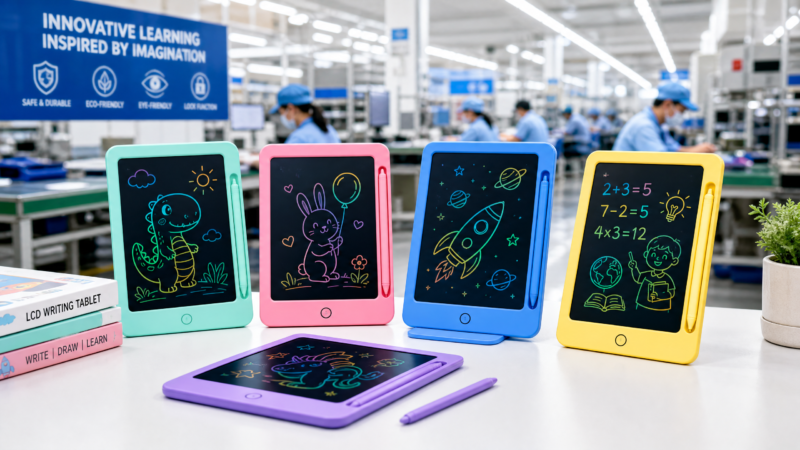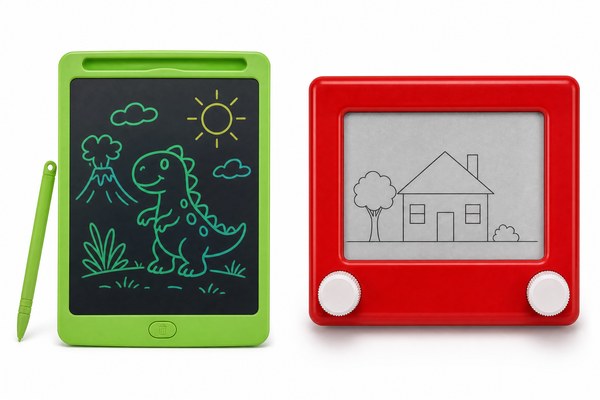
You pick up a drawing toy. You shake it, and your art disappears. But wait — is that the same as an LCD writing tablet? Many people get confused between the two.
An LCD writing tablet uses pressure-sensitive liquid crystal technology to capture lines. An Etch A Sketch uses aluminum powder and a stylus to draw. They look similar but work in completely different ways.
I have seen this question come up again and again. People walk into toy stores or browse online. They see a flat screen with a stylus. They think, “Is this just a fancy Etch A Sketch?” It is a fair question. Both are screen-based drawing tools. Both erase cleanly. But the technology inside, the use cases, and the long-term value are very different. Let me break it all down for you right now.
How Each Device Actually Works Inside
You want to know what is really going on inside these two tools. Understanding the technology helps you make a smarter choice for your home, school, or business.
An Etch A Sketch uses two knobs to move a stylus through aluminum powder on glass. An LCD writing tablet uses a liquid crystal layer that reacts to pressure, changing how it reflects light to show your lines.
I remember the first time I opened up an old Etch A Sketch as a kid. There was aluminum powder everywhere. It was messy and surprising. The drawing was made by scraping that powder off the back of the glass. When you shake it, the powder falls back and covers everything again. It is a clever old trick. But at GY-industries, I work with a completely different kind of technology every day. Our LCD writing tablets have a liquid crystal layer sealed inside a panel. When you press with a stylus, the crystals align and block light. That is what creates the dark line you see. No powder. No mess. No moving parts. It is clean, quiet, and incredibly simple to manufacture at scale in our Shenzhen factory.
Technology Comparison: LCD Writing Tablet vs Etch A Sketch
| Feature | LCD Writing Tablet | Etch A Sketch |
|---|---|---|
| Core Technology | Liquid crystal panel | Aluminum powder on glass |
| Drawing Tool | Stylus or any pointed object | Two rotary knobs |
| Erase Method | Press a button | Shake the device |
| Internal Parts | Sealed LCD panel, battery | Powder, glass, string, pulleys |
What You Can Actually Do With Each One
You want a tool that fits your real life. Knowing what each device lets you do — and what it cannot do — saves you time and money.
An Etch A Sketch is limited to lines made by two knobs. An LCD writing tablet lets you draw freely, write notes, sketch anything, and even save your work on some models. It is far more flexible.
I have watched kids in product testing sessions try to draw a circle on an Etch A Sketch. It takes real skill. You have to turn both knobs at the same time in just the right way. Most kids get frustrated quickly. Now I watch those same kids pick up one of our GY-industries LCD writing tablets. They draw circles, letters, faces, and doodles in seconds. Teachers use our tablets to write lesson reminders. Office workers use them as desktop notepads. Parents use them to keep kids busy on long trips. Our tablets come in sizes from small pocket versions to large desk-sized panels. The use cases are genuinely wide. An Etch A Sketch has one use case. It is a drawing toy. Full stop. You can learn more about our full range of services at GY-industries service page.
Use Case Comparison
| Use Case | LCD Writing Tablet | Etch A Sketch |
|---|---|---|
| Freehand Drawing | Yes, easy and natural | Very limited, knob-controlled only |
| Writing Notes | Yes, very common use | No, impractical |
| Kids’ Creative Play | Yes, all ages | Yes, mainly older kids |
| Office or School Use | Yes, widely used | No |
Safety, Durability, and Long-Term Value
You are buying something for a child or for daily use. You need it to be safe, tough, and worth the price over time.
LCD writing tablets are sealed, powder-free, and certified safe. Etch A Sketch devices contain fine aluminum powder that can spill if broken. For long-term daily use, LCD tablets offer better durability and safety credentials.
I have seen what happens when an Etch A Sketch breaks. The aluminum powder spills out. It is not toxic in small amounts, but it is definitely not something you want a toddler breathing in or touching. That is a real concern for parents. At GY-industries, every LCD writing tablet we produce goes through strict safety testing. Our products carry CE, RoHS, and CPC certifications. These are not just stickers. They mean our tablets have been independently tested for chemical safety, electrical safety, and child safety standards. Our Shenzhen factory follows tight quality control at every production step. I have walked that factory floor myself. The sealed LCD panel means there are no loose materials inside. Nothing can spill. Nothing can leak. For retailers and OEM buyers, this also matters enormously. According to the U.S. Consumer Product Safety Commission, children’s products sold in the U.S. must meet strict safety standards. Our CPC certification covers exactly that.
Safety and Durability Comparison
| Factor | LCD Writing Tablet | Etch A Sketch |
|---|---|---|
| Internal Materials | Sealed LCD, no loose powder | Aluminum powder inside glass |
| Safety Certifications | CE, RoHS, CPC available | Standard toy certifications |
| Durability | High — no moving mechanical parts | Medium — knobs and pulleys can break |
| Long-Term Value | Multi-use, daily writing tool | Single-purpose novelty toy |
Conclusion
LCD writing tablets and Etch A Sketch toys are very different tools. One is modern, flexible, and certified safe. The other is a beloved classic toy with real limits. If you are sourcing LCD writing tablets for retail or OEM projects, I invite you to contact GY-industries today.