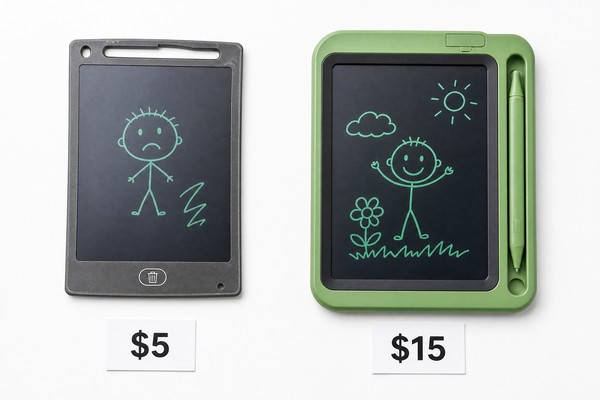
I see this question every week. Buyers pick the cheaper tablet and regret it. Or they overpay and wonder why. The price gap between a $5 and a $15 LCD writing tablet is real. But most people look in the wrong place to explain it. I will show you exactly where the difference lives.
I have been inside factories that make both. I have held the boards, read the spec sheets, and watched the QC lines. What I found surprised me. The gap is not always where you think. Keep reading, because this changes how you buy.
Is the price gap about materials — or marketing?
You assume the cheap one cuts corners on materials. Sometimes that is true. But I have seen expensive tablets with the same LCD film as the budget ones.
The real difference often comes down to QC process and material grade, not the brand name on the box. A factory running tighter inspections and better-grade film will charge more. One skipping those steps will not. The price reflects the process, not just the part.
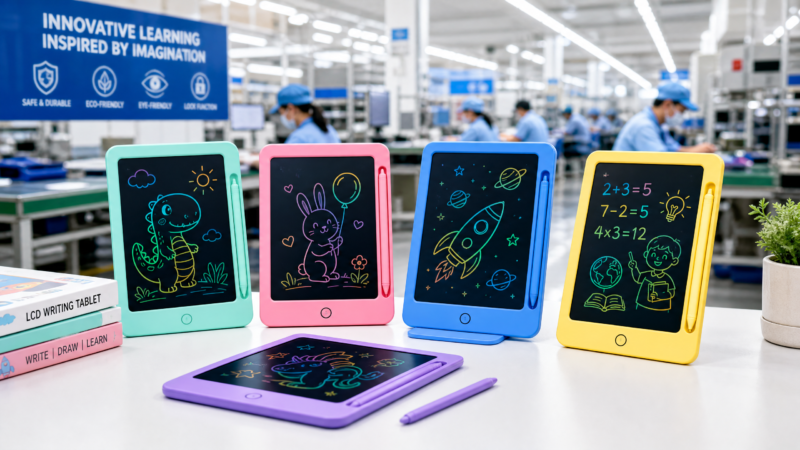
I visited a factory in Shenzhen two years ago. They made tablets at both price points. Same building. Same workers. The $5 line had no pressure-sensitivity testing. Boards moved fast. The $15 line had a dedicated station. Each board got tested before assembly. The LCD film on the higher line also came from a different supplier. Thicker. More consistent color. I picked up both finished units. They looked identical from the outside. But the writing feel was completely different. That moment stuck with me. I stopped judging tablets by the casing alone.
Material and Process Differences by Price Tier
| Feature | $5 Tablet | $10 Tablet | $15 Tablet |
|---|---|---|---|
| LCD Film Grade | Standard, ungraded | Mid-grade, basic check | Graded, consistent thickness |
| QC Stations | None or minimal | 1 final check | 2–3 dedicated stations |
| Pressure Test | Skipped | Spot check only | Every unit tested |
| Button Durability | Basic plastic | Reinforced plastic | High-cycle rated components |
| Defect Rate | 5–10% | 2–4% | Under 1% |
Does a higher price mean better safety certifications?
You worry about selling a product that fails a safety check. One recall can kill your listing. But not every expensive tablet has real certifications.
A higher price does not automatically mean better certifications. I have reviewed supplier documents where cheap tablets had valid CE and RoHS paperwork, and pricier ones had outdated or fake certificates. You must ask for the actual test reports, not just the logo on the box.
I once sourced a batch for a client. The supplier charged a premium price. They sent a nice-looking CE certificate. I asked for the lab report behind it. They stalled for three days. Then they sent a report from a lab I could not verify. I walked away. I found a mid-tier supplier at $11 per unit. They had a full SGS report. Current. Traceable. The client’s Amazon account stayed clean. That experience taught me to separate price from proof. A logo means nothing without the document behind it.
Certification Checklist by Price Range
| Certification | $5 Tier Typical Status | $15 Tier Typical Status | What to Request |
|---|---|---|---|
| CE Marking | Often self-declared | Usually third-party tested | Full technical file |
| RoHS | Logo present, report missing | Lab report available | SGS or Bureau Veritas report |
| ASTM F963 (toys/kids) | Rarely done | Sometimes available | Ask if sold for children |
| Battery Safety (CB/UL) | Usually absent | Present on good suppliers | Cell-level test report |
Which price point actually makes sense for your business?
You want the best margin without risking returns or account suspensions. But picking the wrong price tier costs more in the long run.
The right price point depends on your sales channel, your customer, and your return tolerance. I have seen sellers profit well at $8 landed cost. I have also seen $5 tablets destroy a seller’s review score in 60 days. Match the tier to your risk level, not just your budget.
I work with a seller who runs a private label brand on Amazon. He started with $5 tablets to test the market. Returns hit 12% in the first month. Customers complained about lines on the screen and sticky buttons. He switched to a $12 factory unit. Returns dropped to under 2%. His ranking improved. His reorder rate went up. His total cost per unit sold actually went down when he factored in return shipping and refund processing. I use his numbers when I talk to new clients. The cheapest unit is rarely the cheapest solution.
Business Model vs. Recommended Price Tier
| Business Model | Suggested Tier | Key Reason | Risk if You Go Lower |
|---|---|---|---|
| Amazon Private Label | $10–$15 | Review score depends on quality | High returns, ranking drop |
| Wholesale / Retail | $7–$12 | Volume offsets cost | Chargebacks from buyers |
| Kids Educational Market | $10–$15 | Safety certs are essential | Legal and listing risk |
| Promotional / Giveaway | $5–$8 | Short-use product acceptable | Brand perception damage |
| B2B Bulk Orders | $8–$12 | Buyers expect consistency | Repeat order loss |
Conclusion
Price tells you almost nothing on its own. I look at the QC process and the material grade. Those two things explain every gap I have ever seen.