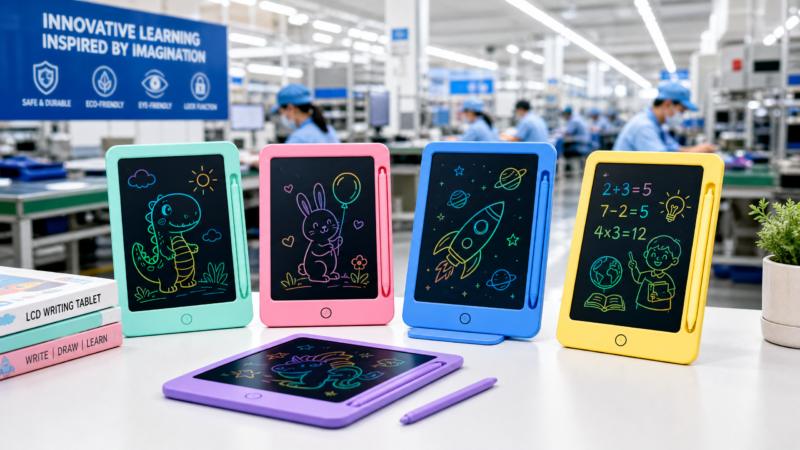
Answer first: Before choosing an lcd writing tablet manufacturer, request a controlled product data sheet, a physical reference sample, a sample-to-production approval record, written change-control rules, and batch-level production records. Compare what the manufacturer can document, not only a catalog image or unit price. For every unverified option, including MOQ, lead time, certification, battery arrangement, interface, compatibility, OID, audio, and service details, require confirmation in quotation and approved pre-production sample.
Who should use this manufacturer qualification checklist?
This guide is for importers, distributors, private-label brand owners, educational suppliers, promotional-product buyers, and quality teams evaluating an LCD writing tablet program. It is especially useful when the buyer will sell the same product through several channels or repeat an order after an initial launch.
A manufacturer is more than the party that sends a product photograph. For a buyer, the manufacturer must connect the product brief to a reproducible sample, an approved production version, a controlled change process, and records that help explain what happened in a particular batch. That evidence is the practical basis for a defensible buying decision.
GY Industries presents LCD writing tablets for wholesale, retail, educational, travel, gift, and OEM/ODM programs. Its wholesale page advises buyers to define the target channel, product reference, estimated quantity, packaging direction, destination market, and sample requirements before requesting a quotation. You can review the wholesale LCD writing tablet range as a starting point, then ask for project-specific confirmation.
What should a buyer request from an LCD writing tablet manufacturer?
Ask for five evidence packages before selecting a supplier: a product identity and data pack, a physical sample set, an approval and change-control record, a batch-record plan, and a quotation that clearly separates confirmed facts from open items. The request should be written so that two manufacturers answer the same questions in the same order.
1. Request a controlled product data pack
Start with a single reference document that identifies the exact product under discussion. It should include the supplier’s product name, internal reference or model identifier, revision date, product photographs, dimensions, weight, colors, included accessories, retail package, carton arrangement, and intended use description. Ask the supplier to mark each field as confirmed, selectable, or pending approval.
For the 12.8-inch LCD writing tablet shown on GY Industries’ product page, the listed product size is 285 × 195 × 7 mm, the listed colors are pink, light blue, and black, the listed product weight is 342 g, and the listed carton quantity is 50 pieces. The page also lists a CR2032 button battery, a 300 × 220 × 10 mm retail box, and a 550 × 315 × 245 mm outer carton. Treat these as page-listed reference information, then reconcile them with the quotation and physical sample before issuing a purchase order.
Request the same information for the exact color mix, packaging version, accessory presentation, and destination market. If a field is absent or differs between documents, do not silently choose the more favorable version. Record it as open and require the phrase “to be confirmed in quotation and approved pre-production sample.”
2. Request a sample set, not only one photograph
A single sample can show appearance, but it may not show consistency. Ask for a standard sample, a branded or customized sample when applicable, and a packaging sample when retail presentation affects the buying decision. Keep an inspection record for each sample, including the date received, supplier reference, color, accessory set, package version, and photographs taken by the buyer.
For an institutional or distributor program, compare more than one physical unit where practical. Look for consistent dimensions, surface appearance, writing and erase behavior, stylus fit, button or control response if present, battery access, printed information, labels, and package contents. Do not convert a visual impression into a guaranteed performance claim. The acceptance criteria should be agreed in writing for the selected configuration.
The relevant product page describes the 12.8-inch model as a larger reusable writing tablet for handwriting practice, drawing, education, travel activities, and wholesale programs. It also shows a slim tablet with an integrated side ruler detail and a matching stylus. These descriptions can guide sample inspection; they do not replace the buyer’s approved sample record.
3. Request the sample-to-production approval path
Ask the manufacturer to explain exactly what happens after sample approval. Who signs the approval? Which files become the controlled production references? How are color, logo placement, artwork, instruction language, accessories, battery arrangement, and carton quantity locked? What happens if the factory discovers that a component, package, or process must change?
The approval record should identify the approved sample or sample photographs, the product data revision, artwork revision, packaging revision, inspection points, and any exceptions. It should also state that production cannot begin against an obsolete file. If a buyer’s internal team approves artwork but not the physical product, keep those approvals separate.
This distinction matters because a product can look correct while the packaging, label, instruction language, or accessory presentation is wrong. A manufacturer qualification review should therefore ask for evidence that product approval and packaging approval are connected but separately traceable.
4. Request written change-control rules
Change control is the difference between “the sample looked right” and “the delivered batch can be evaluated against a known baseline.” Ask the manufacturer to notify the buyer before changes to materials, dimensions, color, battery arrangement, stylus, artwork, packaging, carton quantity, labels, or production location. The notification should identify the reason, affected revision, risk, timing, and whether a new sample is required.
Do not assume that a supplier’s routine substitution is harmless. A change in a small accessory can affect the retail box fit, a change in packaging can affect carton loading, and a change in printed instructions can affect market readiness. The buyer should define which changes require written approval and which require a new pre-production sample.
ISO describes the ISO 9000 family as addressing quality management and helping organizations consistently meet customer expectations. That principle is useful here: ask the manufacturer to show how controlled information and process decisions are handled in the actual project, rather than relying on a general quality statement. The presence or absence of an ISO certificate for a particular factory is to be confirmed in quotation and approved pre-production sample and should never be assumed.
5. Request a batch-record plan
Before placing a repeatable order, ask what records will identify the batch. A useful batch record may include the order or purchase-order reference, production dates, product and packaging revisions, color mix, quantity produced, inspection results, rejected or reworked quantity, carton count, and release approval. The exact record format is to be confirmed in quotation and approved pre-production sample.
Ask whether the manufacturer can link cartons or production lots to the inspection result. If the product uses a battery, request confirmation of the battery specification, installation arrangement, packaging treatment, and any destination-market requirements for the selected configuration. Do not assume battery life, shipping status, replacement policy, or safety documentation from the product category alone.
For a distributor, batch records support repeat orders and customer-service investigations. For a brand, they support version control. For an institutional buyer, they help establish what was actually delivered. The purpose is not to demand an elaborate system that the project does not need; it is to make the minimum evidence explicit before the first order.
How should buyers compare manufacturer evidence?
Use a comparison that separates a standard product from a private-label or fully customized program. The table below does not assign prices, MOQ, or lead times because those depend on the selected model, quantity, customization, destination, and approval status.
| Evidence area | Standard program | Private-label or semi-custom | Fully customized project |
|---|---|---|---|
| Product data | Request the current catalog or product data sheet and confirm the exact model. | Add color, logo, accessory, instruction, and packaging selections. | Require a project specification with revision ownership and approval gates. |
| Samples | Inspect a standard physical sample. | Approve product, logo, and packaging samples as applicable. | Approve development, pre-production, and final reference samples. |
| Change control | Confirm how routine component or package changes are communicated. | Require notice and approval for artwork, color, accessory, and label changes. | Define formal change requests, risk review, re-sampling, and sign-off. |
| Batch records | Request quantity, carton, revision, and release information. | Add color mix, packaging revision, and artwork reference. | Add full traceability expectations and agreed inspection records. |
| Commercial open items | MOQ, price, lead time, battery, certification, interface, compatibility, OID, audio, and service details are to be confirmed in quotation and approved pre-production sample. | Confirm the same items plus customization charges and packaging assumptions. | Confirm development scope, approval timing, ownership, and all project-specific terms in writing. |
This comparison prevents a common mistake: treating a standard product page as if it were a complete private-label manufacturing agreement. A capable response should tell you what is already defined, what can be selected, and what still requires an engineering, compliance, commercial, or sample decision.
Buyer checklist: questions to copy into an RFQ
Send a checklist that requests evidence and a clear answer format. The following questions can be copied into an RFQ for an LCD writing tablet program.
- What is the exact product reference, revision date, and current product data sheet?
- Which dimensions, weight, colors, materials, controls, accessories, and package contents are confirmed for the selected model?
- For the 12.8-inch model, can you reconcile the page-listed 285 × 195 × 7 mm size, 342 g weight, CR2032 battery, retail box, outer carton, and 50-piece carton quantity with the quotation and sample?
- Which items are standard, which are selectable, and which require development or approval?
- What sample types are available: standard, branded, packaging, or pre-production?
- How will the approved sample be identified and stored as the production reference?
- What inspection points will be checked before release, and which results will be supplied to the buyer?
- How will you notify us about changes to the product, battery, stylus, artwork, packaging, label, carton, process, or production location?
- Which changes require written buyer approval or a new pre-production sample?
- Can each batch be linked to an order reference, product revision, packaging revision, quantity, inspection result, and release decision?
- What are the MOQ, unit price, tooling or development charges, sample charges, and payment terms for this exact configuration?
- What is the lead time from approved sample, approved artwork, and confirmed order, and what assumptions affect it?
- What certificate and test-document set applies to the selected configuration and destination market?
- What battery arrangement, shipping treatment, replacement process, and service support apply?
- Are interface, software, compatibility, OID, audio, or connectivity features part of this model? If not verified, state “to be confirmed in quotation and approved pre-production sample.”
- What destination-market labels, warnings, instructions, barcode fields, and carton marks must the buyer provide?
- What information should be included in a repeat-order review before production starts again?
A manufacturer does not need to answer every question with a long document. It does need to identify the owner of each answer and distinguish a confirmed fact from an assumption. A concise “not applicable” is more useful than a vague promise.
Project risks that a qualification review should expose
Specification drift
Specification drift occurs when a product page, quotation, sample, artwork file, and purchase order describe slightly different products. Prevent it with one controlled specification and a revision number on every approval. If the buyer changes a color or package after approval, issue a new revision instead of editing an old file informally.
Sample inconsistency
One sample may be unusually well prepared or may represent an earlier version. Compare the sample against the data sheet and record observable acceptance points. If the project is important to a regulated or institutional channel, consider requesting multiple units and an agreed inspection method. The quantity and inspection level are to be confirmed in quotation and approved pre-production sample.
Packaging and content mismatch
Private-label programs often fail at the handoff between product and printed materials. The device can be acceptable while the retail box has the wrong language, barcode, warning, color, or accessory image. Keep product, artwork, instruction, label, and carton approvals in the same project record. Destination-market compliance is the buyer’s responsibility to review with the appropriate authorities and testing partners.
Uncontrolled substitutions
A component or package substitution can affect fit, appearance, function, shipping, or documentation. Your RFQ should require advance notice and define whether the substitution needs a new sample. If the supplier cannot explain how it records substitutions, treat that as a qualification gap rather than a minor administrative issue.
Weak repeat-order evidence
A first order can pass a visual check while a repeat order exposes a version problem. Before reordering, compare the new quotation with the last approved data sheet, sample, artwork, packaging, and batch record. Confirm whether any change occurred since the previous release. A repeat-order process should be agreed in quotation and approved pre-production sample, not assumed from the first shipment.
What should be confirmed for the 12.8-inch model?
GY Industries’ product page identifies the item as a 12.8-inch LCD writing tablet and lists pink, light blue, and black color options. It describes uses including handwriting practice, drawing, education, travel activities, and wholesale or private-label collections. The page also identifies a matching stylus and discusses possible conversations around housing color, logo placement, retail-box artwork, instruction language, battery arrangement, and carton quantity.
For institutional review, ask the manufacturer to provide the exact physical sample and the exact document set for your market. The product page’s listed battery, dimensions, packaging, carton quantity, compliance references, and stated 1–7 day lead-time range should be reconciled with the selected quantity, customization, destination, and approval status. Certification documents, MOQ, final price, final lead time, interface, compatibility, OID, audio, and service details are to be confirmed in quotation and approved pre-production sample.
If the larger writing area is relevant to your channel, you can review the 12.8-inch LCD writing tablet for institutional review. Use the page as a reference point, not as a substitute for a signed project specification.
FAQ for buyers qualifying a manufacturer
What is the first document to request from an LCD writing tablet manufacturer?
Request a controlled product data sheet that identifies the exact model, revision, dimensions, colors, accessories, package, carton arrangement, and open items. Ask the supplier to reconcile it with the quotation and physical sample.
Is a catalog photograph enough to approve a supplier?
No. A photograph cannot verify sample consistency, packaging, artwork, accessory contents, battery arrangement, or batch records. Request physical samples and written approval criteria before selecting the production version.
Should a buyer request batch records for a small order?
Ask for a proportionate record even when the order is small. At minimum, identify the order, product revision, packaging revision, quantity, inspection result, and release decision. The final record format is to be confirmed in quotation and approved pre-production sample.
What changes should trigger a new sample?
Changes to dimensions, materials, color, battery arrangement, stylus, controls, artwork, labels, instructions, packaging, carton quantity, or production location may affect approval. Define the trigger with the manufacturer; the applicable rule is to be confirmed in quotation and approved pre-production sample.
How should a buyer treat certificates listed on a product page?
Treat them as references to investigate, not as automatic proof for your order. Request the exact certificate and test-document set for the selected configuration and destination market. Certification status is to be confirmed in quotation and approved pre-production sample.
Can a buyer assume the listed battery will be used in every order?
No. The product page lists a CR2032 button battery for the 12.8-inch model, but the installed battery, packaging arrangement, shipping treatment, and destination requirements should be confirmed in quotation and approved pre-production sample.
How should MOQ and lead time be evaluated?
Evaluate them against the exact model, color mix, packaging, customization, quantity, destination, and approval stage. MOQ, price, and lead time are to be confirmed in quotation and approved pre-production sample rather than inferred from a general product page.
What does a good manufacturer response look like?
It answers each question with a document, sample, responsible owner, or explicit open item. It explains approval gates and changes, identifies batch evidence, and avoids presenting unverified interface, compatibility, OID, audio, certification, or service details as finished facts.
Request a quotation with an approval-ready brief
When contacting GY Industries, include the product reference, target market, sales channel, estimated quantity, color mix, logo or artwork needs, retail packaging, instruction language, barcode or label requirements, accessory expectations, sample types, and desired batch documentation. Ask the team to separate confirmed product facts from quotation-dependent items and to identify the pre-production sample that will control mass production.
Request a Quote for your LCD writing tablet project and include the checklist above. The final configuration, MOQ, price, lead time, certification, battery, interface, compatibility, OID, audio, and service details are to be confirmed in quotation and approved pre-production sample.
Sources
- ISO: ISO 9000 family and quality management — used for the general quality-management principle of consistently meeting customer expectations.
- GY Industries wholesale LCD writing tablets — current public landing-page boundaries for buyer process and use cases.
- GY Industries 12.8-inch LCD writing tablet — current public product-page reference for listed product information.