Understanding the Seller–Buyer Relationship for LCD Writing Tablets
Why LCD Writing Tablets Create Unique Support Scenarios
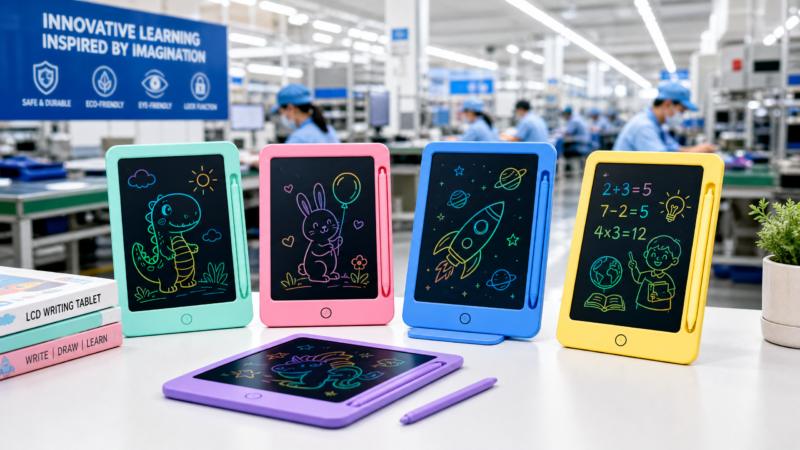
LCD writing tablets occupy an interesting middle ground in the consumer electronics world.
They are simple enough to hand to a two-year-old without instruction, yet they involve genuine technology — pressure-sensitive cholesteric liquid crystal layers, thin-film electrode assemblies, and erase circuits powered by button cell batteries — that can malfunction in ways unfamiliar to the average buyer.
Unlike a broken pencil or a torn notebook, a malfunctioning LCD tablet is not obviously fixable at home. The buyer’s instinct is often to throw it away or to leave a frustrated review, when in many cases a brief conversation with the seller would reveal that the solution is trivially simple.
This is one reason why manufacturers like GY-industries , a Shenzhen-based LCD writing tablet manufacturer, invest in responsive customer support alongside their production capabilities.
A product that generates after-sale confusion — even if the underlying technology is working exactly as designed — costs far more in returns and reputation damage than the investment required to answer customer questions clearly and promptly.
The Difference Between the Manufacturer, the Brand, and the Retailer
For LCD writing tablets in particular, the supply chain often involves three distinct parties: the manufacturer (the factory that makes the physical product), the brand (the company whose name appears on the box), and the retailer (Amazon, Walmart, a toy shop, or a direct-to-consumer website). In many cases, the brand and the retailer are the same entity.
In the children’s toy market, a large proportion of the brands you see on Amazon are actually OEM or ODM customers of contract manufacturers — meaning the factory designed the core product and the brand customized it.
Setting Realistic Expectations for Response Times
Response time expectations vary dramatically by context. A consumer contacting an Amazon seller should typically receive an acknowledgment within 24–48 hours under Amazon’s messaging guidelines.
A B2B buyer contacting a factory in Shenzhen should account for the time zone difference (UTC+8), Chinese public holidays — most notably the Chinese New Year (Lunar New Year), which can result in factory closures of two to four weeks — and the fact that technical or commercial queries may require internal consultation before a meaningful answer is possible.
Pre-Purchase: Questions Worth Asking Before You Commit
Consumer Pre-Purchase Questions: What Parents Should Clarify
Many parents make the mistake of assuming that all LCD writing tablets are essentially the same product in different colors. In reality, there is meaningful variation across key dimensions that affect both safety and usability — and these are dimensions worth asking about before spending money on a product that may not suit your child’s age, needs, or environment.
B2B Pre-Purchase Questions: What Importers and Brand Owners Must Ask
For business buyers, the pre-purchase phase is arguably the most important stage of the entire seller relationship. Decisions made before a purchase order is signed determine the product’s compliance with destination-market regulations, its fit with your brand identity, and your ability to achieve your target retail price.
Asking the right questions early prevents expensive surprises after tooling costs have been incurred or containers have cleared customs.
The most critical pre-purchase questions for B2B buyers include:
- Certifications and compliance: What certifications does the product currently hold (CE, FCC, ASTM F963, EN71, CPC, RoHS)? Can you provide test reports and a Children’s Product Certificate (CPC) if required for the US market?
- Customization scope: What can be customized — screen size, housing color, stylus design, logo placement, packaging, language on instructions? What are the minimum order quantities (MOQs) for customized variants?
- Lead times: What is the production lead time for a first-time order? For repeat orders? How does this change around Chinese New Year or other major holidays?
- Quality assurance: What is the factory’s defect rate? What inspection procedures are in place? Will you accept third-party quality inspection (e.g., by SGS or Bureau Veritas) at the factory before shipment?
- Tooling and intellectual property: If I commission a custom mold, who owns the tooling? Can the factory sell the same design to other buyers?
Questions to Ask When Comparing Multiple Sellers or Suppliers
Whether you are a consumer comparing two Amazon listings or a business buyer evaluating three factories on Alibaba, asking the same set of questions across all candidates is the most efficient way to identify which seller will serve you best over the long term.
For consumers, this might mean sending a message asking about return policy, battery replacement procedure, and warranty terms before clicking “buy.” For B2B buyers, a structured Request for Quotation (RFQ) that specifies your exact requirements — screen size, housing color options, certifications needed, target FOB price, annual volume — allows you to
compare responses on the same basis.
Post-Purchase Consumer Issues: When Parents and Gift-Buyers Should Reach Out
Contacting the Seller Immediately After Delivery
The moment your LCD writing tablet arrives, there is a brief window in which contacting the seller about any observed issue is both easiest and most productive. Inspect the product as soon as it is unboxed.
Look for physical damage to the screen, cracks in the housing, a stylus that is missing or visibly defective, and packaging that is inconsistent with what was shown in the product listing. If you notice any of these problems, contact the seller within 24–48 hours of delivery and document everything with clear photographs.
Warranty Claims and Defective Products
LCD writing tablets sold through reputable channels typically carry a limited warranty — commonly between 30 days and one year, depending on the seller’s policy.
The warranty generally covers manufacturing defects: a stylus that fails to write, an erase button that stops functioning due to a failed internal switch, a screen that develops dead zones without physical damage, or a battery compartment that does not make reliable electrical contact.
When to Push for a Refund vs. a Replacement
Whether to request a refund or a replacement depends on several factors: the nature of the defect, how long you have had the product, and how urgently you need a working tablet.
In general, if the product arrived damaged or develops a clear defect within the first few weeks of normal use, requesting a replacement is reasonable — it allows the seller to maintain the sale relationship while making you whole.
If the product has failed repeatedly, if the replacement arrives with the same defect, or if the product simply does not perform as advertised in ways that a replacement would not fix, a refund is the appropriate request.
Technical Problems Specific to LCD Writing Tablets — and How the Seller Can Help
How LCD Writing Tablets Actually Work — and Why This Matters for Support
Understanding the basic technology behind an LCD writing tablet helps you communicate more effectively with sellers and helps you distinguish between a genuine defect and a misunderstanding of how the product is designed to behave.
LCD writing tablets — more precisely described as pressure-sensitive cholesteric liquid crystal display tablets — work through a mechanism that is fundamentally different from conventional LCD screens used in smartphones or televisions.
Specific Technical Issues That Warrant Contacting the Seller
The following are the most common technical issues LCD writing tablet users encounter, along with guidance on when they represent genuine defects worth reporting:
- Erase button not working: First, check the battery. LCD writing tablets typically use a CR2016 or CR2025 button cell battery. If a new battery does not resolve the issue, contact the seller — this likely indicates a failed internal switch or a broken connection in the erase circuit.
- Partial erasure / ghost images: A faint residual image after erasing can occur if the battery is nearly depleted or if the screen has been under pressure for an extended period. Replace the battery first. If the problem persists with a fresh battery, it may be a manufacturing defect in the liquid crystal layer — contact the seller.
- Writing that is too light or uneven: The pressure-sensitivity of the writing surface is determined by the thickness and composition of the liquid crystal layer. Writing that is consistently faint or absent in certain areas, without physical damage to the surface, may indicate a manufacturing inconsistency. Contact the seller with photographs.
- Stylus tip damage: The stylus tip — typically a smooth, rounded point — should not scratch or indent the writing surface under normal use. If the surface shows permanent indentation marks from the stylus, this may indicate a surface hardness issue. Contact the seller.
- Screen lock malfunction: Many LCD writing tablets include a screen lock switch that prevents accidental erasure. If this switch fails to engage, it is a functional defect. Contact the seller.
Safety-Related Issues: When to Contact the Seller Immediately
There is one category of issue that requires immediate contact with the seller regardless of how minor it might appear at first: safety. For LCD writing tablets intended for children, the following situations warrant urgent outreach:
- Battery compartment that can be opened without a tool: Toys intended for children under three years of age are required by multiple international standards (including ASTM F963 and EN71) to have battery compartments secured with a screwdriver-required fastener. If you receive a product marketed for young children with an easily accessible battery compartment, this is a compliance failure. Contact the seller and, if the product is sold on a major platform, consider reporting it to the platform as well.
- Stylus that breaks and creates sharp edges: If the stylus fractures under normal use and creates a sharp point, this is a physical hazard for children and a potential compliance failure. Report immediately.
- Screen surface delamination or cracking that exposes internal materials: The cholesteric liquid crystal material itself is generally considered non-hazardous, but any situation in which a child could access internal components is a safety concern. Contact the seller immediately.
- Unusual smell or heat from the device: Although LCD writing tablets do not contain rechargeable lithium batteries and do not generate meaningful heat under normal operation, any burning smell or warmth from the device should prompt immediate cessation of use and contact with the seller.
B2B Buyer Scenarios: When Importers, Amazon Sellers, and Toy Brands Must Contact the Manufacturer
Before and During Order Placement
For B2B buyers, the decision of when to contact the manufacturer is governed by a different logic than consumer purchasing. Every phase of the B2B relationship has moments at which proactive communication prevents expensive downstream problems. The pre-order phase has already been discussed; equally important is the period between order placement and production completion.
Once a purchase order has been signed with a manufacturer like GY-industries, contact the factory at the following milestones:
- Pre-production sample approval: Before mass production begins, request a pre-production sample (also called a “golden sample”) for your approval. This is your opportunity to verify that the factory’s interpretation of your specifications matches your expectations. Examine the screen quality, housing color, logo placement, stylus function, erase performance, and packaging. If anything does not match the agreed specification, communicate this immediately — corrections made before production begins cost a fraction of what corrections after production completion cost.
- Production milestone updates: For large orders, ask the factory to provide production updates at agreed intervals. This is not micromanagement — it is standard supply chain practice that helps you plan your own logistics, inventory, and marketing timelines.
- In-line quality inspection: For significant orders, consider arranging a third-party inspection during production (rather than waiting until the container is packed). Contact the factory to facilitate inspector access. A quality issue identified when 30% of units are produced is far easier to correct than one identified when 100% are packed and ready to ship.
Shipping, Customs, and Post-Arrival Issues
A number of situations between the factory gate and your warehouse door warrant contacting the manufacturer or seller. If shipping documentation — packing lists, commercial invoices, certificates of origin, test reports for customs clearance — is incorrect, incomplete, or missing, contact the factory immediately.
Documentation errors can delay customs clearance for days or weeks, resulting in storage fees and supply chain disruptions. Most factories have export teams that can correct and re-issue documentation quickly if you contact them as soon as the problem is identified.
Upon arrival of goods at your warehouse, conduct a receiving inspection before signing off on delivery. If you discover damage, shortfall in quantity, or quality issues inconsistent with the pre-shipment inspection report, contact the manufacturer immediately and document everything photographically.
The window for freight damage claims is often narrow (typically within a few days of delivery), GY-industries · Factory Direct · Shenzhen Ready to Source LCD Writing Tablets? Get factory pricing, free samples, CE/FCC/CPC certificates, and OEM/ODM consultation.
Response within 24 hours. 📄 Get Free Quote 📱 WhatsApp Us ✉ Email Us ✓ Free samples available ✓ MOQ from 500 units ✓ CE / FCC / CPC certified ✓ 15+ years experience References [1] Jungle Scout. Amazon Seller Report 2024. https://www.junglescout.com/amazon-seller-report/ [2] Statista.
Global toy industry statistics. https://www.statista.com/topics/1108/global-toy-industry/ Related Articles Why Choose a Professional OEM/ODM Manufacturer for LCD Writing Tablets? Are LCD Writing Tablets Truly Safe for Children’s Eyes? What Customization Options Are Available for LCD Writing Tablets?
How Does GY-industries Ensure Every Tablet Passes Safety Testing?
LCD Writing Tablet Buyer Review Table
| Area | Buyer check | Evidence |
|---|---|---|
| Buyer review area | What to clarify | Evidence to keep |
| Product scope | Confirm the final model and use case | Approved specification |
| Commercial terms | Agree responsibilities and milestones | Written purchase terms |
| Quality control | Define key acceptance checks | Inspection record |
Explore the LCD writing tablet product catalog to compare relevant product configurations for this sourcing decision.
For independent background guidance, buyers can consult ISO quality-management guidance and confirm the requirements that apply to their exact product and market.