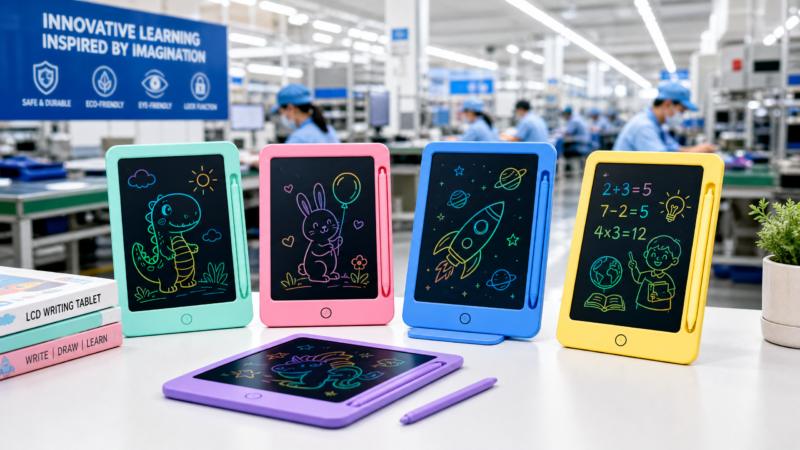
Problem: Choosing a screen-free writing tablet for travel and daily carry is confusing. Agitation: Size, form and accessory differences can cause poor assortment choices or unhappy end users. Solution: This guide compares the common formats and lists procurement checks to reduce risk and speed decision-making.
Answer: Compact, pocket-ready mini formats and slim mid-size designs are typically the best fit for travel and daily use — they balance portability with usable writing area. For slightly larger needs, a 12 inch lcd writing tablet profile or a thin lcd writing tablet that is also a lightweight writing tablet gives more surface without bulk. Confirm catalogue availability, request documentation, and test a pre-production sample before ordering.
This guide is written for retail buyers, importers, brand owners and education procurement teams. It explains form factors, trade-offs, accessory choices and procurement checks so you can compare shelf-ready SKUs and branded projects efficiently.
Form factors for travel
Choosing the right form factor is the first decision for a travel- and daily-use assortment. Buyers decide between pocket-ready mini boards for on-the-go quick notes and larger boards for shared use or display. This section explains common market categories, practical trade-offs and the kinds of SKUs that typically perform well on the road.
size categories
Retail and OEM vocabulary tends to separate screen-free writing tablets into several informal categories: mini, compact/mid-size, and large. A mini lcd writing tablet is often promoted for pocket or handbag carry and quick jotting; compact or mid-size boards offer a larger writing surface while still fitting into a commuter bag. A 12 inch lcd writing tablet occupies the upper mid-size band: it is chosen when buyers want a clearer writing or drawing area without shifting to a full desktop device. For collaborative or classroom boards, a large lcd writing tablet can be appropriate, but larger formats trade portability for surface area.
Example product pages can help buyers validate market fit. If you range small-format SKUs, consider linking or sampling an established compact product such as the 8.5-inch LCD writing tablet to ensure the format matches customer expectations; always confirm catalogue availability and request a production sample before listing.
pros and trade-offs
Mini formats: Pros include instant portability, low perceived price point, and easy impulse purchase placement. Cons are limited writing area and potential user frustration if the surface is too small for their typical tasks.
Mid-size (including 12 inch lcd writing tablet profiles): Pros include improved usability for longer notes and sketching while remaining reasonably portable. Cons can include slightly higher cost per unit and the need for retail shelf space that communicates the device’s size and intended use.
Large formats: Pros include suitability for co‑working, visible display, or classroom activities where many viewers need to see writing. Cons include shipping and display costs and lower appeal for personal daily carry.
| Format | Typical portability | Common travel use | Retail positioning | Accessory note |
|---|---|---|---|---|
| Mini lcd writing tablet | High — fits small bags or large pockets | Quick notes, lists, reminders | Impulse, small-gift, stationery lanes | Often sold with a simple stylus or integrated pen slot |
| Compact / mid-size (e.g., 8–12 profile) | Moderate — commuter bags and backpacks | Nicer sketching, daily planning, travel journaling | Primary SKU for travel-focused ranges | Frequently paired with protective sleeves and stylus holders |
| 12 inch lcd writing tablet | Moderate to low — larger but still portable | Detailed notes, design sketching, larger handwriting | Mid-premium lanes that balance utility and portability | May require more rigid packaging and display signage |
| Large lcd writing tablet | Low — best for bags or designated stations | Shared use, classroom whiteboard replacement | Classroom bundles, office supplies, teaching aids | Often marketed with mounting or desk-stand accessories |
Use the table to map each format to your channel: mini for travel-centric impulse buys, compact for commuter and lifestyle ranges, and mid-size for higher utility SKUs. Large boards fit education and shared-station categories more than pocket- or backpack-focused travel lines.
Weight and thickness considerations
For travel and daily use, perceived weight and thickness matter as much as absolute mass. Buyers and end customers judge devices by how they feel in a backpack, handbag, or hand. This section helps buyers evaluate thin vs more rigid designs and factor packaging and in-store handling into procurement decisions.
thin versus rigid designs
A thin lcd writing tablet profile enhances the sense of portability and can make the product more attractive to commuters. A thin lcd writing tablet usually slides into sleeves and adds less bulk under other items. Rigid designs may withstand pressure better in a packed bag but can feel heavier. When evaluating sample units, inspect how the device lies in a bag under other items and whether the surface flex affects writing comfort.
carry and pocket compatibility
A lightweight writing tablet is an important selling point for travel assortments, but “lightweight” is relative. For buyers, assess how a product is carried in real conditions: held, slipped into a side pocket, or placed in a sleeve. If listing products online, include clear imagery that shows scale against common objects (e.g., notebooks, tablets) and describe recommended carry methods in the product copy. Always request a pre-production sample so you can confirm the feel against your expectations.
Procurement tip: ask suppliers to confirm packing configuration and to provide handling recommendations for stores and distribution. Confirm catalogue availability of the thin models and ask for packaging samples; some thin designs may require additional protective layers in transit.
Use cases by user type
Different buyers will prioritize different attributes. This section breaks down common use cases — travel shoppers, daily commuters, classroom procurement, and corporate buyers — and highlights the format and accessory choices that typically match those needs.
travel and commuting
Commuters often prefer devices that are pocket-friendly or that fit an everyday bag without adding bulk. For this audience, mini or compact boards that advertise quick note-taking and a lightweight writing tablet experience perform well. Packaging should be compact and clear about the device’s purpose; for branded lines consider printed inner packaging that demonstrates how the device fits into a bag to avoid returns from mismatch of expectation.
education and classrooms
Education buyers may be drawn to larger displays or sets intended for group activities. A large lcd writing tablet can support visible in-class annotations, while bundles of compact boards work for small-group practice. If you are tendering for education contracts, request that suppliers confirm compliance documentation applicable to your market and provide classroom-use samples for pilot testing. For classroom packages where multiple boards are used, consider offering cases or mounts for on-desk storage.
retail, gift and point-of-sale
Gift and impulse retail channels favor clear shelf communication: mini and compact formats are easiest to merchandise. A visually differentiated “colorful” face or multi-color writing capability can add grab-and-go appeal. In such retail environments consider assortments combining a small number of formats and a clear signage plan. If you plan to offer decorative variants, ensure artwork proofs are available and that barcode and packaging layout are checked against retailer requirements.
Input and accessories
Input options and accessory choices affect both user satisfaction and point-of-sale presentation. Buyers must choose between included styluses, detachable pens, pen docks, protective sleeves, and bundled display mounts. This section examines common accessory choices and procurement considerations.
lcd tablet with pen and stylus options
An lcd tablet with pen option is a common combination for travel and daily-use SKUs; buyers should evaluate pen feel, attachment method and replacement availability. Some sellers prefer a tethered stylus for small formats to reduce loss; others choose a removable pen that doubles as a pocket clip. When requesting samples, test the writing interaction and replaceability. Do not assume a particular pen style will be acceptable for your market — confirm with a sample that the chosen pen meets your channel’s expectations.
cases, mounts and pen storage
Accessories change perceived value. A simple sleeve or flexible cover can protect a thin lcd writing tablet during transit and store a pen. Some compact SKUs include integrated pen slots; others rely on elastic pen loops. Evaluate accessory fit, how the item displays on shelf, and whether the accessory complicates stock-keeping (extra SKUs). Clarify packaging and packing unit details with your supplier and request packaging mock-ups or physical samples to validate shipping and retail presentation.
Accessory bundles can be a route to higher average order values, but they add complexity. For private-label buyers, consider which accessories you will brand and which the supplier will provide as standard. In all cases ask the supplier to confirm accessory availability, compatible artwork files, and any lead-time or tooling considerations; request pre-production samples demonstrating the configured set.
Standard options
Suppliers typically offer a set of catalog items intended to meet common retail and education needs. Standard options often include plain-face boards, colored faceplates, multi-color writing sets, and small bundles with simple protective accessories. This section outlines common baseline offerings and how to evaluate them for travel-focused ranges.
Typical standard items useful for travel and daily use assortments include mini and compact plain boards (often marketed as portable note boards), models with a stylus or pen slot, and colorful variants for gift aisles. For buyers seeking a multi-color offering for creative or promotional assortments, an OEM multi-color drawing tablet set is an example of how color can be packaged as a selling point — request sample units and confirm the exact color palette and artwork options with the supplier.
For retailers who want a visually distinctive in-store presence, a colorful electronic writing board can be a shelf highlight. Use standard options as anchors in an assortment plan; they reduce complexity and can act as reference SKUs for private-label variations. In every case, ask the supplier to confirm catalogue availability, applicable documentation, and to provide a pre-production sample for your internal review before committing to any order.
Customization notes
Brand owners ordering private‑label or bespoke finishes should plan artwork, packaging and IP considerations early. Customization is frequently requested, but it also introduces lead-time and tooling questions. The following notes outline common customization areas and procurement checks to reduce ambiguity.
Common customization requests include printed front or back surfaces, bespoke packaging with brand messaging, and tailored accessory sets. For graphics and trademarks, prepare high-resolution artwork and layered files; request supplier artwork templates and confirm placement for barcodes, country of origin statements and other required retail marks. Do not assume a supplier’s standard template will match your retailer’s barcode placement rules — confirm with the retailer and ask the supplier to accept your final approved artwork files.
Intellectual property and artwork planning: early-stage buyers should plan for design protection and clearance. For high-level guidance on design, trademark and artwork planning, consult established IP guidance resources and incorporate confidentiality protections in early project stages. Do not treat any supplier description as a legal determination — always confirm IP strategy with your legal or compliance advisors.
Tooling and metallic or embossed finishes may require a proofing stage. For private-label runs ask for mock-ups and a pre-production sample that shows final printing, logo placement, and accessory integration. Confirm whether the supplier can produce an approved sample and what the sample process includes; use conditional procurement language in your brief and request confirmations in writing.
Buyer checklist
This checklist is a practical sequence to follow when evaluating screen-free writing tablet formats for travel and daily use. Use it to structure supplier queries, sample requests and internal approvals.
- Define the intended end user and channel. State whether the SKU is for commuter retail, impulse gift, education, corporate gifts, or a mix. This drives format choice and accessory expectations.
- Map a small assortment. Select a mini, a compact (mid-size), and a larger mid-size or 12 inch lcd writing tablet profile as candidates. Limiting to a few reference SKUs simplifies comparison and pilot testing.
- Request catalogue details and lead samples. Ask the supplier to confirm catalogue availability, provide spec sheets, packaging mock-ups and prototype or pre-production samples. Verify that sample units are representative of mass production.
- Confirm accessory configuration. Ask what is included in the pack (stylus, sleeve, pen slot) and whether alternative accessory options are available. Confirm pen or stylus attachment and replacement availability for long-term aftercare.
- Verify packaging and retail presentation. Request dielines and imagery that show front- and back-of-package, barcode placement, and retail shelf orientation. Check that the packaging communicates portability for travel SKUs.
- Ask about artwork and private-label options. Obtain artwork templates, colour gamut limits and approval process steps. Request a proof or pre-production sample with your brand applied before authorizing production.
- Check market-specific documentation. For your market, list the documentation you may need (transport statements, product safety forms, declarations) and request that the supplier identify which documents they can provide. Do not assume documentation is included; confirm availability in writing.
- Plan a small pilot order and field test. Before committing to a wide roll-out, test product reception in a limited channel or with a selected customer segment. Use pilot feedback to confirm size, accessory choices and retail messaging.
- Confirm packaging for distribution. Ask the supplier how the product will be packed for sea, air or courier distribution and whether additional protective layers are recommended for your distribution conditions. Request packaging samples and an outline of unit-per-carton arrangements.
- Clarify post-order support. Confirm processes for replacements, spare accessories and reorders; request estimated options for reorder artwork and sample approvals, and get documented contact points for order updates.
Procurement language to include in your RFQ or specification: “Please confirm catalogue availability, provide current documentation and indicate whether a pre-production sample is possible. State any optional accessory kits and list the file formats needed for artwork approvals.” This conditional phrasing keeps requirements clear without assuming supplier capabilities.
Conclusion
For travel and daily use, the best formats are those that match the buyer’s channel and end-user expectation: mini formats for on-the-go convenience, mid-size boards (including 12 inch lcd writing tablet profiles) for better usability, and thin lcd writing tablet options for a sleeker carry experience. Always verify accessory choices such as an lcd tablet with pen or stylus and request pre-production samples to validate feel and fit. Use the buyer checklist above to structure supplier conversations and reduce surprises in packaging, artwork and retail presentation.
Talk with GY-Industries about your brief
If you would like to discuss a sample or an OEM briefing, please contact GY-Industries or email sales@gy-industries.com. When you reach out, provide the intended user, target market, artwork files or guidelines, your order plan (pilot vs full roll-out), and the requested configuration (format choices, accessory preferences and packaging expectations). Ask the supplier to confirm catalogue availability and to provide any applicable documentation and a pre-production sample for your approval. Do not assume any capability until confirmations are received in writing.
Assortment and merchandising decisions for travel and daily-use lines
SKU selection logic and pairing for mixed channels
Start by mapping the shopping context and the perceived need. For travel- and daily-use ranges, buyers should think in terms of intent clusters rather than only size classes. Typical intent clusters include: quick-capture (notes, lists), creative sketching (doodles, travel journaling), and visible communication (shared notes on a commute or at a desk). For each cluster, select one reference SKU and one aspirational SKU that can be tested as a pair in a pilot listing. For example, pair a pocket-oriented mini lcd writing tablet with a compact commuter option aimed at creatives, and include a mid-size reference such as a 12 inch lcd writing tablet for customers who want a larger daily surface.
When assembling pairs, consider how each SKU will be merchandised together on shelf or within a single product page. Complementary pairs should minimize cross-confusion: show scale images, list recommended use cases, and call out accessory differences clearly. If you plan to present a multi‑format starter bundle for retailers, use one clearly labelled hero SKU on pack and show the alternatives as “also available” rather than overloading the primary carton with multiple sizes that could create buyer hesitation.
Retail packaging decisions that communicate portability
Packaging is the primary signal of intended use for travel customers. For travel- and daily-use SKUs, prioritize imagery and copy that depict the device in a real carry scenario: inside a commuter bag, clipped to a notebook, or slipped into a notebook sleeve. Use a single, unambiguous headline that communicates the device’s main travel advantage (for example, “slips into your commute bag” or “pocket-ready jotter”) and test alternative claims in pilot listings to see which phrasing reduces return rates and customer questions.
Decide early whether to sell the product in closed retail-ready cartons or open blister-style packaging. Closed cartons protect thin designs in transit and allow for multiple languages and regulatory marks; open display can improve impulse purchase conversion in some physical channels. Ask suppliers to provide packaging dielines, artwork templates and a sample mock-up so you can validate how the packaging communicates portability and how it fits standard shelf depths. Always request confirmation in writing and a pre-production sample with your final artwork applied before approving mass production.
Accessory bundling strategy and SKU complexity management
Accessories can add perceived value but also increase SKU complexity and inventory cost. Make deliberate choices about which accessories to include as standard versus optional add-ons. For travel-focused offers, common accessory choices include a protective sleeve, a tethered stylus, or a compact pen loop. Determine whether an included accessory addresses a core user pain (e.g., loss of stylus) or is merely decorative. If the accessory addresses a frequent after‑sale contact point (lost stylus, damaged sleeve), include it and plan for after‑sales replacement parts availability.
When designing bundles, model how the bundle will be stocked and replenished. Bundles with multiple accessories often require separate packaging SKUs, which can complicate replenishment and create dead stock if retail demand shifts. Use conditional procurement language in briefs: ask the supplier to confirm catalogue availability of each accessory option, describe substitute options if an accessory is unavailable, and provide cost-neutral mock-ups for retail acceptance. Always request pre-production samples of the complete bundle so you can verify fit, finish and pack-out.
Validation, pilot testing and logistics protocols before roll‑out
Pre-production sample protocols and acceptance criteria
Establish a clear sample acceptance process that includes physical inspection criteria and a short field test. Your sample checklist should capture at minimum: feel and ergonomics, stylus attachment method, surface usability under typical lighting, and how the unit tolerates being carried in a packed bag or sleeve. When documenting acceptance criteria, use observable measures (e.g., “stylus fits in pen slot without rattling” or “pack dimensions as shown on dieline fit into a standard A5 sleeve”) rather than prescriptive technical specs that suppliers may not provide in early stages.
Include conditional procurement language in sample requests: “Please confirm catalogue availability, provide applicable documentation and indicate whether a pre-production sample can be produced. If a sample cannot be provided, please state what alternative documentation and mock-up options you can supply.” Insist on signed confirmation of sample lead content so both parties understand what will be delivered for evaluation. Do not treat any supplier claim as final until you have physically inspected a pre-production sample and documented any non-conformances in writing.
Designing a small pilot and gathering actionable metrics
Run a controlled pilot before full roll‑out. Define the pilot’s objectives in buyer‑centric terms: conversion rate for the travel-focused SKU, return rate due to fit/misunderstanding, and accessory replacement requests. Limit pilot scope to a manageable geography or channel where customer feedback can be collected and acted upon quickly. For online pilots, include scale imagery and a clear “how it fits in a bag” video; for retail pilots, provide shelf talkers showing recommended use cases.
Collect both quantitative and qualitative feedback. Quantitative data should include sell-through, returns, and accessory replacement requests. Qualitative feedback—customer comments, associate feedback at POS, and visual merchandising observations—often reveal mismatch between packaging claims and real-world perception. Use pilot results to decide whether to adjust the assortment (for example, swap a mini for a slightly larger compact in the travel cluster) and to update packaging copy to better manage expectations.
Logistics, packing and distribution considerations for travel SKUs
Travel- and daily-use SKUs often emphasize thin profiles; these require protective packing to survive distribution without flex damage. Ask suppliers to confirm their recommended packing configuration and to provide a packaging sample for your distribution team to trial. Confirm how retail-ready cartons are palletized and whether any overpacking is used for fragile thin designs. Use conditional phrasing in logistics queries: “Please confirm catalogue availability and the standard pack‑out for sea/air/courier distribution, and provide handling recommendations and a pre-production packaging sample.”
Plan for spare accessory logistics as part of post-launch support. If the chosen accessory (for example, a particular stylus attachment) is prone to loss in the chosen channel, ensure you have SKU definitions for replacement parts and confirm their availability with the supplier. Ask for lead-time windows for replacement accessory shipments and clarify the artwork files needed for replenishment labels so that restocking is straightforward. Document these arrangements in writing as part of your supplier agreement.
Post-pilot controls: reorder triggers and continuous improvement
Define clear reorder triggers before the pilot ends. Typical triggers include a sell-through threshold, a maximum acceptable return rate, or a customer satisfaction benchmark for travel suitability. When a trigger is reached, have a protocol that specifies whether the next action is a full roll-out, a secondary pilot with adjusted packaging, or a procurement pause pending supplier correction. Use conditional procurement requests to ensure the supplier can support the planned scale: confirm catalogue availability, list required documentation, and request that a pre-production sample of any revised SKU be provided for re-evaluation.
Build a feedback loop with merchandising and customer care teams to capture ongoing issues related to portability and daily carry. Track returns specifics (e.g., “stylus missing”, “product flexed in transit”) and prioritize fixes that reduce friction for travel users. For product iterations, request a controlled sample run to validate changes before updating packaging and online imagery. Keep communications with the supplier conditional and documented to avoid assumptions about what will be delivered or when changes can be made.
Contracting and supplier terms to reduce travel‑SKU risk
Define sample acceptance criteria and the approval workflow
Before any firm order, document the exact criteria a pre‑production sample must meet and the steps for approval or rejection. Define what you will check during sample inspection in operational terms: packaging fit, ergonomics, stylus attachment, accessory fit and basic handling in a packed bag scenario. Use statements such as “sample to demonstrate finalartwork, pack‑out and accessory integration” and require the supplier to confirm they can produce that sample. Do not assume a supplied sample represents mass production unless the supplier confirms in writing that it is a pre‑production sample intended to match the approved production run.
Make the approval workflow explicit in your purchase documents: who within your organisation inspects the sample, what discrete pass/fail checks apply, and the maximum number of minor non‑conformances that are acceptable before a formal corrective action is required. Ask suppliers to confirm catalogue availability and whether they can provide an updated sample after corrective actions. Use conditional language: “Please confirm catalogue availability, provide applicable documentation and state whether a pre‑production sample can be produced with the applied artwork.”
Contract terms that protect merchandising and market positioning
Include clauses that protect how the SKU will be represented and merchandised. Typical buyer requests include signed confirmation of the final dielines, primary product imagery showing scale in a travel context, and agreement on the exact accessory set to ship with production units. Require the supplier to acknowledge any restrictions on artwork placement imposed by specific retailers and to confirm that packaging dielines will be adjusted to meet those requirements before mass production.
Insist on conditional commitments rather than assumptions: require the supplier to confirm the documents they can provide (for example, packaging dielines and artwork templates) and whether a pre‑production pack mock‑up is possible. Specify turnaround expectations for any requested corrections to artwork or pack design so your merchandising deadlines are respected; request these commitments in writing as part of the RFQ or contract.
Inspection, sampling and dispute handling
Embed a clear sampling and inspection protocol in agreements to avoid ambiguity. Define who pays for the initial pre‑production sample, whether a small fee will be charged for revised samples, and what constitutes a satisfactory resolution if a sample fails to meet the acceptance criteria. Use neutral procurement language that places the onus on both parties to resolve non‑conformances: “If a pre‑production sample fails acceptance, supplier to propose corrective actions and timelines; buyer to confirm either acceptance of corrective plan or request a reworked sample.”
Clarify where and how final inspection will occur and whether a third‑party inspection is permitted. Ask suppliers to confirm their sample and inspection policies and to provide the documentation they can supply. Keep requests conditional: “Please confirm catalogue availability, indicate what inspection documentation is available, and state whether you can provide pre‑production samples for buyer inspection.”
Packaging and distribution obligations to protect thin and portable designs
Thin or lightweight designs intended for travel have particular packaging needs. Specify the expected pack‑out (retail carton, inner protective sleeve, unit packing orientation) as part of contract negotiations and ask for a physical packaging sample. Require suppliers to confirm catalogue availability of pack variants (retail carton vs. bulk bulk pack) and to provide packaging mock‑ups so distribution and retail teams can test shelf fit and protective performance. Use conditional procurement phrasing: “Please provide packaging dielines and a pre‑production packaging sample where possible.”
Document responsibilities for damaged goods discovered on receipt. Agree in writing how short shipments, visible transit damage, or packaging non‑conformance will be handled, including the timeline for reporting and the supplier’s proposed remediation steps. These clauses prevent confusion where thin lcd writing tablet designs are susceptible to flex damage in transit without adequate protection.
Operational KPIs, decision matrices and launch controls for travel and daily‑use SKUs
Design a decision matrix that weights travel attributes
Create a scoring matrix that reflects the relative importance of attributes for travel and daily carry. Suggested decision factors include portability perception (how the device is carried or shown in imagery), accessory completeness (stylus, sleeve, pen loop), merchandising clarity (pack copy and imagery), and sample ergonomics (how the stylus sits, surface feel in hand). For each candidate—mini lcd writing tablet, compact option, and a 12 inch lcd writing tablet profile—score these factors to quantify trade‑offs and guide SKU selection.
Keep the matrix practical: use buyer‑defined weightings and make the scoring process part of the pilot evaluation. Require suppliers to confirm that any SKU used in the matrix is listed in their catalogue and to provide a pre‑production sample that aligns with the scored attributes. Conditional language to include in RFQs: “Confirm catalogue availability of the model used for scoring and provide a pre‑production sample for verification.”
Pilot metrics and practical go/no‑go controls
Define pilot metrics that align with launch objectives. Typical measures for travel SKUs include conversion on product pages when “fits in bag” imagery is present, frequency of accessory replacement requests (stylus or sleeve), and customer feedback mentioning fit or portability. Avoid prescriptive numerical thresholds in your contract; instead, set action rules that specify the response when unacceptable pilot outcomes occur—for example, pause reordering, require revised packaging, or request a reworked sample.
Document the operational steps to be taken when pilot outcomes trigger intervention: who approves changes, typical proofing cycles for revised artwork or accessory configuration, and whether the supplier will supply a follow‑up pre‑production sample. Use conditional procurement verbiage: “Please confirm catalogue availability and whether a revised pre‑production sample can be produced if pilot results require adjustments.”
Replenishment logic and spare‑part planning for travel lines
Plan replenishment with spare‑part availability in mind. For travel SKU types—particularly those that emphasise an lcd tablet with pen or stylus options—specify how spare styluses and sleeves will be ordered, labelled and shipped. Define simple replenishment rules (for instance, reorder cadence aligned with sell‑through signals) and require suppliers to confirm which accessory SKUs are kept in catalogue and how they will be packaged for replacements.
Insist that the supplier document the artwork files and label formats needed for replenishment cartons so your logistics team can generate accurate restock labels. Use conditional buyer language: “Confirm catalogue availability for each spare accessory SKU and provide the artwork files and packaging mock‑ups required for reorder labelling.”
Customer care, returns patterns and continuous improvement
Establish a closed‑loop process between customer care, merchandising and the supplier to capture and address travel‑related return reasons. Classify returns into clear categories (fit/size mismatch, accessory missing, transit damage, functional complaint) and require suppliers to confirm they will cooperate on root cause analysis of any systemic issues discovered during the pilot or early production runs.
Use the data from returns and customer comments to refine packaging copy and imagery. For example, if customers repeatedly note confusion about the device’s intended carry method, update the pack headline and online product imagery and ask the supplier to provide a pre‑production sample that demonstrates the revised packaging. Always request written confirmation from the supplier about any agreed corrective artwork or pack changes and the availability of a reworked pre‑production sample to validate fixes.
Decision checkpoints to manage SKU proliferation
Finally, set explicit decision checkpoints that limit SKU proliferation in travel assortments. Use staged approvals—sample acceptance, pilot performance review, and merchandising acceptance—before approving additional colours, faceplates or accessory bundles. Require suppliers to confirm catalogue availability for any added variant and to supply a pre‑production sample for each new variant prior to broad release. Phrase this in procurement language such as: “Please confirm catalogue availability of the proposed variant, provide packaging dielines and indicate whether a pre‑production sample is available for buyer inspection.”
These controls protect your range from drift, ensure clear merchandising for travel users, and make supplier commitments explicit and actionable without assuming any supplier capability until confirmed in writing.
Sources
WIPO: Why Intellectual Property Is Essential for Your Business — use for high-level design, trademark, artwork and confidentiality planning (not legal advice).
GS1 US: Barcode Placement and Printing Guidelines — use for retail barcode-artwork and placement checks; retailers and markets may have their own requirements.
ISTA Responsible Packaging by Design overview — use for the general principle that packaging should be planned for the actual distribution environment; do not claim certification or a particular test outcome.