“`html
I see it happen all the time. A child sits down to write. They try. They fail. They give up. That cycle is painful to watch — and even more painful to live through.
Many children with learning differences face this every single day. Traditional paper and pencil feel like enemies. The pressure is too much. The mistakes stay visible. The frustration builds fast.
There is a better starting point. LCD writing tablets are changing how therapists approach early writing intervention — and the results are hard to ignore.
I spoke with an occupational therapist recently. She told me something that stopped me in my tracks. She said: “For a child who has failed at writing a hundred times, the erase button is not just convenient. It is the first time they believe they can try again.”
That single sentence changed how I think about these tools. This is not just about writing. It is about rebuilding confidence. It is about giving children a way to try without fear. LCD writing tablets, made with the right features, do exactly that. Let me explain how.
1. What Makes LCD Tablets Particularly Effective for Children with Fine Motor Challenges?
Problem: Fine motor challenges make traditional writing overwhelming. Pencils require grip strength. Paper tears. Mistakes leave marks. Children with low muscle tone or coordination struggles feel defeated fast.
Agitation: Every failed attempt adds to anxiety. The more a child struggles with paper, the more they avoid writing entirely. Avoidance becomes habit. Habit becomes a real barrier to learning.
Solution: LCD writing tablets remove many of these physical barriers. They are lightweight, forgiving, and designed for repeated practice without frustration.
The right LCD tablet weighs between 150g and 380g. That low weight matters enormously for children with low muscle tone. Less weight means less fatigue. Less fatigue means longer practice sessions. Longer sessions mean real progress.
A Child Named Leo
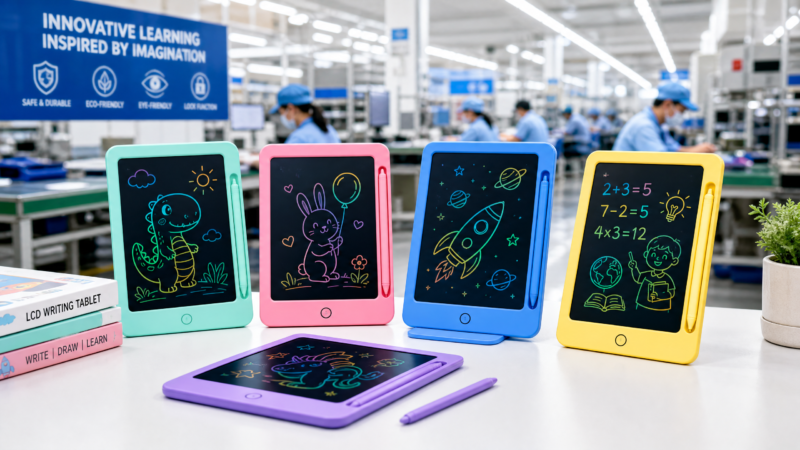
Leo was seven years old. He had low muscle tone and struggled to hold a pencil for more than two minutes. His therapist introduced an 8.5-inch LCD writing tablet during sessions. It weighed under 200g. Leo could hold it flat on the table without gripping tightly. The smooth matte surface gave him consistent tactile feedback every time he drew a line. There were no sharp edges — rounded corners and safe ABS plastic meant no injury risk during restless moments. After three weeks, Leo was practicing strokes for ten minutes straight. His mother cried. His therapist smiled. The tablet did not teach Leo to write. It taught him that writing was worth trying.
Key Physical Features That Support Fine Motor Development
| Feature | Why It Matters for Fine Motor Challenges |
|---|---|
| Lightweight design (150–380g) | Reduces fatigue for children with low muscle tone |
| Smooth matte surface | Consistent tactile feedback supports motor learning |
| Rounded corners, safe ABS plastic | Safe for children who move suddenly or unpredictably |
| Screw-secured battery | Prevents accidental opening, adds durability in therapy settings |
| 8.5-inch size | Ideal workspace — not too small, not overwhelming |
2. How Do Therapists Use the Pressure-Sensitive Surface in Sensory Integration Sessions?
Problem: Many children with sensory processing difficulties either press too hard or barely touch surfaces. They cannot gauge their own force. This makes writing difficult and unpredictable.
Agitation: Without real-time feedback, children cannot self-correct. They do not know they are pressing too hard until the pencil breaks. They do not know they are pressing too softly until nothing appears. The gap between action and awareness is wide.
Solution: A pressure-sensitive LCD surface gives children immediate visual feedback. The line changes with pressure. That visible change is a powerful teaching tool.
On a pressure-sensitive LCD tablet, pressing harder creates a thicker line. Pressing lighter creates a thinner one. Therapists use this directly in pressure regulation exercises. Children can see their force — and learn to control it in real time.
A Session with Maya
Maya was nine. She had sensory processing disorder. She pressed so hard on paper that she tore it constantly. Her occupational therapist introduced pressure regulation exercises using an LCD writing tablet with a pressure-sensitive surface. The goal was simple: draw a line that stays the same thickness from start to finish. If Maya pressed too hard, the line got thick. She could see it instantly. The therapist gave her a target thickness. Maya practiced matching it. Within four sessions, Maya’s pressure control improved measurably. The tablet turned an invisible problem — force regulation — into something Maya could see, understand, and change. That visibility was the breakthrough.
Therapist Techniques Using Pressure Sensitivity
| Technique | Goal | How the Tablet Helps |
|---|---|---|
| Consistent line exercises | Pressure regulation | Line thickness changes with force — instant visual feedback |
| Light touch tracing | Sensory awareness for under-responders | Thin lines only appear with deliberate, controlled contact |
| Heavy press patterns | Proprioceptive input for sensory seekers | Thick lines reward firm, grounding pressure |
| Erase and repeat cycles | Reduce anxiety, build persistence | One button erases everything — no evidence of mistakes remains |
According to the American Occupational Therapy Association (AOTA), sensory integration approaches work best when children receive clear, immediate, and meaningful feedback. Pressure-sensitive LCD tablets deliver exactly that in a tool children actually want to use.
3. What Should Parents Look for When Choosing an LCD Tablet for a Child in Therapy?
Problem: Parents want to support therapy at home. But the market is full of LCD tablets. Not all of them are suitable for children with learning differences. Some are flimsy. Some have inconsistent surfaces. Some are not safe.
Agitation: Buying the wrong tablet wastes money. Worse, it can undermine progress. A tablet that skips lines or has inconsistent pressure response teaches the wrong feedback. A tablet with loose parts becomes a safety risk.
Solution: Knowing what to look for makes the decision simple. A few key features separate a therapeutic tool from a toy.
Look for CE, CPC, and RoHS certification. These are not just labels. They confirm the tablet is tested for safety, material quality, and children’s product standards. A certified tablet is a trustworthy one for therapeutic use.
A Family That Got It Right
Daniel was ten, diagnosed with dyspraxia. His therapist recommended continuing pressure exercises at home between sessions. His parents searched online and found an 8.5-inch LCD writing tablet from a certified manufacturer. It had CE, CPC, and RoHS certifications. The screw-secured battery meant Daniel could not pull it apart — something he had done with other devices. The rounded corners and smooth matte surface were exactly what the therapist described. At 180g, Daniel’s mother said it felt “almost weightless.” He used it every evening. His handwriting sessions went from two minutes to fifteen. Certification mattered. Build quality mattered. They got both — and it showed.
Parent Buying Checklist for Therapeutic LCD Tablets
| What to Check | What to Look For | Why It Matters |
|---|---|---|
| Safety certification | CE, CPC, RoHS certified | Confirms child-safe materials and tested quality |
| Weight | 150g–380g range | Light enough for low muscle tone, reduces fatigue |
| Screen size | 8.5 inches recommended | Enough space for meaningful practice without overwhelming |
| Surface consistency | Smooth matte finish | Predictable tactile feedback supports motor learning |
| Pressure sensitivity | Visible line thickness variation | Enables pressure regulation exercises |
| Build safety | Rounded corners, screw-secured battery, ABS plastic | Prevents injury and accidental disassembly |
| Supplier reliability | OEM manufacturer with wholesale options | Consistent quality for therapy centers and home use |
If you run a therapy center, buying wholesale from a certified OEM manufacturer ensures every tablet your clients use meets the same standard. Consistency across devices matters when you are building a structured program. You can learn more about wholesale options through GY-Industries’ service page.
Final Thoughts
LCD writing tablets are not magic. But in the right hands, with the right features, they remove real barriers for real children. They make trying feel safe. That changes everything.
Ready to bring certified LCD writing tablets into your practice or home? Contact GY-Industries today and let’s talk about what works for your children.
“`