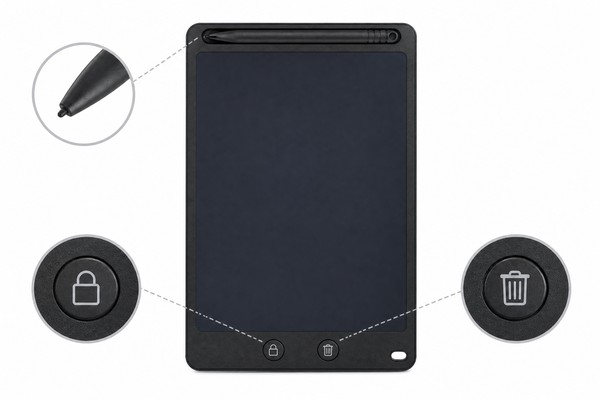
You hand your child a freshly erased LCD writing tablet — or so you think. A few taps of the erase button later, you are still staring at a ghost of the last drawing, a smudgy patch in the corner that simply will not go away. If this sounds familiar, you are not alone.
Partial erasure is one of the most common complaints about LCD writing tablets, and yet it is one of the least understood. This article explains exactly why it happens, using real LCD technology to walk you through the science.
Whether you are a parent troubleshooting a tablet your child received as a gift, or a B2B buyer sourcing tens of thousands of units for your Amazon store, understanding the root causes of partial erasure will save you time, money, and frustration.
—
How LCD Writing Tablets Actually Erase: The Technology Behind the Button
Before diagnosing why your screen is not erasing completely, it helps enormously to understand what is supposed to happen when you press that little button. LCD writing tablets do not work like a traditional chalkboard, and they do not work quite like a smartphone screen either.
They use a specific class of liquid crystal technology that has fascinating physical properties — properties that, when they go wrong, produce exactly the kind of partial ghosting you are seeing.
Cholesteric Liquid Crystals: The Heart of the Writing Surface
Most consumer LCD writing tablets use a display technology based on cholesteric liquid crystals (ChLC), sometimes called bistable cholesteric liquid crystals. This is a distinct branch of liquid crystal science, different from the TFT-LCD panels in televisions and smartphones.
The word “bistable” is the key: these crystals can exist stably in two distinct physical states without requiring any ongoing power to maintain either state.
What the Erase Button Actually Does: The Electrical Pulse Mechanism
Here is the part that surprises most people: pressing the erase button on an LCD writing tablet is not a mechanical action. You are not physically wiping the crystals flat. Instead, you are triggering a brief electrical pulse that travels across the entire display panel through a transparent conductive electrode layer, typically made from indium tin oxide (ITO).
This is why the erase button requires a battery. Without a power source, there is no electrical pulse, and there is no erase. The battery is not powering a light source (these tablets have no backlight in standard mode) — it is powering the erase circuit entirely. This is also why, when the battery is low, erasure becomes unreliable.
The pulse may be too weak to flip all of the crystals, leaving behind the patches and ghosts that are the subject of this article.
The Erase Electrode and Circuit Design
The quality of the erase experience depends heavily on two components: the ITO electrode layer deposited on the inner surface of the display, and the erase driver circuit that delivers the pulse. The ITO layer must have uniform electrical resistance across its entire surface area.
If it does not — due to poor deposition, micro-scratches during assembly, or simply cutting corners on materials — some areas of the panel will receive a stronger electrical field than others during the erase cycle.
—
The Most Common Reasons a Screen Only Erases Partly
Now that we understand the underlying technology, we can diagnose specific causes of partial erasure with precision. Most cases fall into one of several clear categories, each with its own cause and solution.
Knowing which category applies to your situation helps you decide whether the issue is fixable at home, requires a replacement unit, or represents a systemic quality problem in a product line.
Cause 1: A Weak or Depleted Battery
This is, by a significant margin, the most common cause of partial erasure in LCD writing tablets — and the most frequently overlooked one. Because the erase circuit requires a specific minimum voltage to generate the electrical pulse needed to flip all the liquid crystal molecules, a battery that is running low will produce a weaker-than-required pulse.
Cause 2: Excessive or Repeated Hard Pressure on One Area
Cholesteric liquid crystals in their planar state are, by definition, under a specific physical arrangement that was induced by mechanical pressure. Under normal use, the electrical erase pulse is strong enough to overcome this arrangement and return the molecules to their focal conic state.
However, when extreme pressure is applied repeatedly to a specific small area of the screen — something very young children are especially prone to doing with their fists, palms, or heavy stylus strokes — the liquid crystal layer in that region can be compressed beyond normal parameters.
Cause 3: Manufacturing Defects in the ITO Electrode Layer
As described in the previous section, the ITO electrode layer is responsible for distributing the electrical erase pulse evenly across the entire panel. Any imperfection in this layer creates a zone of higher resistance where the field is weaker during the erase cycle.
The liquid crystals in that zone receive insufficient energy to transition back to focal conic state, so they remain visible after erasure.
ITO defect-related partial erasure is not something users can fix — it is a production quality issue. The unit needs to be replaced. For consumers, this is a warranty claim. For B2B buyers, it represents a quality control failure at the factory level.
This is why ITO uniformity testing, and the use of consistent, high-specification ITO substrates, is a meaningful differentiator when evaluating LCD tablet suppliers. Reputable manufacturers like GY-industries use ITO substrates within defined sheet resistance tolerances specifically to prevent this failure mode at scale.
—
Physical Damage and Environmental Factors That Cause Partial Erasure
Even a perfectly manufactured LCD writing tablet can develop partial erasure problems if it is subjected to physical stress or stored and used in conditions outside its design parameters.
This section covers the environmental and mechanical factors that can cause erasure failure in otherwise good-quality units — important context for both everyday users and for B2B buyers writing return and warranty policies.
Impact Damage: Drops, Bends, and Substrate Separation
An LCD writing tablet’s display panel consists of two flexible or semi-rigid substrates — typically made from PET (polyethylene terephthalate) film — sandwiching the liquid crystal layer between them. These substrates must maintain precise, uniform spacing across their entire surface area.
That spacing is maintained by microscopic glass or polymer spacers distributed throughout the liquid crystal layer, called spacer balls or column spacers depending on the design.
Temperature Extremes: Cold, Heat, and Liquid Crystal Viscosity
Liquid crystals are, quite literally, a phase of matter between solid and liquid. This means their behavior is significantly temperature-dependent. Every liquid crystal formulation has an operational temperature range within which it transitions correctly between states.
Outside that range — either too cold or too hot — the performance of both the writing and erasing functions degrades in predictable ways.
Stylus and Surface Wear Over Extended Use
Over time, particularly with heavy use by young children, the writing surface of an LCD tablet experiences cumulative mechanical wear.
The very thin protective coating over the liquid crystal panel can develop micro-abrasions from stylus contact, and in some low-quality designs, repeated pressure can gradually compact the liquid crystal layer in high-use areas — typically the center of the screen where most drawing occurs.
This is a design quality and material quality issue simultaneously. A well-designed tablet uses a liquid crystal layer thick enough to resist compaction over the product’s intended useful life, and an erase circuit with sufficient margin above the minimum required energy to account for normal wear.
Reviewing these specifications — cell gap thickness and erase circuit voltage output — with your supplier is a meaningful quality assurance step for B2B buyers placing large orders.
—
Manufacturing Quality and Why It Determines Erase Performance
For parents, understanding manufacturing quality helps explain why some tablets erase perfectly for years while apparently identical-looking tablets from different brands fail within weeks.
For B2B buyers, this section is critical: the factors that determine erase reliability are almost entirely determined in the factory, before the product ever reaches a customer. Selecting the right manufacturing partner is the most effective quality control tool available.
Panel Construction: Cell Gap Uniformity and Spacer Distribution
The single most important structural factor in long-term erase reliability is cell gap uniformity — how consistently the spacing between the two panel substrates is maintained across the entire display area. This spacing, typically in the range of a few micrometers, determines the thickness of the liquid crystal layer.
A uniform cell gap means the liquid crystal layer is the same thickness everywhere, which in turn means the electrical erase field needed to transition the crystals is the same everywhere.
ITO Coating Quality and Resistance Uniformity
As introduced earlier, the ITO (indium tin oxide) transparent electrode layer is the electrical highway that carries the erase pulse across the panel. Its quality is determined by two main parameters: sheet resistance (measured in ohms per square) and uniformity across the panel area. Both matter enormously for erase performance.
Erase Circuit Design: Voltage, Duration, and Battery Management
The erase driver circuit — the small electronic assembly that converts the button press into the electrical pulse — has three key design parameters that determine reliability: output voltage, pulse duration, and low-battery compensation strategy.
—
What Parents and B2B Buyers Can Do About Partial Erasure
Armed with a clear understanding of why partial erasure happens, we can now address the practical question: what can you actually do about it? The answers differ significantly depending on whether you are a consumer dealing with a single unit, or a B2B buyer managing quality at scale.
Consumer Troubleshooting: A Step-by-Step Approach
If your child’s LCD writing tablet is only erasing partly, work through these steps in order before concluding that the product is defective:
- Step 1 — Replace the battery first. This resolves the majority of partial-erase complaints. Use a fresh battery of the exact specified type. Do not substitute a “should be close enough” battery — voltage specifications matter here. If full erasure is restored, you are done. If not, continue.
- Step 2 — Check the temperature. If the tablet has been in a cold environment, bring it to room temperature (around 20–25°C / 68–77°F) and allow 10–15 minutes for it to warm through. Then try erasing again with the fresh battery.
-
GY-industries · Factory Direct · Shenzhen
Ready to Source LCD Writing Tablets?
Get factory pricing, free samples, CE/FCC/CPC certificates, and OEM/ODM consultation. Response within 24 hours.
✓ Free samples available
✓ MOQ from 500 units
✓ CE / FCC / CPC certified
✓ 15+ years experienceReferences
- [1] American Academy of Ophthalmology. Digital devices and eye health. https://www.aao.org/eye-health/tips-prevention/digital-devices-your-eyes
- [2] American Academy of Pediatrics. Screen time guidelines for children. https://www.aap.org/en/patient-care/media-and-children/
LCD Writing Tablet Buyer Review Table
| Area | Buyer check | Evidence |
|---|---|---|
| Product factor | Buyer check | Evidence to request |
| Writing response | Test line clarity and pressure response | Sample review |
| Erase function | Confirm reset behavior and lock feature | Functional test |
| Durability | Review surface, stylus, and housing use case | Specification sheet |