“`html
I’ve sourced products from factories in four countries. I’ve chased lead times, negotiated MOQs, and fixed quality problems from thousands of miles away. Nothing — and I mean nothing — compares to what Shenzhen offers. The ecosystem is the product.
Most buyers focus on unit price. That’s a mistake. Price is just one variable. Lead time, component availability, certification support, and logistics access all shape your real landed cost. Miss any one of them and your margin disappears fast.
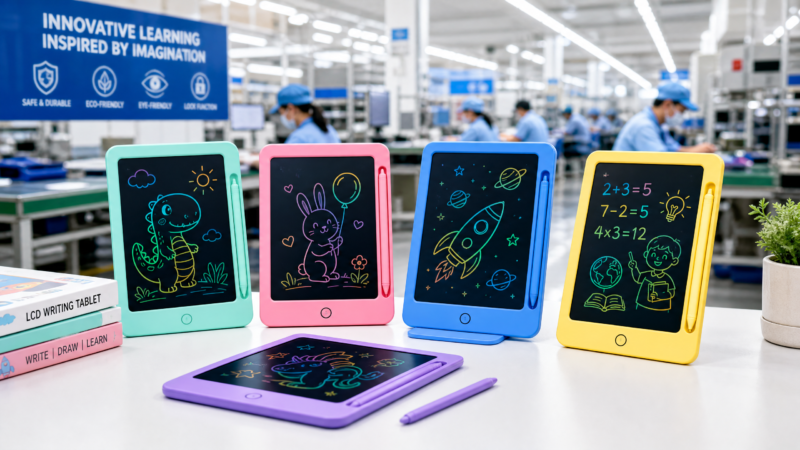
Shenzhen remains the world’s most complete manufacturing ecosystem for LCD writing tablets in 2026. Every component, every certification, every shipping route — it’s all here, compressed into one city. No other region comes close.
I want to show you exactly why that’s true. I’ll walk you through supply chain density, ecosystem evolution, and what to expect when you visit a factory floor. By the end, you’ll understand why buyers keep coming back to Shenzhen year after year.
—
1. What does Shenzhen’s supply chain density actually mean for your lead time and cost?
Long lead times kill cash flow. Expensive components kill margin. Most buyers accept both as inevitable. They shouldn’t.
Shenzhen’s supply chain density means every component for your LCD writing tablet — panels, plastics, batteries, packaging — sits within a 50km radius of your factory. That proximity cuts days off production and dollars off cost. No other city offers this for consumer electronics.
A Real Story From the Factory Floor
Last year, I stood inside a 10,000+ square metre production facility in Shenzhen. The team at GY-industries was running a 2,000-unit order for a European retailer. I asked the production manager about their LCD panel supplier. He pointed roughly north. “Forty minutes,” he said. The ABS plastic supplier? “Same industrial zone.” Batteries? “Thirty kilometres.” Packaging? “Even closer.”
That proximity is not an accident. It took decades to build. It means GY-industries can quote a production lead time of just 15 to 30 days from order confirmation. For a finished consumer electronic device, that is extraordinary. Compare that to factories I’ve visited in Southeast Asia, where component sourcing alone adds two to three weeks.
When components arrive fast, production starts fast. When production starts fast, your goods reach the port fast. With direct access to Yantian and Shekou ports, shipments move to global markets without unnecessary delay. Your working capital thanks you.
Lead Time and Cost Comparison by Sourcing Region
| Region | Avg. Component Sourcing Distance | Typical Production Lead Time | Port Access | Component Cost Index |
|---|---|---|---|---|
| Shenzhen, China | <50km for all key parts | 15–30 days | Yantian & Shekou (direct) | Low |
| Vietnam | 200–800km (imported) | 45–70 days | Limited deep-water options | Medium |
| India | 300–1,200km (partially imported) | 50–80 days | Multiple, but congested | Medium–High |
| Eastern Europe | 500km+ (mostly imported) | 60–90 days | Indirect routes required | High |
The numbers speak clearly. Shenzhen wins on every logistics metric. For buyers placing orders starting from 500 units, that speed advantage compounds fast across multiple reorder cycles per year.
—
2. How has Shenzhen’s manufacturing ecosystem evolved to stay ahead of other regions?
Other regions have tried to replicate Shenzhen for twenty years. Most have failed. Why?
Shenzhen’s edge isn’t cheap labour anymore. It’s accumulated knowledge, supplier networks, and quality infrastructure built over decades. You cannot copy that overnight. In 2026, the city’s ecosystem is more sophisticated — and more unbeatable — than ever.
Depth Over Decades
GY-industries has been manufacturing LCD writing tablets in Shenzhen for over 15 years. That tenure matters more than most buyers realise. Over 15 years, a factory builds deep supplier relationships. It qualifies backup vendors. It refines production processes through thousands of real orders. It learns what overseas buyers actually need — not just in product specs, but in documentation, compliance, and communication.
That compliance depth is visible in GY-industries’ certification portfolio. CE, FCC, RoHS, CPC, ASTM, and ISO 9001 certifications cover the major markets: Europe, North America, and global retail. Achieving and maintaining this stack requires consistent investment. Many factories in emerging regions simply haven’t had the time or volume to build it.
Shenzhen’s ecosystem also evolved in response to buyer pressure. Retailers demanded better packaging. The packaging cluster grew. Brands demanded greener materials. The RoHS-compliant supply chain expanded. The city adapts because its factories have the feedback loop — millions of units shipped, millions of customer interactions processed, millions of data points absorbed.
According to McKinsey’s research on global supply chains, co-location of suppliers and manufacturers remains one of the strongest predictors of production agility. Shenzhen is the textbook case.
Ecosystem Maturity by Key Factor
| Factor | Shenzhen 2015 | Shenzhen 2026 | Competing Regions 2026 |
|---|---|---|---|
| Certification Support (CE, FCC, etc.) | Partial | Full stack, in-house at top factories | Fragmented |
| Component Supplier Density | High | Very High | Low–Medium |
| OEM Customisation Speed | Moderate | Fast (sample in 7–14 days typical) | Slow |
| Skilled Technician Availability | Good | Excellent | Limited for electronics |
| Quality Management Systems | Variable | ISO 9001 standard at leading factories | Inconsistent |
The gap between Shenzhen and everywhere else is not closing. It is widening in sophistication. That matters deeply for buyers who need consistent quality across repeat orders.
—
3. What should overseas buyers know before visiting a Shenzhen factory for the first time?
First factory visits often go wrong. Not because the factory is bad. Because the buyer is unprepared.
Visiting a Shenzhen factory is not like touring a warehouse. It’s a technical evaluation, a relationship-building session, and a negotiation all at once. Buyers who prepare properly leave with better prices, better terms, and far more confidence in their supplier.
What I Learned Visiting GY-industries
When I walked into the GY-industries facility in Shenzhen, I came with a checklist. Over 10,000 square metres of production space greeted me. That scale tells you something immediately. A factory of that size handles volume seriously. It has dedicated QC stations, organised material flow, and separate areas for assembly, testing, and packaging.
I asked to see their certification documents on-site. CE, FCC, RoHS, CPC, ASTM, and ISO 9001 certificates were all current and available. I asked about their minimum order quantity. Five hundred units — low enough for new buyers to trial a product without overcommitting capital. I asked about shipping. The team walked me through their standard routing via Yantian and Shekou ports. Both serve major global lanes efficiently.
The most important thing I noticed? The staff had answers. Fifteen-plus years of experience means the team has seen almost every buyer question before. That institutional knowledge reduces your risk as a buyer enormously.
Pre-Visit Checklist for Buyers
| Category | What to Check | Why It Matters |
|---|---|---|
| Certifications | Request CE, FCC, RoHS, CPC, ASTM, ISO 9001 originals | Protects you in your home market legally |
| Facility Size | Verify production space (e.g., 10,000+ sqm) | Indicates capacity to handle your volume |
| MOQ Flexibility | Confirm minimum order (e.g., from 500 units) | Allows low-risk product trials |
| Lead Time | Get written confirmation (e.g., 15–30 days) | Feeds directly into your inventory planning |
| Component Sourcing | Ask where LCD panels, plastic, batteries come from | Proximity = speed and cost stability |
| Logistics Access | Confirm port access (Yantian, Shekou, or equivalent) | Affects shipping cost and transit time to your market |
| Years in Operation | Verify track record (e.g., 15+ years for LCD tablets) | Experience reduces defect rates and delays |
Use this checklist before and during your visit. It forces the right conversations early. Factories that handle these questions well — like GY-industries does — are worth your long-term business. Learn more about GY-industries’ manufacturing services here.
—
Final Thoughts
Shenzhen in 2026 is not a compromise. It is the standard. The ecosystem is the product. If you’re ready to source smarter, contact GY-industries today and let’s get started.
“`