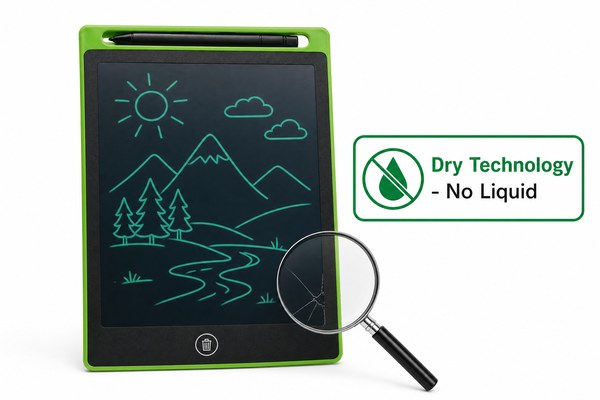
You dropped your LCD writing tablet. Now there’s a crack. You’re worried about liquid dripping out. That fear is very common.
Here is the short answer: LCD writing tablets do not contain free liquid. The “liquid” in the name is sealed inside microscopic capsules. If the screen cracks, you will not see liquid pour out. You may see dark spots or dead areas instead.
But there is more to understand here. A cracked screen still causes real problems. The display may stop working properly. Some people panic and throw the tablet away too fast. Others keep using it without knowing the risks. I want to walk you through exactly what happens inside that screen, why cracks behave the way they do, and what you should actually do next. Let me break it all down simply.
What Is Actually Inside an LCD Writing Tablet Screen?
Most people assume “liquid crystal” means there is a pool of liquid inside. That assumption causes a lot of unnecessary worry. The reality is very different from what you imagine.
LCD writing tablets use liquid crystal material that is trapped inside a thin film layer. This material is not a flowing liquid. It behaves more like a gel or paste. There is no reservoir of liquid waiting to spill out when the screen breaks.
I remember the first time someone at our Shenzhen factory showed me a cross-section of a screen panel. I expected something wet. What I saw was a dry-looking, layered sandwich of materials. The liquid crystal layer sat between two thin plastic or glass sheets. It looked more like colored film than anything that could drip. That moment completely changed how I explained our products to customers. At GY-industries, we manufacture LCD writing tablets for OEM and ODM clients around the world. I have answered this liquid question hundreds of times. The confusion is understandable. The name “liquid crystal” does sound like there is a cup of liquid inside.
LCD Screen Layer Breakdown
| Layer Name | Material Type | Can It Leak? | What It Does |
|---|---|---|---|
| Top protective sheet | Plastic or tempered film | No | Protects surface from scratches |
| Liquid crystal film | Gel-like compound in microcapsules | No free flow | Changes state when pressure is applied |
| Electrode layer | Conductive film | No | Carries the erase signal |
| Back substrate | Rigid plastic or board | No | Holds all layers together |
What Really Happens When the Screen Cracks?
A crack appears. You look for liquid. You find nothing wet. But the screen still looks damaged. Something has clearly gone wrong inside. So what is actually happening?
When an LCD writing tablet screen cracks, the microcapsule layer gets physically broken. The crystals inside those capsules lose their alignment. This shows up as dark patches, permanent marks, or areas that no longer erase. No liquid flows out. The damage is structural, not liquid-based.
I have seen this happen with samples during our quality testing at GY-industries. We deliberately stress-test screens as part of our process before products earn CE, RoHS, and CPC certifications. When a panel cracks under pressure testing, the result is always the same. A dark blotch appears where the impact happened. The area around it might still work fine. No moisture. No dripping. No puddle. The cracked zone simply stops responding to the stylus. It stays permanently dark or permanently light. This is why I always tell clients that a cracked screen is a functionality problem, not a safety hazard from leaking chemicals.
Common Crack Outcomes Compared
| Type of Damage | Visible Sign | Liquid Leak? | Still Usable? |
|---|---|---|---|
| Minor surface scratch | Faint line on top film | No | Usually yes |
| Deep crack through film layer | Dark permanent patch | No | Partially or not at all |
| Full screen shatter | Multiple dark zones | No | No |
| Edge chip | Small dead corner | No | Often yes, except that corner |
Is a Cracked LCD Writing Tablet Safe to Handle?
You know liquid will not spill out. But you still have a cracked screen in your hands. Is it safe to touch? Should children still use it? These are fair questions to ask.
A cracked LCD writing tablet is generally safe to handle. There are no toxic liquids to absorb through your skin. However, sharp plastic or glass edges can cut fingers. Broken screens should be kept away from very young children. Responsible disposal matters too.
At GY-industries, we design our tablets with child safety in mind. Our products meet RoHS standards, which means the materials inside are restricted from harmful substances. I always feel confident telling parents this. Even if a child somehow broke the screen open completely, the materials inside are not acutely toxic. That said, I have personally handled cracked samples and nicked my finger on a sharp edge before. That physical sharpness is the real danger, not a chemical spill. For schools and children’s brands that order OEM tablets through us, I recommend rounded casing designs and stronger top film layers. You can learn more about our product customization services here. According to the U.S. Consumer Product Safety Commission, sharp edges on children’s products require careful attention during design. We take that seriously at our Shenzhen factory every day.
Safety Assessment by User Type
| User Type | Main Risk from Cracked Screen | Liquid Danger? | Recommended Action |
|---|---|---|---|
| Adults | Sharp edges | No | Handle with care, dispose properly |
| School-age children | Sharp edges, small pieces | No | Remove from use immediately |
| Toddlers | Choking on broken pieces | No | Discard safely right away |
| Office users | Reduced functionality | No | Replace screen or unit |
Conclusion
Cracked LCD writing tablet screens do not leak liquid. The screen loses function, not fluid. Need a reliable OEM partner? Contact GY-industries today for certified, safe, durable LCD writing tablets built to your exact specifications.