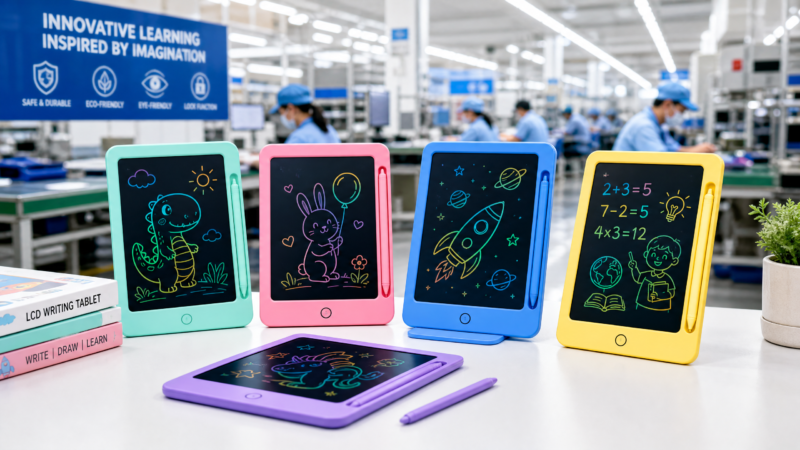
Parents worry about screen time. They want safe tools for their kids. But is an LCD writing tablet even a screen?
Most child development experts suggest children aged 3 and up can safely use an LCD writing tablet. These tablets have no blue light, no Wi-Fi, and no apps. They are simple drawing and writing tools. A child aged 3 can grip the stylus and make marks. Younger toddlers may need supervision.
I have spent years working closely with GY-industries, a Shenzhen-based LCD writing tablet factory. I have seen thousands of these tablets shipped to families worldwide. I have watched parents ask this exact question again and again. The answer is not complicated. But it does depend on the child’s age, size, and how you use the tablet. Let me walk you through what I have learned. I want to help you make the right choice for your family.
Why LCD Writing Tablets Are Different From Regular Screens
Most parents hear “screen” and feel worried. They think of phones and tablets with bright lights. But LCD writing tablets are very different tools.
An LCD writing tablet does not emit light like a phone screen. It uses pressure-sensitive liquid crystal technology. There is no backlight, no blue light, and no Wi-Fi signal. This makes it much safer for young eyes. Even toddlers are not exposed to harmful light when they draw on one.
I remember visiting the GY-industries production floor in Shenzhen. I watched workers assemble the LCD panels by hand. I asked the quality team about eye safety. They told me the panels produce zero light emission on their own. The child only sees a dark line on a grey surface. There is no glow. I tested one myself in a dark room. The screen was completely dark unless I drew on it. That moment really stuck with me. I felt confident recommending these to parents of very young children. The technology is genuinely passive and calm on the eyes.
According to the American Academy of Pediatrics, screen time guidance focuses on interactive digital media. Non-emissive drawing tools fall outside typical screen time concerns.
LCD Writing Tablet vs. Other Children’s Tools
| Tool | Emits Light? | Safe for Age 3+? | Mess-Free? |
|---|---|---|---|
| LCD Writing Tablet | No | Yes | Yes |
| Tablet / iPad | Yes | With limits | Yes |
| Crayons and Paper | No | Yes | No |
| Chalkboard | No | Yes | No |
Age-by-Age Guide to Using LCD Writing Tablets
Not every child develops at the same pace. A three-year-old and a five-year-old use tools very differently. Parents need a clear breakdown by age.
Children aged 3 to 5 can use LCD writing tablets for free drawing and scribbling. Children aged 6 to 9 can practice letters and numbers. Children aged 10 and up can use them for school notes, to-do lists, and study aids. Each age group gets real value from these simple tools.
I have a young niece who started using a small GY-industries LCD tablet when she was just three years old. At first, she only scribbled shapes and pressed the erase button over and over. She loved that part. By age four, she was drawing houses and stick figures. By five, she was tracing letters her mother wrote for her. I watched this happen in real time. It was a joy to see. The tablet never needed charging for weeks. It never crashed. It never showed her an ad. It just worked. That simplicity is exactly what young children need from a learning tool.
Recommended Use by Age Group
| Age Group | Best Activities | Recommended Screen Size | Adult Supervision Needed? |
|---|---|---|---|
| Under 3 years | Not recommended unsupervised | N/A | Always |
| 3 to 5 years | Free drawing, scribbling | 8.5 inch | Recommended |
| 6 to 9 years | Letters, numbers, art | 10 to 12 inch | Sometimes |
| 10 years and up | Notes, study, lists | 12 to 17 inch | Rarely |
Safety Features Parents Should Look For
Not all LCD writing tablets are made the same way. Some are built better than others. Parents deserve to know what to check before buying.
Look for tablets with rounded corners and smooth stylus edges. Check for CE, RoHS, and CPC certifications. These certifications confirm the product has been tested for child safety. They check for harmful chemicals and sharp parts. A certified tablet gives parents real peace of mind.
I have seen many cheap tablets come off production lines with sharp stylus tips and rough corner edges. That is not acceptable for young children. GY-industries takes a different approach at their Shenzhen factory. Every tablet they make for the children’s market goes through CE, RoHS, and CPC certification testing. I reviewed their compliance documents myself. The CPC certification in particular is critical. It is required for children’s products sold in the United States. It checks for small parts, material toxicity, and physical safety. I always tell parents to ask for this certificate before buying any LCD tablet for a child. It matters more than the price tag.
You can learn more about GY-industries’ quality standards and OEM/ODM services on their services page.
Key Safety Certifications to Check
| Certification | What It Checks | Required For | Does GY-industries Hold It? |
|---|---|---|---|
| CE | Electrical and physical safety | European market | Yes |
| RoHS | No harmful chemicals in materials | EU and global markets | Yes |
| CPC | Children’s product safety, small parts, toxins | US market, children’s products | Yes |
| ASTM F963 | US toy safety standard | Children’s toys in the US | Available on request |
Conclusion
Children aged 3 and up can safely enjoy LCD writing tablets. Choose certified products from trusted makers. Reach out to GY-industries today for safe, OEM-ready options.