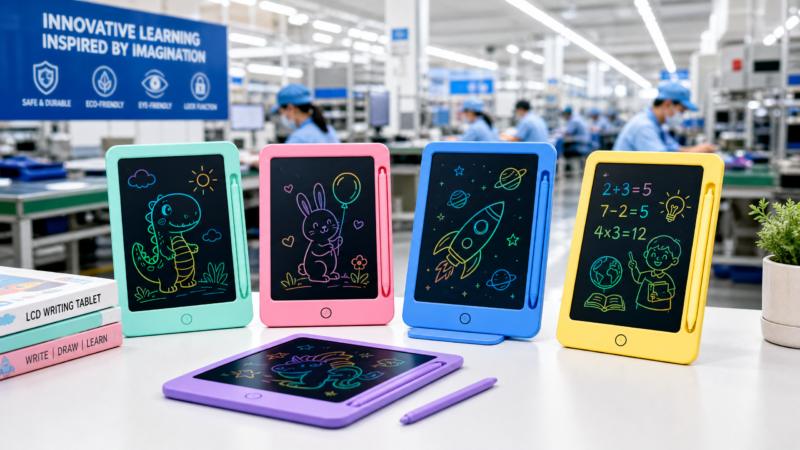
Can an LCD Writing Tablet Display Multiple Colors?
Short answer:Traditional LCD writing tablets are predominantly monochrome—dark marks on a reflective background.
Advances in cholesteric liquid crystal (CLC) technology and layered/filtered designs make two- and three-color reflective tablets possible, but full-color performance comparable to emissive LCD or OLED screens is not yet practical for low-cost, low-power writing tablets. For further reference, see Wikipedia: Liquid-crystal display.
How LCD Writing Tablets Work
Cholesteric liquid crystals and reflective display principles
Most LCD writing tablets use a reflective architecture based on cholesteric liquid crystal (CLC) materials.
These materials reflect ambient light rather than emit it, enabling a paper-like appearance and extremely low energy consumption because power is typically used only during screen resets.
The reflective, bistable nature of CLC is a core reason these tablets are comfortable for prolonged near-work compared with backlit devices—research on digital eye strain supports the benefit of non-emissive displays for some users (NIH: Digital Eye Strain).
Why most consumer models are monochrome
- Simplicity and cost: A single-layer CLC stack is inexpensive to manufacture and assemble at scale.
- Power efficiency: Reflective designs consume minimal power; many models only use energy to clear the screen.
- Readability: High contrast and the absence of backlight glare make text and sketches easy to read in ambient light.
Technical Approaches to Multi-Color Reflective Writing Tablets
Manufacturers pursuing multi-color writing tablets generally adopt one or a combination of the following approaches. Each method adds complexity and cost, and introduces trade-offs in durability, viewing angle, and achievable palette.
Multi-layer CLC films
Stacking CLC layers with different pitch parameters allows the display to reflect different wavelengths (colors) when specific layers are activated. This approach can yield two or three distinct colors (for example, black/dark gray, red, and green) but requires precise lamination and layer control.
Color filters and segmented zones
Applying colored filters or dividing the active area into color zones lets reflected light be tinted. Segmenting the panel enables selected areas to show different colors simultaneously. This technique is easier to implement for simple two- or three-color layouts but cannot reproduce wide color gamuts or smooth gradients.
Hybrid and layered technologies
Some OEMs combine reflective CLC layers with other technologies—such as electrophoretic (e-paper) segments or localized backlighting—to increase perceived color options. These hybrid solutions can improve versatility but sacrifice some of the hallmark benefits of pure reflective tablets.
For further reading on the behavior of cholesteric displays and their zero-power image retention, see this technical overview: Laser Focus World: Cholesteric LCDs.
Practical Trade-offs: Why Multicolor Is Not Always the Right Choice
- Cost and manufacturing complexity: Additional layers, filters, and tighter tolerances raise unit cost and yield risk.
- Battery and power considerations: More complex driving schemes or hybrid components can increase power draw; consult technical battery guidance such as our page on what type of battery an LCD writing tablet uses and how long a single battery typically lasts for real-world expectations.
- Durability and serviceability: Added optical layers increase the chance of delamination or edge failures. For fielded devices, surface damage and repairability are important considerations; learn more about screen maintenance and repairs at Can a scratched LCD writing tablet screen be repaired?
- Viewing angles and color fidelity: CLC-based colors can shift with viewing angle more than emissive displays, limiting applicability for some commercial signage or collaborative meeting-room uses.
When Multicolor Makes Sense
Two- and three-color reflective writing tablets have clear value in specific B2B applications where extra semantic information or branding is helpful without sacrificing the low-power, paper-like reading experience. Typical use cases include:
- Education: color-coding answers or annotations for classroom engagement
- Point-of-sale and queue management: highlighting key information without backlights
- Creative roughing and ideation tools: quickly distinguishing layers or annotations
- Corporate branded giveaways: adding color accents for brand recognition
For general-purpose personal or classroom tablets where cost and battery life are priorities, a high-quality monochrome reflective display still offers the best balance of price, longevity, and readability. For more on expected lifespan, see How long does an LCD writing tablet last?
Quality, Customization and OEM/ODM Considerations
Delivering reliable multi-color writing tablets at scale requires OEM/ODM expertise in materials, lamination, and quality assurance.
Manufacturers with established QC systems can tune color balance, optimize drive voltages for minimal power impact, and specify tougher front-surface coatings to resist abrasion.
At gy-industries.com, our engineering and production teams perform lifecycle and environmental testing to ensure color layers remain stable across production batches and field use.
Conclusion and B2B Call-to-Action
Multi-color LCD writing tablets are technically feasible and commercially available in niche segments, but they involve deliberate trade-offs in cost, power, and complexity. For many B2B buyers, the question is not “can it be done?” but “does it meet my use-case and ROI requirements?”
If your company is evaluating multi-color or customized reflective writing solutions, gy-industries.com offers end-to-end OEM/ODM services—from feasibility assessment and materials selection to prototyping, certification, and high-volume manufacturing.
Contact our sales engineering team to discuss custom color palettes, durability requirements, pricing tiers, and sample programs tailored to your market.
Comparison of LCD Writing Tablet Color Capabilities
| Tablet Type | Color Capability | Technology Used | Power Consumption | Typical Use Case |
|---|---|---|---|---|
| Traditional LCD Writing Tablet | Monochrome (Black & White) | Cholesteric Liquid Crystal (CLC) | Very Low | Note-taking, Sketching |
| Two-Color Reflective LCD Tablet | Two Colors (e.g., Black & Red) | Layered/Filtered CLC | Low | Enhanced Notes, Simple Highlights |
| Three-Color Reflective LCD Tablet | Three Colors (e.g., Black, Red & Green) | Advanced Layered CLC with Filters | Moderate | Color Coding, Educational Use |
| Full-Color LCD/OLED Tablet | Full RGB Colors | Emissive LCD or OLED | High | Graphic Design, Multimedia |
Request a quote or technical consultation: gy-industries.com — Wholesale and OEM/ODM solutions for professional-grade LCD writing tablets.